Saturday Jul 04, 2026
Saturday Jul 04, 2026
Saturday, 4 July 2026 04:07 - - {{hitsCtrl.values.hits}}
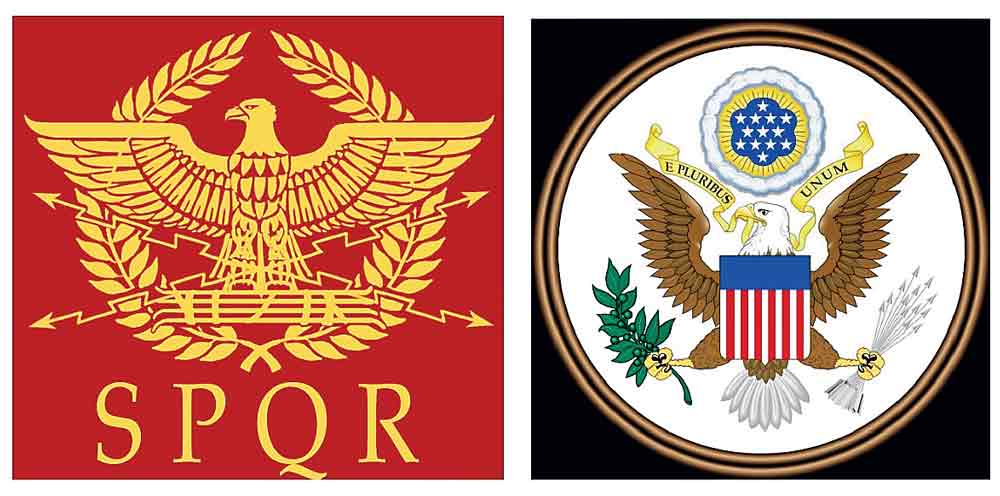
The sun may not set on the American empire these days. I essayed that observation yesterday (see https://www.ft.lk/columns/Decline-of-Pax-Americana-Empire-republic-and-the-lessons-of-Rome-Part-I/4-794127). Today we continue to examine the republic that became a global phenomenon.
 The phrase Pax Americana carries with it a certain late-imperial confidence, as though history itself had been provisionally arrested in favour of a single organising power. It is a term that invites both admiration and unease. Admiration for the unprecedented scale of American power since 1945, and unease at the historical suggestion that no such arrangement is permanent. To speak today of its twilight is not to declare its collapse, but to interrogate its coherence under contemporary strain: geopolitical, fiscal, technological, and moral.
The United States remains, in material terms, the most formidable State in the international system. Its network of alliances, from NATO to the Indo-Pacific partnerships, its currency dominance, its technological ecosystems, and its military reach still exceed any peer competitor.
Yet power in history is rarely measured in static inventories. It is measured in elasticity: the capacity to convert material advantage into stable order, and to renew legitimacy across generations. On that score, the comparison with earlier hegemonic formations becomes instructive. Not because history repeats itself, but because it moves in the tonal shifts of overextension, internal contestation, and institutional fatigue.
Analogue of America
Rome remains the most frequently invoked analogue, though often in a manner more poetic than analytical. The late republic in particular offers a cautionary architecture: expansion producing inequality; inequality producing faction; faction producing institutional paralysis. Polybius, observing Rome’s earlier ascent, famously praised its mixed constitution for balancing monarchy, aristocracy, and democracy.
Yet even within his account lies an implicit warning: no constitutional equilibrium is self-sustaining under the pressure of imperial scale.
Modern scholarship has complicated the declension narrative of Rome’s ‘fall’, emphasising transformation rather than collapse. Still, the political texture of the late republic remains suggestive. Cicero’s lament (“O tempora, o mores!”) is often quoted as cultural nostalgia, but it is more precisely an index of elite disorientation in the face of accelerating norm erosion. When republican norms cease to bind competing factions, legality persists in form while dissolving in substance.
 Pax Americana is neither ending nor unchallenged. It is being renegotiated in a more plural, more contested, and more technologically diffuse world. Whether that renegotiation produces a durable equilibrium or a more volatile fragmentation will depend less on structural analogy than on political imagination. History, as ever, offers warnings rather than prophecies
The United States today does not replicate Rome, but it exhibits analogous structural tensions. Its global commitments function as both stabiliser and strain. The cost of alliance maintenance, forward deployment, and deterrence architecture is increasingly debated within domestic politics; not as strategy, but as burden. Meanwhile, internal polarisation has begun to shape foreign policy continuity in ways that were previously buffered by elite consensus.
Systemic pressures
At the systemic level, three pressures stand out.
First is fiscal asymmetry. Empires rarely fall from a single bankruptcy event. Rather, they experience a progressive narrowing of fiscal space. The Roman state increasingly relied on extraordinary revenues from conquest, while its domestic tax base became politically contested and administratively uneven. The United States, by contrast, finances its global posture through debt issuance underwritten by the dollar’s reserve status. That privilege remains intact, but not immune to erosion if confidence in long-term stability weakens or if alternative financial architectures gain traction.
Second is strategic diffusion. The post-Cold War moment briefly produced what Charles Krauthammer called a “unipolar moment”. But unipolarity is structurally self-limiting. Power attracts counterbalancing behaviour not only from rivals but from system-wide adaptation. China’s rise; Russia’s revisionism; and the gradual assertion of regional autonomy in Asia, the Middle East, and parts of the Global South reflect not a coordinated anti-American coalition but a distributed recalibration of expectations.
Third is institutional strain within the republic itself. Unlike Rome, the United States is a mass democracy with deeply embedded electoral legitimacy. Yet precisely because of this, its foreign policy becomes increasingly sensitive to domestic political cycles. Strategic patience, once a hallmark of hegemonic stewardship, now competes with electoral immediacy. The result is not incoherence, but oscillation.
The other side of it
It is important, however, not to overstate the declinist thesis. The most persuasive counterargument rests on adaptability. The United States has repeatedly absorbed systemic shocks (the Vietnam era, the stagflation crisis of the 1970s, the post-2008 financial collapse) and emerged structurally intact. Its innovation ecosystems remain unmatched, particularly in artificial intelligence, biotechnology, and defence technologies. Its alliance system, though strained, is still the densest security network in history.
Moreover, unlike Rome, the United States does not rely on territorial annexation as the primary mode of power projection. Its hegemony is infrastructural rather than purely extractive. Standards, platforms, financial systems, and security guarantees form the architecture of influence. This makes it both more resilient and more dependent on voluntary compliance.
Still, even infrastructural empires are not exempt from entropy. As Joseph Nye has argued in his formulation of ‘soft power’, attraction is as critical as coercion. When legitimacy erodes, compliance becomes more transactional, more conditional, and more expensive to maintain.
A final Roman parallel is worth considering, though cautiously. The transition from republic to empire under Augustus is often misread as abrupt. In reality, it was a gradual consolidation of emergency powers, justified by crisis, normalised by precedent, and eventually sanctified by stability. Tacitus’ later reflection on imperial rule – “they make a desert and call it peace” –captures not only conquest but the psychological narrowing of political imagination.
Decline or drift?
The question for the United States is not whether it is Rome, but whether it can avoid the subtle drift from republican stewardship to managerial empire: a system that preserves order but loses consent, that maintains reach but dilutes purpose.
To understand whether Pax Americana is entering twilight, as I argued in yesterday’s column, we must therefore distinguish decline from transformation, and transformation from failure. The more precise question is whether American power is still capable of renewing the moral and strategic consensus upon which its global role depends. The answer remains contested, and the evidence ambivalent.
It is in this ambiguity that the second movement of the argument must proceed: from structural strain to historical trajectory, and from analogy to prognosis.
If the Roman analogy illuminates structural tensions, it also risks flattening the distinctiveness of the present. Unlike Rome, the United States operates within a dense global system of interdependence rather than a territorially bounded imperial field. Its ‘provinces’ are not conquered territories but allied states, embedded in institutions that often constrain as much as they extend American agency. This distinction matters, because it suggests that what is often described as imperial decline may in fact be systemic reconfiguration.
Slide or shape-shift?
The more relevant question, then, is not whether American power is weakening in absolute terms, but whether its relative capacity to shape norms and outcomes is becoming more contested and fragmented.
Contemporary realism offers one answer: that all hegemonic orders are cyclical, and that multipolarity is the natural equilibrium of international politics. From this perspective, the United States is not in twilight, but in transition toward a more plural distribution of power. The historian Paul Kennedy’s thesis on ‘imperial overstretch’ is often invoked here, though his argument is frequently simplified. Kennedy did not predict collapse, but rather a structural tendency for great powers to incur commitments exceeding their economic base. The United States, critics argue, now faces precisely such a gap between global obligations and domestic consensus.
Yet liberal institutionalists counter that the post-1945 order has demonstrated unusual durability precisely because it is institutional rather than purely hegemonic. Institutions outlive shifts in relative power because they embed expectations, procedures, and sunk costs. NATO, for instance, has expanded and adapted far beyond its original Cold War purpose, suggesting that the architecture of Pax Americana is not easily dismantled even under stress.
There is also a technological dimension that complicates classical imperial analogies. Power today is increasingly decentralised through digital networks, private corporations, and algorithmic infrastructures. The State remains central, but no longer monopolistic. In such a world, imperial control is less about territorial command and more about ecosystem governance.
Power paradox
The United States retains disproportionate influence over these ecosystems, but it no longer exclusively defines them.
This diffusion of power produces a paradox. American primacy persists in key domains, yet the visibility of alternatives has increased. China’s technological and industrial ascent represents not a mirror image of American power, but a parallel system with different logics of control and legitimacy. Meanwhile, regional powers from India to Brazil assert strategic autonomy rather than alignment, producing a more fluid and less hierarchical order.
The strongest argument against declinism, however, may be historical resilience. The United States has repeatedly demonstrated what might be called adaptive reinvention. The New Deal recalibrated domestic capitalism. The post-1945 order internationalised it. The post-Cold War era globalised it further. Each phase involved ideological adjustment as much as structural continuity. There is little evidence that this adaptive capacity has been exhausted.
Still, adaptation has limits when confronted with internal fragmentation. Empires in their mature phases often experience a narrowing of shared narratives. The United States today struggles to articulate a coherent account of its global role that commands bipartisan durability. Is it guarantor of order, promoter of democracy, offshore balancer, or selective retrencher? The absence of consensus does not imply paralysis, but it does increase volatility.
Here the Roman comparison re-emerges in subtler form. The late republic was not undone by external enemies alone, but by the erosion of shared political grammar. Once competing factions ceased to recognise each other as legitimate interlocutors within a common system, institutions became instruments rather than frameworks. The United States has not reached this point, but the stress indicators – polarisation, institutional distrust, and episodic governance crises – suggest an increasing strain on its republican substrate.
Final word
And yet, history resists deterministic closure. The most prudent conclusion is not that Pax Americana is ending, but that it is thinning: becoming less universal in its acceptance, more negotiated in its application, and more contingent in its endurance. This is not collapse, but attenuation.
In this sense, the metaphor of twilight is both useful and misleading. Twilight is not night; it is a transitional condition in which forms remain visible but altered, and boundaries become less distinct. The danger lies in mistaking diminished dominance for disappearance, or endurance for permanence.
If there is a Roman lesson worth preserving, it is not the inevitability of decline but the centrality of institutional self-renewal. Rome endured not because it avoided crisis, but because it repeatedly reconfigured authority under pressure. The United States retains similar capacity, though whether it will be exercised effectively remains an open question.
A restrained verdict, then, is appropriate. Pax Americana is neither ending nor unchallenged. It is being renegotiated in a more plural, more contested, and more technologically diffuse world. Whether that renegotiation produces a durable equilibrium or a more volatile fragmentation will depend less on structural analogy than on political imagination.
History, as ever, offers warnings rather than prophecies.
(The writer is the Editor-at-large of LMD and is a senior journalist with a Post-graduate Diploma in Politics and Governance)




