Thursday Oct 15, 2026
Thursday Oct 15, 2026
Saturday, 4 July 2026 03:00 - - {{hitsCtrl.values.hits}}
By Surya Vishwa
The book, ‘Manal Aru/Weli Oya; The violent history of the River Valley Development, Frontier Colonisation and Ethnic Territorialisation’ by Urs Geiser and Benedikt Korf (first print 2026) printed by Big Bird printers and published by the Social Scientists Association belongs in the hands of every national policy maker in Sri Lanka.
The foundation of the ethnographic research in this book had been done by Prof. Hasbullah on the politics of human settlement in Weli Oya (as referred to in Sinhala) (and Manal Aru in Tamil) which is territory in the North East of Sri Lanka. The book points out that from 2014 and shortly before his untimely death on 25 August in 2018 that Prof. Hasbullah carried out field work on repeated visits to various locations on the larger region of Manal Aru/Weli Oya particularly in Kokkilai lagoon area in the east of the Mahaweli system in a backdrop of high militarisation of the area.
The comments of Stanford University Associate Professor of Anthropology Sharika Thiranagama, as cited in the book is as follows:
“Korf and Geiser have produced a theoretically sophisticated and empirically grounded study of the deeply contentious Weli Oya settlement in Sri Lanka. Based partly on their original archival work and fieldwork, as well as on the work conducted by the late Shahul Hasbullah and Thiruni Kelegama, this book stands as a testament to Prof. Hasbullah’s profound work and is a significant contribution to scholarship on Sri Lanka’s contemporary history. It illuminates the militarisation of Sri Lanka along with a complex landscape of land claims, titles, use and provisions. Most importantly it shows how militarisation, and ‘frontier struggles’ and ‘frontier frictions’ produced and continue to shape Sri Lanka decades before and after its civil war. It is a profoundly important and groundbreaking study.”
Last week we covered the contextual framework of the book and core segments of the introduction. (See https://www.ft.lk/harmony_page/Saga-of-Manal-Aru-Weli-Oya/10523-793877).
Under the title Manal Aru/Weli Oya in the broader Dry Zone context the introduction of the book further points out that Periya Oya or Ma Oya is a river in the North East of Sri Lanka which has its source in the interior area called the Vanni.
“It is just one river among many in the eastern part of Sri Lanka, all sharing roughly the same pattern: stemming from the island’s densely agricultural interior, flowing through jungles, and then reaching the east (again an agriculturally intensive area). Other such rivers are (starting from the country’s South East the Gal Oya (or Pattipola Aru), Maduru Oya, Kantalai, and Yan Oya, just to mention a few. Manal Aru/Weli Oya is located north of the Periya Aru river,” the book notes.
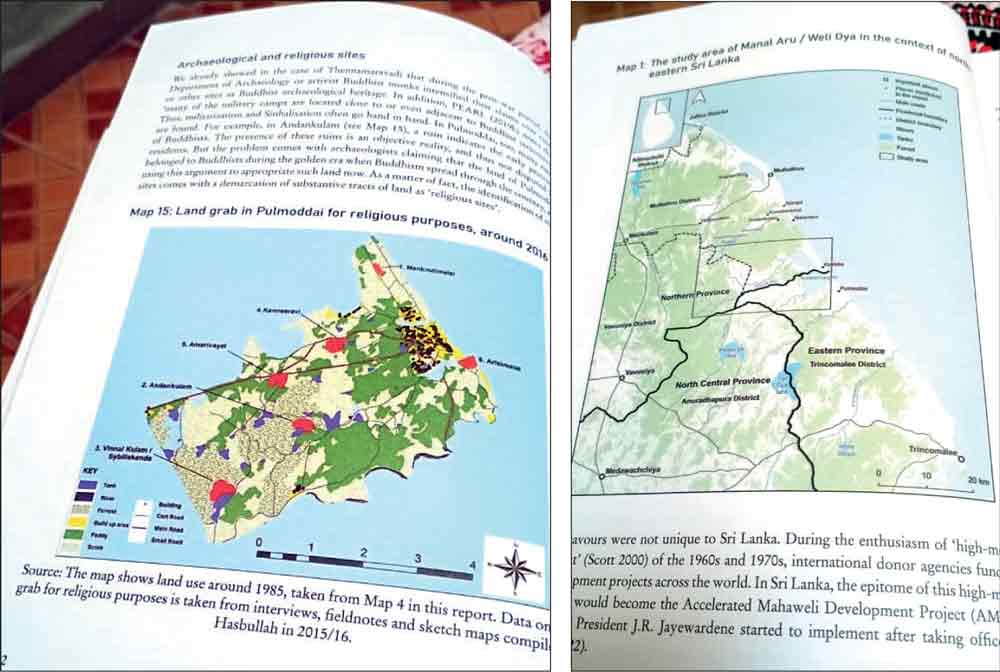
It further points out that naming the place as Manal Aru is somewhat ambiguous (referring to Map 1 ). It points out that the region is also located at the border between the Eastern and Northern Provinces, between Trincomalee, Mullaitivu, and Vavuniya districts. This section of the book marks the geographical reach in context to what will be shown in the overall study the impact borne during conflict, war and its aftermath.
Explaining river valley development further it points out that in Sri Lanka with the emergence of the ‘Development State’ after independence, rivers and their catchment areas became a crucial resource to be tapped for agricultural and regional development. Through the notion of ‘river valley development’ dams were erected to store river water for irrigation and power generation.”
The book points out that irrigation canals were constructed downstream, huge extents of jungle were cleared and turned into homesteads and paddy fields, and many settlers arrived from other (often densely populated) regions of the country in search of better livelihood.
Here this reviewer wishes to take a small reprieve. In the midst of reading this book, I contacted a now 87-year old Sri Lankan Tamil who was a Government officer linked to the river valley development scheme in Sri Lanka. While repeating much of what was in this study he recalled how a Tamil woman married to a Sinhalese insisted that the land be applied for under her husband’s name – stating that his Sinhala surname will ensure the land and the opposite if applied in her Tamil surname. This woman was requesting from the State as part of the above mentioned national program a portion of land, which should be applicable to Sri Lankans irrespective of their ethnicity.
“It is important to emphasise that initially the Dry Zone frontier colonisation was not tied to Sinhala Buddhist nationalism and ethno-nationalist territorialism, but rather to development ideas of agrarian development. These ideas however gradually translated into, ideas of re-awakening a past (Sinhala) hydraulic civilisation and the claim that the state had a right to acquire the land of the Dry Zone for the Sinhala Buddhist nation (Moore 1989).”
Under the title Ethno-nationalist territorialism the book notes that it is not surprising then that in post independent Sri Lanka one dominant critique of river valley development and dry zone colonisation links these approaches with ethno-nationalism: it reads it as part of the Sri Lankan State’s ‘majoritarian nationalist’ politics, with that state understood as representing the majority ethnic group only.
Under the theme Unravelling the ‘politics and practices on the ground’ in Manal Aru/Weli Oya points out at the outset that the critical analysis of the particular conjuncture sketched in previous pages requires empirical evidence, but that such evidence is scarce and scattered across many reports and documents.
“Indeed very little data is available about the history of Manal Aru/Weli Oya
“This specifically refers to the precolonial and early post-colonial time. The region only became known through the war. There are reports about atrocities that the LTTE and the military committed in late 1984. Most of these reports are from human rights activists, especially from the University Teachers for Human Rights – Jaffna (UTHR),” states the book.
It is stated that the site of Manal Aru/Weli Oya was inaccessible for researchers throughout the war, and no primary evidence could be collected because the site was declared a high security zone.
“Even after the war ended in 2009, access to Manal Aru/Weli Oya still required a military pass. Any independent research was difficult to conduct, as the area was still under heavy surveillance by the military.”
Despite these difficulties it is cited that in 2011 and 2012 the Centre for Policy Alternatives (CPA) and the International Crisis Group (ICG) conducted short field visits to collect evidence about the return of displaced people.
It is then pointed out that in 2014 Thiruni Kelegama started fieldwork in Manal Aru/Weli Oya in a context of military surveillance.
“By focusing on the post war living conditions and on the majoritarian political discourse that continued to justify the presence of the settlers, she highlighted the vulnerability of settlers’ lives and the region’s nestedness within the ethnic nationalist politics.
“In a nutshell, then, our conjunctural analysis seeks to understand how a remote, sparsely populated region, without rich resources other than the ‘free land’ became a core hotspot for the practice of military confrontations, but also for the discursive intensification of ethno-nationalist discourses within which these confrontations were embedded. More specifically this involves a range of research questions, the book noted and stated as below which thereafter engages the reader with the methodology of the study.
 How did people live and use land in our study area in the late colonial and early post colonial period (up to the 1960s)?
How far were such earlier dynamics linked (or not linked) to broader political processes of Sri Lanka as an emerging nation state?
What were the dominant discourses concerning control over land on both sides, i.e. on the side of the Government in power and of the Tamil militants?
How has the situation in Manal Aru/Weli Oya, a highly militarised zone during the civil war changed after the war had ended?
How has this change shaped the livelihoods of differently positioned residents in that region, and how do they cope with, or even contest, these challenges?
Under the theme Methodology of the study an emphasis is given to the historic perspective concerning the last several decades, using a geographical approach that maps changes in land use and administrative boundaries over time. The authors note that they considered as many data sources as possible, including older empirical studies, for example by Government departments but also details reported in newspapers.
“We found only a limited number of such primary sources,” the authors point out, stating that many secondary documents are based on those primary sources though they often interpret the situation through a specific (ethno-nationalist) gaze. The archival data is complemented by empirical field work, conducted in the post war period first by Kelegama in 2019 and then a range of field visits by the mate Shahul Hasbullah who repeatedly travelled to the larger Weli Oya region to document land claims by minority groups.




