Thursday Oct 15, 2026
Thursday Oct 15, 2026
Saturday, 27 June 2026 00:25 - - {{hitsCtrl.values.hits}}
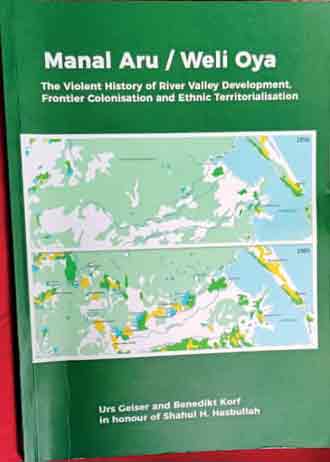 The book, “Manal Aru/Weli Oya: The Violent History of the River Valley Development, Frontier Colonisation and Ethnic Territorialisation” by Urs Geiser and Benedikt Korf, was launched recently at the Social Scientists’ Association in Colombo. The book was launched in honour of Professor Shahul H. Hasbullah, who taught political geography at the University of Peradeniya.
The foundation of the ethnographic research in this book was laid by Prof. Hasbullah through his work on the politics of human settlement in Weli Oya (as referred to in Sinhala) and Manal Aru (in Tamil), a territory in the North East of Sri Lanka.
The book points out that from 2014 until shortly before his untimely death on 25 August 2018, Prof. Hasbullah carried out fieldwork through repeated visits to various locations in the larger Manal Aru/Weli Oya region, particularly the Kokkilai lagoon area in the east of the Mahaweli system, against a backdrop of high militarisation. The book also points out that Thiruni Kelegama conducted fieldwork in two locations in Manal Aru/Weli Oya between 2014 and 2018 for her doctoral dissertation, in which she worked in collaboration with Prof. Hasbullah.
The maps were prepared by Tim Fassler, Livia Zeller and Nawfhal Samad. Ahilan Kadirgamar, Mahendran Thiruvaragan, Thiruni Kelegama and Rajesh Venugopal provided detailed comments on previous drafts of this study and helped with the verification of the data and information in the book’s notes. This is how University of Jaffna Senior Lecturer Ahilan Kadirgamar described Manal Aru/Weli Oya in the book.
“Manal Aru/Weli Oya in north-eastern Sri Lanka has been a fiercely contested region with enormous symbolic significance. Located on the edge between the North and the East, it emerged as a strategic location for both Sinhala-Buddhist and Tamil nationalist ambitions of state formation in the 1970s and 1980s.
“This study goes beyond explanations of the conflict that emphasise antagonistic ethno-nationalist politics alone. Instead, it adopts a conjunctural approach by documenting the convergence of three historical forces and their often complex political practices: river valley development that created new arable land since the 1950s; Dry Zone frontier colonisation that attracted new settlers through Mahaweli System L (including the Kivul Oya scheme); and ethno-nationalist territorialisation by selecting settlers exclusively from a single ethnic group,” he notes.
Must read
The book “Manal Aru/Weli Oya” is a must-read for all policymakers to ensure that Sri Lanka learns from its past and that history does not repeat itself through ethnic-centric land allocation that does little for development and much to foster race-based friction.
Replete with maps charting the past and present of Weli Oya/Manal Aru, the book contains detailed sections beginning with four themes in the introduction as follows: The Puzzle of “Weli Oya”, Manal Aru/Weli Oya in the Broader Dry Zone Context, Unravelling the ‘Policies and Practices on the Ground’ in Manal Aru/Weli Oya, Methodology of the Study and Structure of the Study.
Thereafter, the sections are as follows: A Remote Land, the Situation up to the 1950s; Dry Zone Colonisation and Early Land Allocation (The Padaviya Scheme, First ‘Ethnic’ Tensions, Special Land Leases, the Gradually Emerging Idea of Mahaweli System L); Illegal Encroachment and the Kent and Dollar Farm Incidents (Refugees from the 1977 Riots, Illegal Encroachments, the 1984 Kent and Dollar Farm Massacres, Settling Sinhalese Beyond the Kent and Dollar Farms); Militarising Manal Aru/Weli Oya as a Violent Borderland (The Weli Oya Forward Defence Line, 1987–1990: The Indian Peace Keeping Force, 1990–2001: Another Decade of War, the Ceasefire Period from 2001 to 2006/2008, the Last War Years).
The next sections are: The Nexus of Mahaweli System L and the Military (The Arrival of Mahaweli System L, System L and the North Central Province (NCP) Canal, the Powers of the Mahaweli Authority, the Nexus Between Mahaweli L and the Military, the Contested Number of Settlers and Their Living Conditions); Manal Aru/Weli Oya and Continued Post-war Frictions (The Mahaweli L and Army Nexus Continued, Returnees and Contested Claims over Land, Land Struggles Around Kokkilai Lagoon, Thennamaravadi, Returnees’ Land Claims, Land Disputes on the Kokkilai Peninsula, Pulmoddai: Muslim Grievances over Land Grabbing, Public Protests Around Land); Territorial Anxieties: Decades of Administrative Re-arrangements (The Changing Structure of State Administration, the Weli Oya Divisional Secretariat Division, the 13th Amendment and the Policies of Land); ending with Discussion, Postscript and References.
By now, the reader will be clear on the framework of the research presented in this book and the understanding it offers for reimagining and remaking a Sri Lanka that consciously learns from its past.
We will review this book in depth in the upcoming edition and will now focus on the introduction, which begins with the following quote from 1995 by the University Teachers for Human Rights (UTHR):
“When ordinary folk in search of a bare living are caught up in a vortex resulting from crosswinds of ideology, their destiny is one they lack any control over.”
The puzzle of Weli Oya
The introduction thereafter begins with an attempt to understand ‘the puzzle of Weli Oya’. It starts by explaining that before 1984, the region called Manal Aru or Weli Oya in the North East of Sri Lanka was almost unknown to most citizens of the country. However, it then points out that within that year, massive military operations by the Sri Lanka Army as well as the Liberation Tigers of Tamil Eelam (LTTE) began to escalate in the region.
“When the LTTE killed dozens of Sinhalese people at a place called Dollar Farm and the Army retaliated, Manal Aru/Weli Oya suddenly hit the headlines throughout the country and internationally,” the book notes. It then goes on to show how Manal Aru/Weli Oya became a hotspot for ethno-nationalism.
“Tamil nationalists argue that the Sri Lankan state is controlled by the country’s ethnic majority (the Sinhalese), which systematically uses the state apparatus to actively marginalise the country’s minorities (the Tamils and the Muslims) – thus the common notions of a ‘Sinhala-Buddhist nationalist state’ or an ‘ethnic Sinhala-majority-controlled Sri Lankan state’,” the introduction to this book states and then adds as follows:
“On the other hand, the Sri Lankan Government, under the dominant influence of Sinhala-Buddhist nationalist politicians, sees the integrity of the Sri Lankan nation-state endangered through radical demands by the minority (the Tamils): demands that also included a separatist territorial unit for the Tamils that would effectively subvert the territorial integrity of the state.”
The relevance of the study is that while it captures the ethnically polarised blueprint that led to the civil war in Sri Lanka and shows how land ownership and identity were at its centre, it also examines the post-war realities. In the discussion with which the book concludes, it paves the way for a sane approach where land, which is the basic need of every human being, transitions towards eliminating ethnic bias.
The review of this book will continue in depth in the upcoming edition of this page. Meanwhile, it is pertinent to end with a query this writer shared with a Sri Lankan academic researcher who was present at the Social Scientists’ Association during the launch of this study. The query posed to her was why no government official had been invited to the book launch. Would it not have made sense to extend such an invitation, especially considering the scenario that was meant to ‘change the system’, as hoped for in the 2024 Presidential and General Elections?
Given that academics and researchers play a vital role in keeping the country united through unbiased research, it would be good to witness invitations being extended to policymakers at book launches such as these, not for them to make grand speeches, but to sit quietly and listen. And hopefully then act, because the ultimate goal of such research is to spearhead action so that Sri Lanka does not have to research the same unpleasant topics again and again. (SV)
NOTE: The book Manal Aru/Weli Oya (first print, 2026) is published by the Social Scientists’ Association and printed by Big Bird Printers.




