Friday Oct 02, 2026
Friday Oct 02, 2026
Thursday, 28 May 2026 03:49 - - {{hitsCtrl.values.hits}}
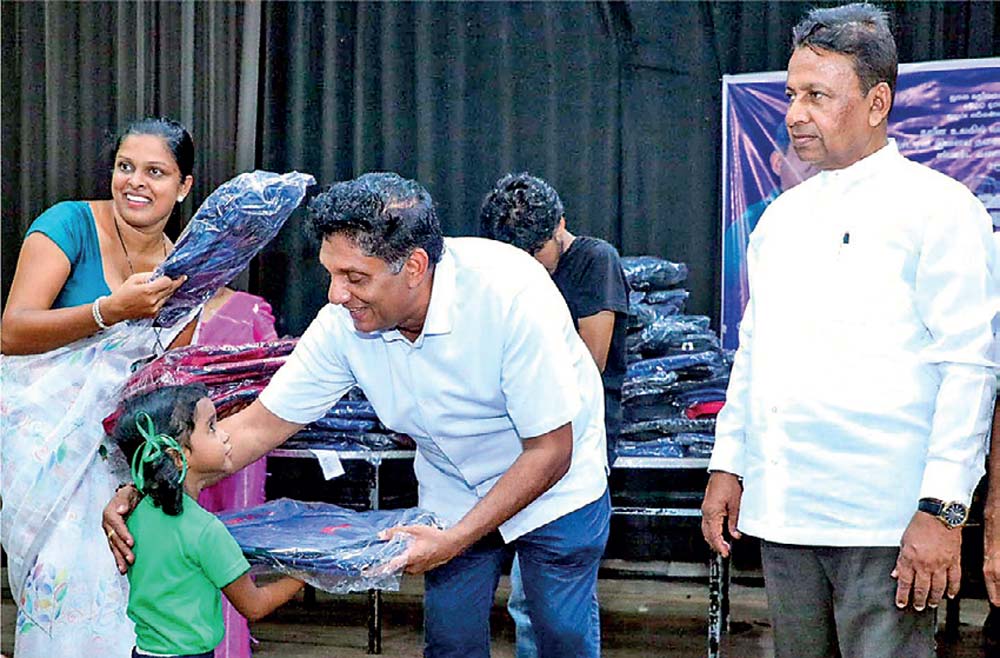
Sajith takes children’s education more seriously and contributes more to it than any other politician
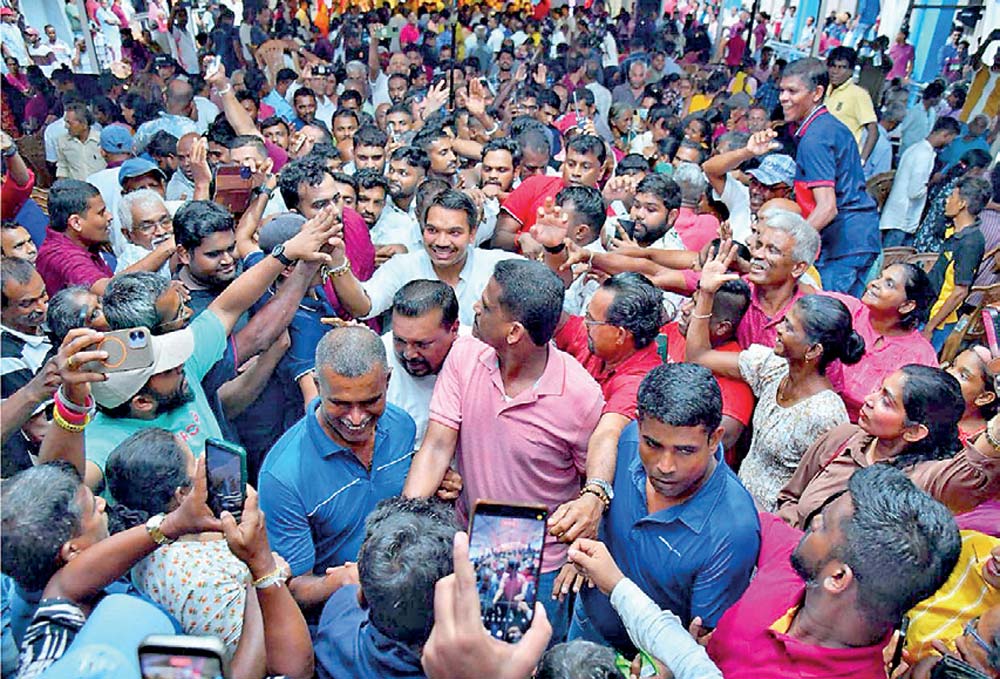
Namal mobbed in Panadura
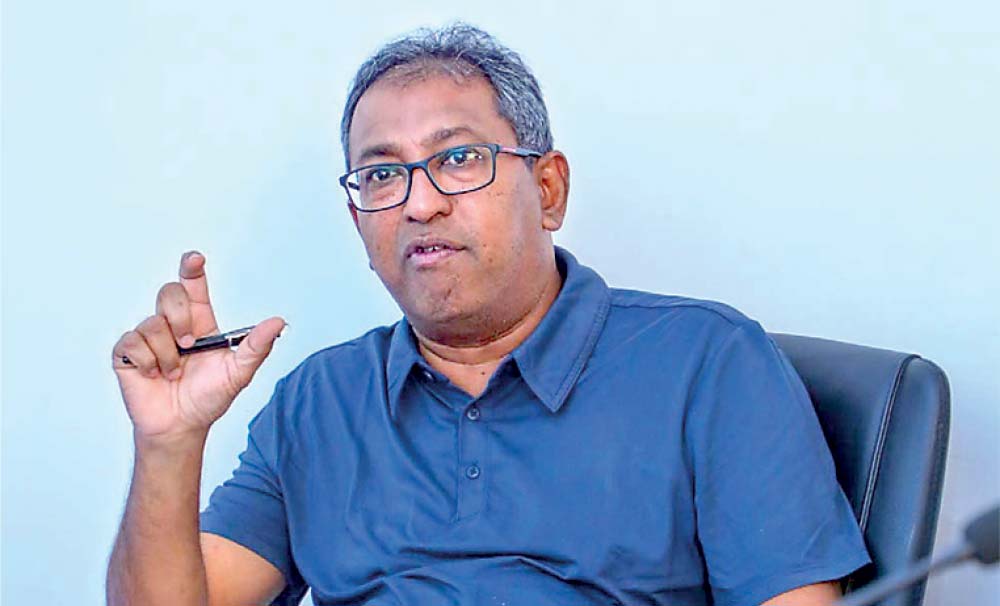
Dr. Harsha de Silva: Chief Economist of the ‘centre-right camp’
 Not being an economist, I do not urge that Sri Lanka leave the IMF program. I am agnostic about an 18th program. My point is that an IMF program is an option, an instrument in the toolkit, the resort to which requires thinking-through, and that an Opposition party whose only or primary slogan – and more shocking, its main demand to the Government—is “run like The Flash to the IMF, now!” obviously doesn’t have its own economic program, with or without an IMF component, to offer as alternative
 Lenin’s terse definitional insight on politics captured his unmatched Realist lucidity:
"Politics begin where millions of men and women are; where there are not thousands, but millions, that is where serious politics begin."
—VI Lenin, Political Report, Extraordinary Seventh Congress of the Russian Communist Party (Bolsheviks), March 7, 1918, Collected Works Vol 27.
Sri Lanka’s political system is primarily presidential and the central political question is that of leadership, i.e., presidential candidacy.
There are only two personalities with sufficiently wide mass appeal, party networks and the ability or potential to top a million votes—thanks in significant measure to the social foundations laid by their respective fathers. Within the Opposition, only two can be seriously considered as national figures and credible presidential candidates by 2029: Sajith Premadasa and Namal Rajapaksa.
Realism dictates that other Opposition formations/elements eventually accept and align with the leadership of either. (https://www.youtube.com/watch?v=ngf0hXvQYH0)
The crisis
The tumbling of the rupee, the racking up of new foreign debt, the observation at a CEPA conference that in terms of poverty, inequality and poverty alleviation, we have gone a quarter-century backwards, are but manifestations of the grossly erroneous, imbalanced policy and hopelessly incompetent implementation by the dysfunctional Anura Dissanayake administration. It cannot run the economy, will run this place into the ground, and be consigned to long electoral exile like the SLFP-LSSP-CPSL (1977).
The other part of the crisis is the complete strategic confusion within the Opposition.
During the OPEC oil shock of 1973, one sensed the United Front Government which enjoyed a two-thirds majority in parliament had begun to head downhill in terms of popularity, and the 17-MP UNP in Opposition led by J.R. Jayewardene and R. Premadasa had shifted gear and moved onto the offensive in the form of civic protests. That Opposition was clear and purposive, and therefore jumped from a meagre 17 MPs in 1970 to a 5/6ths majority by 1977.
Today’s main Opposition the Samagi Jana Balavegaya (SJB) is hopelessly befuddled in its political strategy.
In a statement entitled ‘Negotiate Now While We Still Have Something to Negotiate With’ the party has called on President Anura Dissanayake to enlist for the 18th IMF program enabling seamless transition from the ongoing 17th IMF program to the 18th. It wants AKD to summon an all-parties conclave to discuss the economic crisis and commit to a successor IMF program.
This from an SJB leader who had earlier, correctly criticised the existing IMF program for imposing economic constriction and austerity, which he argued should be rectified by renegotiation.
Not being an economist, I do not urge that Sri Lanka leave the IMF program. I am agnostic about an 18th program. My point is that an IMF program is an option, an instrument in the toolkit, the resort to which requires thinking-through, and that an Opposition party whose only or primary slogan – and more shocking, its main demand to the Government—is “run like The Flash to the IMF, now!” obviously doesn’t have its own economic program, with or without an IMF component, to offer as alternative.
In 1973, year of the OPEC oil price shock, R. Premadasa, Opposition MP aged 48, addressed the Rotary Club of Colombo West and rolled-out a new economic policy paradigm as answer to the acute, mounting, unprecedented crisis. His speech was published in full in the Lake House press by Editor-in-Chief Mervyn de Silva. In 1991, while newly elected Chairperson of SAARC, President Premadasa requested Editor Daily News Manik de Silva to republish the text, underscoring the decades-long consistency of his economic doctrine.
Neither the JR-led UNP in Opposition nor R. Premadasa as an Opposition politician called on the Sirimavo Government to summon an all-parties conference and return uninterruptedly to the IMF—which Dr. N.M. Perera was going to every year starting 1970 anyway. Indeed, JR’s future Finance Minister who managed the Open Economy, the brilliant Ronnie de Mel was quoting from books by Teresa Hayter and Cheryl Payer to savagely attack in Parliament, the alacrity with which the UF Government ran to the IMF and World Bank and complied with them.
The UNP Opposition of that day presented new economic ideas. The IFIs—IMF, IBRD, ADB—weren’t presented as the answer to the crisis; the UNP was, with its double-barrelled Big Idea, the Executive Presidency and Open Economy.
In 1988, running against the formidable Sirimavo Bandaranaike, UNP candidate Premadasa who accepted the challenge of a “torch ablaze at both ends” (civil wars North and South; 70,000 Indian troops) didn’t champion the IMF. He presented ‘A New Vision, a New Deal’, his neo-Rooseveltian manifesto, with the Janasaviya Poverty Alleviation Program as engine.
If the SJB leadership now thinks the NPP Government has “demonstrated reforms credibility”, it means that it now approves those reforms—an abrupt about-face. If it is “not proposing the renegotiation of the existing program which is proceeding”, it is asserting the exact opposite of what it was proposing until recently. If it is not proposing a “retreat from fiscal discipline” but “the opposite”, the SJB is reversing its earlier critique of the IMF’s policy of constriction and austerity
IMF addiction
Once elected President, Ranasinghe Premadasa tapped the IMF and World Bank—but even then he summoned R. Paskaralingam, flayed him for complying with excessive IFI conditionality without executive authorisation, quoted from the ‘New Vision, New Deal’ Manifesto, made him watch a videoed oration by young Janasaviya recipient Violet Lalani (‘Violet Akka’), and got Pasky to return to the visiting IFI delegation and amend the deal.
By contrast, the SJB’s incantatory answer to the crisis is ‘IMF’ not ‘SJB’ or a resumption (with updates) of President Premadasa’s export-led, province-based, rapid industrialisation drive to generate dollars and exit the debt repayment crisis. This despite the Premadasa precedent and the Vietnam parallel being explicitly urged today by experts as ideologically diverse as Prof. Howard Nicholas and Prof. Lakshman R Watawala.
If, as the SJB leader correctly says, the IMF program 17 had a negative aspect of economic constriction, why advocate swift, uninterrupted passage into IMF program No 18 without re-scrutiny of results and stipulating a more balanced, less harmful and painful package?
What is the guarantee that AKD who has been urged to summon an all-parties conference and rush headlong into IMF-18, and whose track record shows enthusiastic, uncritical embrace and implementation of the IMF program, will not do the same this time around—agreeing to fiscal stringency and socially painful conditionalities? Why assume he needs an all-parties conference to lobby him?
When the hurt comes with the IMF package, how can the SJB position itself as the alternative, since the public would remember that it was precisely the SJB that lobbied loudly for it?
Why is the SJB leader who rightly criticised the AKD administration for its ‘slavishness’ to the IMF and complained that the IMF isn’t talking to him anymore because he is critical of those aspects which hurt the people, now commending the AKD administration for its “demonstrated reform credibility” and promising that he isn’t proposing for a retreat from fiscal stringency but doing the opposite?
‘…Opposition Leader Sajith Premadasa has urged the National People’s Power (NPP) Government to use its ‘demonstrated reforms credibility’ to negotiate another bail-out package with the International Monetary Fund (IMF), amid growing concerns on the Middle East war’s impact on the economy.
“…The window to negotiate from relative strength with $ 7 billion in reserves, a functioning (IMF Extended Fund Facility) program, and demonstrated reform credibility is open…” the Opposition Leader said in a letter to the Government yesterday.
“...Not to renegotiate the existing arrangement, which is proceeding. A successor program, the arrangement that takes effect when this one ends. What I am proposing is not a retreat from fiscal discipline. It is the opposite.”
If the SJB leadership now thinks the NPP Government has “demonstrated reforms credibility”, it means that it now approves those reforms—an abrupt about-face.
If it is “not proposing the renegotiation of the existing program which is proceeding”, it is asserting the exact opposite of what it was proposing until recently.
If it is not proposing a “retreat from fiscal discipline” but “the opposite”, the SJB is reversing its earlier critique of the IMF’s policy of constriction and austerity.
Given these multiple flip-flops, one can logically conclude that an SJB Government will probably continue with Anura’s IMF approved ‘reforms’ and stringent ‘fiscal discipline’, remaining on an economic and fiscal continuum with the current AKD-NPP administration and the previous Wickremesinghe administration. New hamster, old wheel.
Winning the presidency would be a tougher proposition for Namal because of Tamil-Muslim-Catholic/Christian minority votes lost (thanks to GR) and the majority vote split (Sajith-Namal-Anura). Nothing prevents Sri Lankans from voting for Sajith Premadasa as President, and Namal Rajapaksa as PM at the helm of a centre-left and patriotic coalition which can command a parliamentary majority
Poor political strategy
The central political task of any Opposition is to persuade the public that the Government is part of the problem or much more part of the problem than the solution, and that therefore, the Opposition has/is the solution.
The SJB displays complete unclarity on the most basic of political questions: is the incumbent administration part of the problem or part of the solution? If it is part of the problem, or much more part of the problem than of the solution, why call on AKD to summon an All-Parties Conference?
If the SJB is the alternative or the major part of the alternative, why not organise an SJB Economic Conference followed by an Opposition All-Parties Conference at leadership level, with economic experts to draft an alternative economic program and pathway?
The most successful Opposition that Sri Lanka ever had, the UNP under JR-Premadasa, leveraged the 1973 OPEC oil price shock crisis and weaponised Government-imposed austerity against the incumbent administration. That’s how the massive popular mandate was obtained for the modernising revolution of the Open Economy.
The SJB never learned the lesson that serious politics is a zero-sum game and prevailing in it i.e., winning, necessarily preceded and was precondition for desired economic transformation.
When the economic crunch comes, the SJB would find it has ideologically boxed itself once again as with Harsha’s Blueprint in 2022-4, into a position where it cannot be considered an alternative but only a better managerial substitute.
The SJB has inherited from its post-1993 Ranilist UNP ‘parent’, the habit of pushing ideological economic formulas which trip it up politically, preventing it from being popularly elected to the country’s leadership and gaining the ability to implement its economics.
With its renewed IMF lobbyist role, the SJB is compromising itself heavily, reducing its credibility, inclination and ability to lead effective protest against the economic pain that will inevitably follow further IMF ‘reforms’ and ‘fiscal discipline’. The contrast with the JR-Premadasa-led populist protest (Satyagraha) campaigns of the UNP Opposition from the OPEC oil price shock of 1973 through to 1977, couldn’t be greater.
In a presidential system, there is no creature as His Majesty’s Loyal Opposition—the role the SJB is slipping into again as in late-2022/2023. Even in the UK the voters have rejected it. At the recent election, both the governing UK Labour and the Opposition UK Conservatives failed. Instead, voters turned to the populist-nationalist UK Reform led by Brexiteer Nigel Farrage.
Sajith Premadasa, SJB Govt.
I have publicly endorsed Sajith Premadasa for years as the best President we could have from the available crop, for three reasons apart from his education and civility.
 Absence of racism and religious chauvinism in his make-up.
Proven propensity to programmatically (and personally) intervene to help the needy; uplift the underprivileged.
Commitment to compulsory teaching of English from pre-school onwards.
These factors, together with whatever he may have gleaned from his father, make him likelier to implement a socially more sensitive, responsive, and better-balanced macroeconomic model than any rival.
So far, I have no evidence to abandon or negate that conclusion, though my support is not immutable; it is ‘conjunctural’, comparative and contextual. I do have problems and doubts though.
Sajith Premadasa is a progressive-centrist liberal with a social democratic element in the mix.
The SJB needle is flickering between being a centrist party (Sajith) and a neoliberal Rightist party (Harsha). It is likely to settle on being a centre-right party, successor and substitute for the Ranil Wickremesinghe UNP.
If the driving force of economic policy in any future SJB Government is Dr. Harsha de Silva, then Sajith Premadasa as President may prove susceptible to Ranil-Milinda-Harsha economics, a scenario which contains distressingly negative possibilities/probabilities:
If the SJB practices the same IMF-dictated reforms, fiscal discipline and recourse to private money markets as the Wickremesinghe and Dissanayake administrations, there will be little space for – and chance of—'social democratic’ pro-people programs of relief and upliftment.
Dr Harsha de Silva’s Economic Blueprint with its objective of economic and physical infrastructural integration with Tamil Nadu, borrowed from Ranil Wickremesinghe and Milinda Moragoda’s ‘Regaining Sri Lanka’ (2001-2) is likely to be implemented.
The SJB’s rightward shift to uncritical endorsement—actually, shrill advocacy—of uninterrupted entry into an 18th IMF program without reflection and re-scrutiny, reveals a mindset of dependency on West-dominated global institutions rather than one of diversification of dependence which leverages the economic power of China, Asia, and Eurasia.
Fetishisation of the IMF is unlikely to be accompanied by a foreign policy committed to global multipolarity. It is likelier to be accompanied or followed by alignment with the West and the Quad.
Balance: Namal as PM
Here’s the major contradiction:
On the one hand, the dominant faction of the SJB parliamentary group is currently manifesting and would be likely to practice in Government, the economic ideology of Ranil Wickremesinghe and Mangala Samaraweera, not President Premadasa. Sajith Premadasa cannot be relied on to override or ignore this ideological influence. This will have damaging consequences for Sri Lanka’s national interest; its independence, sovereignty, territorial unity and integrity.
On the other hand, the country must obtain the best deal it can—marginal though the improvement may be—for the rapidly growing poor and socially hard-pressed, for which purpose Sajith Premadasa remains clearly the best option.
Here’s how to resolve that contradiction:
Aristotle concluded that a mixed political system is best.
John Locke advocated and Alexis de Tocqueville praised the separation of powers.
The Global South believes that in world politics, a balance is a good thing, and a balance tending to equilibrium is even better.
Our post-1978 political order, is a mixed system, in which a balanced outcome leading to a stronger separation of powers is obtainable. In 2001 we had Chandrika Bandaranaike Kumaratunga as President (re-elected in 1999) and Ranil Wickremesinghe as Prime Minister (possessing a parliamentary majority).
The SJB’s ‘run with the hare, hunt with the hounds’ inconsistency of messaging opens the space for a Namal Rajapaksa-led centre-left and patriotic Opposition bloc as a consistent counterpoint to the AKD Government.
An economic program for the centre-left already exists in ‘Idirimagen Idiriyata’ of the Asian Progress Forum and the Communist Party, inspired by the original ‘Idirimaga’ (‘The Way Forward’) of Dr. S.A. Wickramasinghe and G.V.S. de Silva. Dr. Nalaka Godahewa too could draft an excellent economic program. A fusion of texts would be more viable and superior to anything Dr. Harsha de Silva produces.
A centre-left, moderate nationalist coalition under Namal stands an excellent chance at a parliamentary election because it can win back ex-MR voters who swung to AKD-NPP far more easily than the SJB can with its West-centric right-wing stance.
Winning the presidency would be a tougher proposition for Namal because of Tamil-Muslim-Catholic/Christian minority votes lost (thanks to GR) and the majority vote split (Sajith-Namal-Anura).
Nothing prevents Sri Lankans from voting for Sajith Premadasa as President, and Namal Rajapaksa as PM at the helm of a centre-left and patriotic coalition which can command a parliamentary majority.



