Saturday Oct 03, 2026
Saturday Oct 03, 2026
Friday, 22 May 2026 00:22 - - {{hitsCtrl.values.hits}}
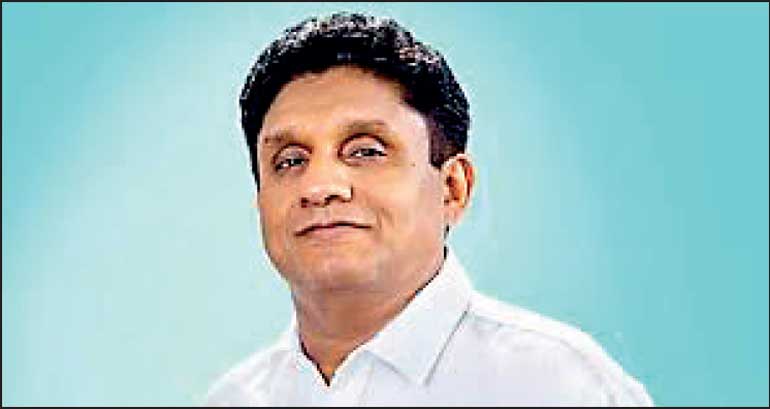
Opposition Leader Sajith Premadasa
Opposition Leader Sajith Premadasa has urged the National People’s Power (NPP) Government to use its ‘demonstrated reforms credibility’ to negotiate another bail-out package with the International Monetary Fund (IMF), amid growing concerns on the Middle East war’s impact on the economy.
“The window to negotiate from relative strength with $ 7 billion in reserves, a functioning (IMF Extended Fund Facility) program, and demonstrated reform credibility is open. I am asking this Government to plan for March 2027 and explain to the country Sri Lanka’s contingency plan when we fail to meet the IMF target,” the Opposition Leader said in a letter to the Government yesterday.
The IMF target in question is reserves.
“The numbers are not complicated. Sri Lanka has $ 7 billion in gross official reserves. The IMF’s own target for when our current program ends in March 2027 is $ 14.2 billion. To bridge that gap, we would need to accumulate $ 600 million in reserves every month for the next 12 months. We are not on track to meet that target,” Premadasa said.
“And yet, the Government has said nothing about what comes after March 2027. I am calling on the Government today to begin negotiations for a successor IMF program.
Not to renegotiate the existing arrangement, which is proceeding. A successor program, the arrangement that takes effect when this one ends. What I am proposing is not a retreat from fiscal discipline. It is the opposite.
“Sri Lanka is not in a position of strength indefinitely. The rupee has weakened by approximately 14% against the dollar over the past 12 months. Petrol stands at Rs. 410 per litre today, close to the Rs. 470 crisis peak of June 2022, reached in just four months from Rs. 294 in January. Our $ 8.1 billion in annual remittances depends heavily on continued employment in Gulf States at a moment when the Middle East conflict is reshaping the regional economy. These are not distant risks.
“We have had 17 IMF programs. Every one of them that involved a genuine crisis was negotiated after the reserves were gone and the rupee was in free fall. Every time, Sri Lanka accepted whatever terms were offered, because it had no other choice.
“We have a choice right now. The window to negotiate from relative strength with $ 7 billion in reserves, a functioning program, and demonstrated reform credibility is open. I am asking this Government to plan for March 2027 and explain to the country Sri Lanka’s contingency plan when we fail to meet the IMF target,” the Opposition Leader said.
The concerns raised by Premadasa also come at a time when the economic pressures confronting Sri Lanka are increasingly tied to broader global developments rather than purely domestic weaknesses.
The pick-up in pressure on the rupee has coincided with the escalation of the Middle East war, which has disrupted global supply chains, pushed oil prices sharply higher, and strengthened the US dollar against many regional currencies. The rupee, which had weakened 1.4% year-to-date (YTD) by 27 March, depreciated further to 2.9% by 30 April and 4.5% by 15 May as external pressures intensified.
The Government and the IMF are already in discussions on adjusting aspects of the existing Extended Fund Facility (EFF) program to deal with the fallout from Middle East war-related global supply shocks.
IMF Managing Director Kristalina Georgieva has warned that the economic risks stemming from the conflict are becoming increasingly severe, particularly if oil prices remain above $ 100 per barrel for an extended period.
Speaking on the sidelines of the Europe Gulf Forum in Greece last week, Georgieva said higher oil prices, rising inflation, increasing government Bond yields, and tightening financial conditions could significantly slow global growth and potentially push some economies towards recession territory by 2027 if instability persists.
She also warned that central banks may be forced to tighten monetary policy again if inflation expectations continue to rise, despite already elevated global debt levels and shrinking fiscal space in many countries.
The IMF has separately indicated that it expects at least a dozen countries to seek new IMF programs due to energy price shocks and supply chain disruptions linked to the conflict, while the Fund itself is preparing for between $ 20 billion and $ 50 billion in additional balance of payments support requests globally.
The conflict has had particularly severe consequences for energy-importing economies with limited fiscal buffers, with the IMF and World Bank warning of rising food insecurity, higher fertiliser costs, transport bottlenecks, and slower global growth.
Against that backdrop, the IMF has continued to signal support for Sri Lanka’s reform program despite acknowledging that the country has already faced “two very large shocks” in the form of Cyclone Ditwah and the Middle East conflict.



