Thursday Oct 15, 2026
Thursday Oct 15, 2026
Thursday, 30 July 2026 04:52 - - {{hitsCtrl.values.hits}}
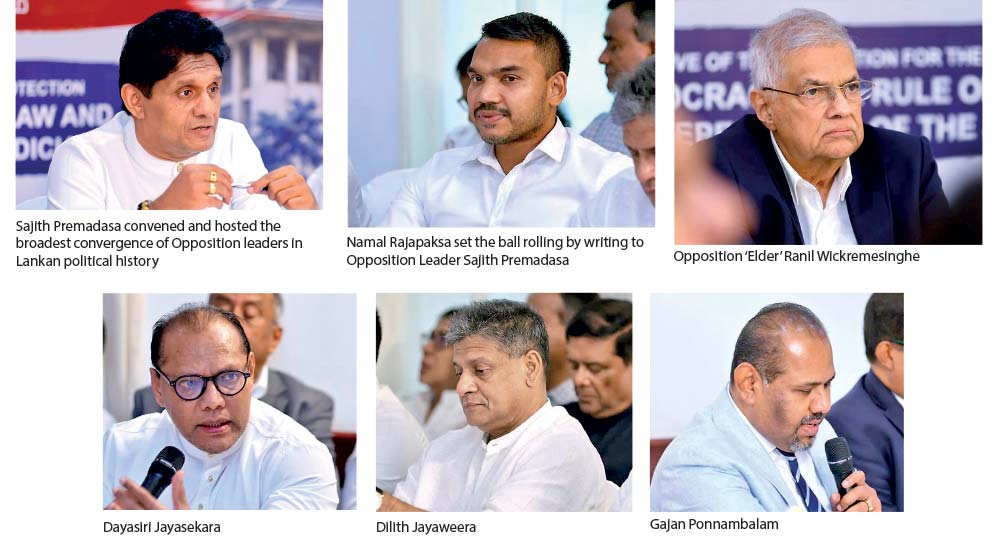
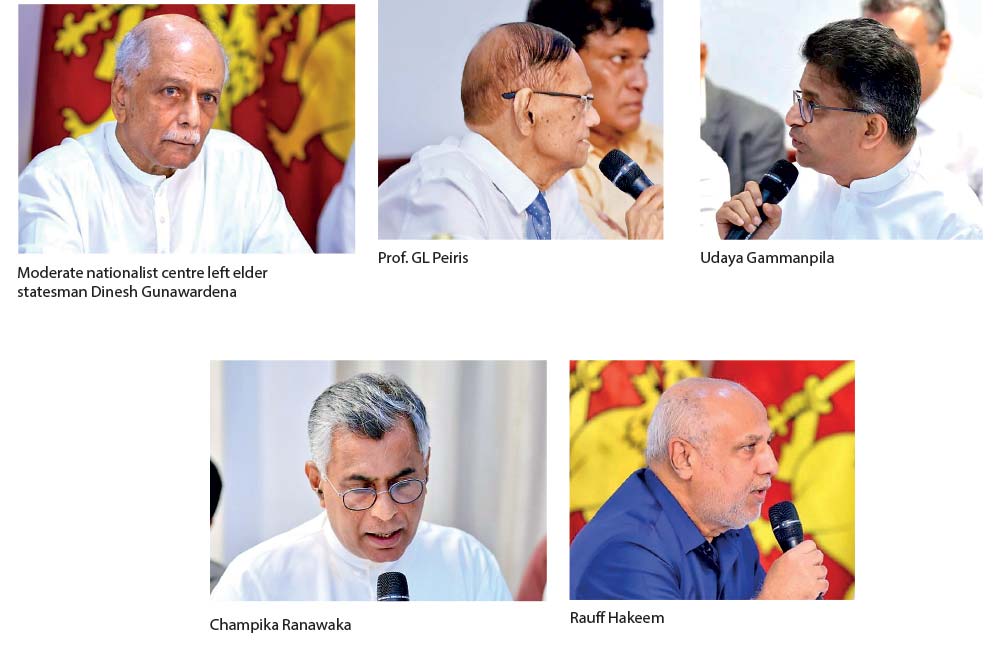
 Having come together once, the Opposition leaders will know they have to come together again, and this time, stay together until they secure an election on schedule. If they don’t, they will have to manage without elections for as long as the JVP-NPP pleases—as with PC elections. The mainstream Opposition will be as disempowered as the minority parties representing the North and East are
 Notwithstanding the scheduled discussion between the BASL and the Justice Minister, the Cabinet decided to forge ahead with the controversial term extension for the higher judiciary. NPP Exco member Lal Wijenaike, senior leftist and lawyer, says the Exco did not approve the move—but that he had been told to shut up.
Earlier, the Cabinet decided that Provincial Council election can be held only after a new Election law, and declined to commit to a time-frame.
Meanwhile the Government seems set to suffocate civil society with its draconian draft NGO law. (https://www.ft.lk/columns/The-draft-NGO-law-casts-a-wide-net-to-build-an-architecture-of-oppression/4-795241)
Connect the dots and one can see where things are headed—towards the dismantling of democracy and its substitution by political despotism. The Opposition should not be naive enough to think that elections in 2029 are a certainty. So, how can it resist and roll back the arrogant dictatorial trend?
Democracy in Asia
Fortunately, we are living in a moment of democratic people’s power in South Asia: Sri Lanka 2022, Bangladesh 2024, and Nepal 2025.
We must unequivocally applaud the ‘flash uprising’ of the student youth of India, the world’s most populous democracy—an uprising led by the refreshingly unconventional Cockroach Janta Party (CJP). It showed that even with a weakened parliamentary Opposition, the country’s educated youth succeeded in pushing back the dominant Modi dispensation on a single specific issue impacting the present and future prospects of vast numbers. India’s youth uprising has made more meaningful the republican character of India’s democracy and dented the overlordship of the Modi-BJP-RSS bloc.
As in Europe in May 1968, the student movements in each country must learn from the experiences of the others. Sharing lessons and building South Asian networks must not be limited in a sectarian spirit to ‘fraternal’ youth movements of left parties, but must embrace all democratic, anti-authoritarian student, youth and people’s movements.
Just as liberal democrats and radical democrats (e.g., Tom Paine) rebelled against ‘tyranny’, Marx, Engels and Lenin (‘Two Tactics’-1905) prioritised the ‘general democratic’ struggle against ‘political absolutism’ as the primary goal. It would be a strange ‘Third Worldist’ or Asian radical conclave or perspective which failed to:
 Denounce the brutal military junta of Myanmar, the oldest military dictatorship in Asia, the Global South and the world.
Solidarise with the Myanmar youth and students fighting for democracy—a struggle which justifiably became guerrilla resistance after lethal repression of peaceful protest.
Unprecedented convergence
July 23rd was billed as a decisive test for Sajith Premadasa as Opposition leader. Namal Rajapaksa had taken the initiative of writing to Sajith urging him to take up the leadership of resistance to the AKD Government’s tampering with the judiciary. Sajith convened a gathering of the Opposition to address the issue.
Sajith Premadasa passed the test with flying colours, because I cannot recall a more widely attended meeting of leaders of Ceylonese/Sri Lankan Opposition parties on any issue whatsoever. Almost everyone imaginable was there, cutting across all barriers. It was the most inclusive Opposition ingathering on the record.
While there were 43 attendees in all, not all were party leaders, but over half were. The list of leading personalities included: Sajith Premadasa, Ranil Wickremesinghe, Dinesh Gunawardena, Namal Rajapaksa, Jeevan Thondaman, Nimal Siripala, Tiran Alles, Dilith Jayaweera, Prof. GL Peiris, Wimal Weerawansa, Udaya Gammanpila, Dayasiri Jayasekara, Patali Champika Ranawake, Asanka Navaratne, Maithri Gunarathna, Rauff Hakeem, Ravi Karunanayaka, Mano Ganeshan, Gajendran Ponnambalam, Rishard Bathiudeen, P Digambaram, and V Radhakrishnan.
There were only three exceptions:
The ITAK (Sumanthiran, Rasamanikkam et al), which declined to attend, though it needs the goodwill and buy-in of the Opposition gathered on 23 July to regain devolved provincial political space.
The Frontline Socialist Party which had not been invited, in a blunder by the organisers.
The Communist Party of Sri Lanka which had been invited, but myopically and counterproductively absented itself.
The full-spectrum Opposition gathering was a political defeat for the Government which had benefited from the fissured Opposition space. While such an ingathering may not be reassembled for some time though it should, and the collective Opposition may not take the convergence to the next level as it should, it is no less true that the taboos have been overcome momentarily, and the ice has been broken.
For the first time in a long time, we are able to talk of ‘The Opposition’, and not just this or that party or grouping.
The Opposition parties may return to their respective silos, but they’ve come together once, and can do so again, for a more sustained time and extended, ambitious effort. On balance, this is more likely than not, given the polarising policies and practices of the Government.
Grassroots Opposition unity
The Multi-Purpose Cooperative Society (MPCS) elections have witnessed a spontaneous drawing together of the anti-Government masses, manifested in the domino-like defeats of the JVP-NPP at the hands of combined Opposition blocs led by the SJB.
Will the national-level leaders learn from the masses, i.e., from their own grassroots supporters, and form a collective or coordinated political leadership, thereby securing national elections on schedule and eliminating the chances of an electoral victory by the incumbent administration?
We’d be lucky if the Opposition streamlines itself into a bipolar formation rather than the current multipolar arrangement and clusters around Sajith Premadasa and Namal Rajapaksa as candidates. I’m not idealistic enough to assume that the two will arrive at an equation which presents a combined Opposition slate. Any power-sharing will have to be post-election.
Existential threat to Opposition
The Opposition imperatively needs to realise what the 17-MP UNP Opposition figured in 1970-1977. A ruling alliance with a 2/3rds majority in parliament and acting like a steamroller, leaves only one option for the parliamentary Opposition—supplement parliamentary politics with the extra-parliamentary path of peaceful mass protest. This strategic realisation expressed itself in the famous ‘satyagraha’ campaigns under JR-Premadasa leadership.
Today’s Opposition must use the Parliament to the maximum as a platform but begin to shift the centre of gravity of activity outside of Parliament. ‘Swarm tactics’ by all Opposition currents would multiply chances of success. The faces around the table at the Opposition Leader’s Office on 23 July should be seen together on public platforms and picket-lines. The Opposition must learn to “walk the talk” i.e., walk on the streets, the talk around the table. It must turn its shared precepts into united political practice.
However, as India has shown there is no viable politics for any Opposition that does not foreground the social dimension—social impacts, social movements, social issues. Will the Opposition come together on the material issues of the people, such the growing crisis of the peasant/agrarian sector, issues of the fisherfolk, and the student youth? Will the Opposition hit the streets with these social forces?
Opposition party leaders are primarily preoccupied with becoming the ‘common Presidential Candidate’ and winning a Presidential Election. Opposition parties are preoccupied with sharing out future ministerial posts and keeping out other parties.
Some are expecting JVP-NPP ‘lawfare’ to incarcerate Namal Rajapaksa and take him off the board as a contender, enabling them to fill the space. It will be too late when they figure that the JVP-NPP’s target list includes all of them and that its endgame is the long-term postponement of elections and deep entrenchment in power.
Before the Presidential and Parliamentary Elections of 2029 comes the struggle to ensure that those elections are held on schedule, because in its political genes, the JVP is predisposed towards one-party tyranny. This requires that Opposition leaders and parties should be primarily preoccupied with:
Constructing the broadest Opposition convergence to campaign for a ‘NO’ vote at any Referendum the Government may hold.
Obtaining the overdue Provincial Council elections as a stepping-stone to national elections on schedule.
Deterring Government efforts to prevent or postpone the 2029 elections.
Building capacity to retaliate instantly and massively (like India’s CJP) against any Government moves at deferment of democratic elections.
The long-term symbolic value of Sajith Premadasa’s successful rallying almost the whole Opposition around a table at the Opposition Leader’s office on 23 July, will be seen when in face of the tightening economic crisis, AKD and the JVP-NPP manifest their long-standing totalitarian reflexes and strive to kick the can of national elections down the road—probably using the PC polls ‘blockade’ as template.
Having come together once, the Opposition leaders will know they have to come together again, and this time, stay together until they secure an election on schedule. If they don’t, they will have to manage without elections for as long as the JVP-NPP pleases—as with PC elections. The mainstream Opposition will be as disempowered as the minority parties representing the North and East are.
Universal strategy, two tactics
The Opposition needs to grasp a universal principle of serious politics practised by figures as diverse as Lenin and Churchill, Mao and Roosevelt, Ho Chi Minh and De Gaulle. That principle is: draw lines of demarcation of fundamental, foundational issues of program and ideology, but transcend those lines and unite on matters of shared principle and common interests against existential threats.
The principle of the United Front cuts across ideological enmities and national/international distinctions. Churchill set aside his hostility towards Stalin’s communism and stridently advocated a broad alliance against Hitler’s fascism, resuming the anti-communist cause only after World War II was won.
Presidents George HW Bush (Bush Sr.), Bill Clinton and Barack Obama held that the USA should act multilaterally whenever it can, and unilaterally only when it must.
Lenin, who correctly insisted during WW I on splitting with the old socialist parties and forming an international movement of intransigent communist parties (1919), no less correctly changed gear and called for a United Front of workers’ parties (1921), against the rise of the violent European counterrevolution which was turning fascist.
Memorably, Trotsky said he would be willing to enter a united front even “with the Devil’s grandmother” against Nazi fascism.
Most famously and successfully, the Communist International under Stalin and Dimitrov launched the strategy of the Popular Front consisting of left and bourgeois-democratic parties. Mao Zedong and Ho Chi Minh adapted it to the East in a broadened version which included ‘national’ capitalists. Mao termed the “United Front” one of the “Three Magic Wands of the Revolution” (the others being the Party and the Army).
The most inclusive and pluralist convergence of Opposition leaders ever in Sri Lankan politics didn’t go to the next level of becoming a July 23rd Movement or ‘Standing Conference’. The historic convergence should be formalised as a quarterly conference of the whole Opposition.
To operationalise the universal doctrine of political strategy sketched above, Opposition Leader Sajith Premadasa and all other Opposition party leaders must apply ‘two tactics’ in alternation but in combination:
(I) Push ahead as far and fast as possible as a single party or with like-minded partners whenever it can, while uniting with all Opposition parties when it must.
(II) Converge as many parties as possible in action on as many issues as possible, i.e., encirclement through ‘swarm tactics’, while each party goes its own way or acts together with like-minded parties only when common ground cannot be found among all or most Opposition parties.
Sajith’s suitability
July 23rd hopefully put paid to gossip about possible challenges to Sajith Premadasa as SJB leader and (perhaps SJB-UNP) Presidential Candidate. As a realist who has observed national politics since 1964, I don’t see any candidates in the Opposition who can even make it into double-digits, other than Sajith Premadasa and Namal Rajapaksa.
Whether Sajith will win in 2029 depends on the challenges that face the citizens and the country at the time and whether his mature, balanced, centrist progressivism are perceived as the best to answer, or whether Namal Rajapaksa’s youthful, combative spirit is perceived as the requirement.
The limitations of the main Opposition party—the SJB—certainly weakens the Opposition and democracy as a whole, but it is important to grasp that:
(a) There’s no Opposition party anywhere as big as the SJB.
(b) The main limitation of the SJB is not its founder-leader Sajith Premadasa who as Presidential Candidate consistently scores higher than the supposed sibling parties, the SJB and UNP.
The SJB’s problem stems from what it stubbornly chose to remain as, when there was another, much better identification available as option—that of the last popularly elected UNP President’s policies. Instead of returning to and following a success story, the SJB chose to be the successor party or identical twin of the losing UNP of Ranil Wickremesinghe, inheriting its ‘genetic’ electoral defects.
This is evidenced by the SJB’s stagnation which continues that of the UNP under Ranil who inherited the island’s largest single party with a vote base of 40%, and reduced it to a party with a vote ceiling of 20%. Thus:
While holding the Prime Ministership and Cabinet portfolios under Yahapalanaya, the UNP fell to 20% in February 2018.
Its clone the SJB took over that 20% in August 2020.
Ranil running as incumbent (albeit appointed) President in 2024 with some SLPP (‘Gas Cylinder’) support, scored 20%.
The SJB reappropriated that 20% in November 2024.
Meanwhile Sajith Premadasa scored 42% in November 2019 and 32% in September 2024—which can’t be entirely attributed to the minorities, because the SJB had some of that support in the mix at the Parliamentary Elections too. It is Sajith’s heritage of Premadasa populism that gets him a bigger vote nationally than the SJB, UNP, or Ranil.
The SJB’s main liability is its right-wing economic ideologues who fail to grasp that there is no national ‘market share’ beyond 20% for their Wickremesinghe-era UNP neoliberal economics.
The ‘magic formula’ of uniting the SJB and UNP will not work electorally because it is the same 20% that either or both will get, so long as they adopt the same de-Premadasaised economic policy of three decades of neoliberal electoral failure and defeat 1994-2024.
The NPP’s 2024 vote showed what formula works electorally—a progressive, centre-left populism—which AKD-JVP-NPP pivoted away from sharply to the right once elected, as did Syriza’s Alexis Tsipras after winning Greece’s referendum against the EU debt-restructuring package.
The SJB’s right-wing ideologues Dr Harsha de Silva and Eran Wickremaratne bitterly resisted every effort by Sajith to broaden the scope of the SJB’s appeal by an alliance with the Dullas-GL group of 13 progressive dissidents from the Pohottuwa (who also had considerable experience of electoral success and working with elected presidents). If that partnership lasted, the SJB would have had a bridge to the disillusioned SLFP-SLPP voters and won in 2024. With Harsha-Eran building walls not bridges against that partnership, those voters floated to the NPP instead. Only Dr. Charitha Herath remains.
Sajith Premadasa had a great public welcome and fired up oratorically in Mihintale this week. (https://youtu.be/UcmY--cvySc?si=vLLi15pdHGcN0gGi)
I’d like to see Dr. Harsha de Silva campaign in the rural ‘heartland’ advocating integration with Tamil Nadu as he does in Colombo.
For the SJB and UNP, Sajith Premadasa is the only game in town, unless they want to remain stagnant at a shared 20%.




