Sunday Sep 13, 2026
Sunday Sep 13, 2026
Tuesday, 28 July 2026 06:09 - - {{hitsCtrl.values.hits}}
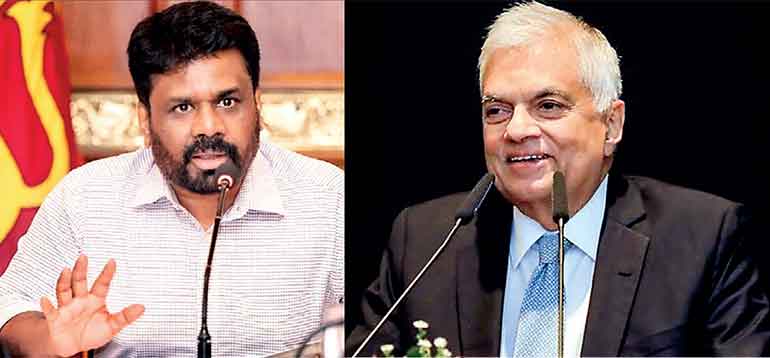
President Anura Kumara Dissanayake, Former President Ranil Wickremesinghe
 The draft law to ‘register and supervise’ NGOs, circulated in July 2026, evokes a sense of déjà vu. Why? Because the NPP Government is recycling the law drafted by the Ministry of Public Security headed by Tiran Alles during the Ranil Wickremesinghe Government.
Why should you care about it? Because it applies to a wide range of organisations- microfinance non-Governmental organisation, trusts, companies limited by guarantee, associations, councils, community hostels, foundations, movements, international organisations not established via an inter-Governmental agreement and a group formed by not less than five persons to serve the general public and engage in any voluntary social service or non-profit oriented activity.
The Government’s argument is that this law is required to adhere to the standards set by the Financial Action Task Force (FATF), the global, inter-Governmental watchdog tasked with countering terrorist financing and money laundering. Yet, the draft NGO law is incompatible with FATF standards, especially Recommendation 8 on non-profit organisations. This has been pointed out both publicly via articles, and privately via letters to the President and relevant ministers several times.
Yet, the Government has disregarded these interventions. Its disregard demonstrates that the intent to control any non-Governmental activity through the weaponisation of FATF standards is a systemic strategy that does not change despite change in Government. It should be noted there was no consultation with civil society during the drafting of the law, either during the Ranil Wickremesinghe Government or the Anura Kumara Dissanayake Government.
Why is the NPP, that critiqued the Wickremesinghe’s oppressive policies and practices when in Opposition, now seeking to enact the repressive law that Wickremesinghe and Tiran Alles put forward? Are the anti-NGO elements in the JVP driving this or is the Government being misled by bureaucrats who are entrenched in a system that has been shaped by the security sector which views dissent and critique as a national security threat?
What does the proposed NGO law aim to do?
The draft law makes it mandatory for the extensive list of organisations previously mentioned to register and be subject to monitoring by a Competent Authority (CA). Hence, the law, if enacted, will be applicable to many types of organisations NOT ONLY to organisations traditionally viewed as NGOs in Sri Lanka. Non-registration is an offence under the proposed law.
The draft law bestows the Competent Authority with substantial powers to review, monitor and interfere with the functions, projects and activities of registered organisations. The Competent Authority and Police have the power to enter the premises of any registered organisation without a warrant and upon prior notice, to access or examine its records. This empowers the Government to prevent any activities that it wishes.
Current Government disregard demonstrates that the intent to control any non-Governmental activity through the weaponisation of FATF standards is a systemic strategy that does not change despite change in Government. It should be noted there was no consultation with civil society during the drafting of the law, either during the Ranil Wickremesinghe Government or the Anura Kumara Dissanayake Government. Why is the NPP, that critiqued the Wickremesinghe’s oppressive policies and practices when in Opposition, now seeking to enact the repressive law that Wickremesinghe and Tiran Alles put forward?
The registration issued by the CA is valid for only three years after which it has to be renewed via a fresh application. Issuing registration for only three years will prevent an organisation from long term planning, which will adversely impact its programmes, staffing, efficiency and financial security.
According to the proposed law, every registered NGO shall not “Engage in any activity that adversely affect (sic) sovereignty or territorial integrity of Sri Lanka” or “ Induce or cause to induce any public disorder which affect (sic) safety and interests of the general public.’ These are broad, undefined terms that can be interpreted broadly to label any activity that is critical of the Government or seeks to hold the Government accountable as a prohibited activity. For example, a collective of media professionals that conducts a protest condemning an act of the Government that undermines media freedom could be viewed as inducing public disorder. If that happens, their registration could be suspended because the proposed law allows the suspension of an organisation’s registration for engaging in activities contrary to the provisions of the Act.
The CA has the power to suspend registration of a NGO on prima facie evidence of money laundering, terrorist financing or financial irregularity, without a judicial order, as well as where their activities or existence are “prejudicial or a threat to national security, territorial integrity, sovereignty”. The phrase, ‘prejudicial or a threat to national security, territorial integrity, sovereignty” is undefined, broad and can be interpreted any way the state wishes. Hence, it can be used to shut down any activity the Government wants, such as anything it views as critical of it, without following due process or a judicial order.
Building an architecture of oppression: How is the NGO law connected to recent legal reforms?
The amendments to the Convention on the Suppression of Terrorist Financing Act, the Financial Transactions Reporting Act and the Prevention of Money Laundering Act under the guise of adhering to the standards of FATF, along with the proposed NGO law, can be used to stifle and even altogether stop any activity the Government deems unacceptable or not to its liking.
For instance, the Financial Transactions Reporting Act extends the period the Financial Investigation Unit (FIU) can suspend a person’s or organisation’s financial transactions from seven days to fourteen working days (nearly three weeks), combined with ex parte High Court procedures and in-camera hearings. This raises serious concerns about due process and transparency, and risks enabling arbitrary restrictions on financial transactions, which can adversely impact people’s livelihoods and commercial activity.
The amendment requires banks to report all transactions above a yet unspecified threshold. This introduces a blanket reporting obligation that is not based on reasonable suspicion and departs from FATF’s risk-based and proportionate approach. It also imposes significant administrative burdens on banks.
The draft law makes it mandatory for the extensive list of organisations previously mentioned to register and be subject to monitoring by a Competent Authority (CA). Hence, the law, if enacted, will be applicable to many types of organisations NOT ONLY to organisations traditionally viewed as NGOs in Sri Lanka. Non-registration is an offence under the proposed law
The amendment permits extensive information-sharing by the FIU, including with international entities, but does not establish adequate safeguards on data retention, protection of privileged information or deletion of personal data, raising significant privacy and cybersecurity concerns.
The amendment to the Convention on the Suppression of Terrorist Financing Act has similar provisions on freezing orders by the police without judicial oversight.
The amendment to the Prevention of Money Laundering Act confers wide and unguided discretionary powers on investigative and enforcement authorities, particularly in relation to freezing, forfeiture and investigative measures. It lacks adequate procedural safeguards and permits intrusive interference with property rights, livelihood and lawful financial activity through expansive freezing and forfeiture powers.
It contains vague and overbroad provisions, including undefined standards governing “special investigation techniques”, derivative property freezing and expands the scope of “unlawful activity”. The law creates investigative mechanisms that undermine the presumption of innocence and protections against self incrimination through compelled affidavits and penal consequences arising from purported contradictory statements.
The amendment authorises extensive sharing of financial and personal information with foreign agencies without adequate safeguards relating to necessity, proportionality, accountability or oversight. Concerningly, it permits regulations to come into operation prior to Parliamentary approval, thereby undermining Parliamentary control over delegated legislation.
Debunking Government justifications for weaponising FATF requirements
The Government is using FATF standards to justify enacting repressive laws that will have an adverse impact on the freedom of association and expression amongst other rights. For example, it has included new clauses on anti-money laundering and countering financing terrorism in the draft NGO law that allow the Competent Authority to monitor NGOs to detect money launder/financing terrorism and suspend the operations of a NGO. Yet, FATF requires governments to implement focused, proportionate, and risk-based measures to protect vulnerable non-profit organisations from being exploited only with regard to financing terrorism and not money laundering.
FATF Recommendation 8 states that of all organisations that fall within the FATF definition of NPOs, only a small portion may be at “high risk” of terror financing abuse. However, the proposed law uses a highly securitised framework that treats all organisations as carrying the same level of risk of terrorist financing as well as money laundering abuse. System change, this is not
The draft NGO law and amendments to the three laws discussed above are contrary to FATF standards, as FATF requires oversight measures to be proportionate and targeted, based on identified risks rather than blanket requirements. A centralised monitoring entity is not required nor endorsed by FATF, which does not require supervision of non-profit entities either.
FATF Recommendation 8 states that of all organisations that fall within the FATF definition of NPOs, only a small portion may be at “high risk” of terror financing abuse. However, the proposed law uses a highly securitised framework that treats all organisations as carrying the same level of risk of terrorist financing as well as money laundering abuse. System change, this is not.




