Thursday Nov 19, 2026
Thursday Nov 19, 2026
Thursday, 19 November 2026 05:23 - - {{hitsCtrl.values.hits}}
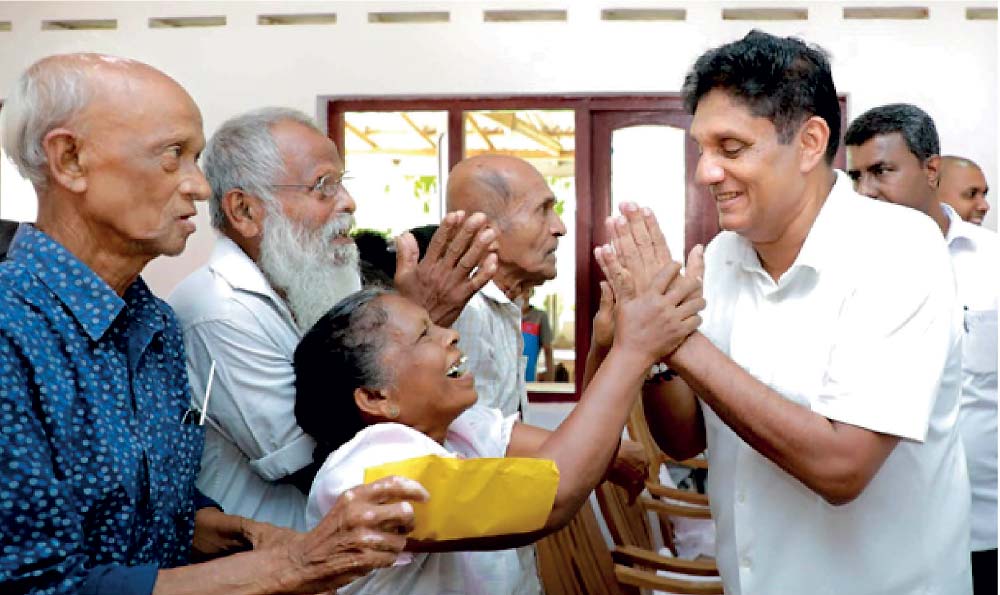
Sajith’s Budget speech reflects concern for the underprivileged
 Resting on the legacy of stellar economic achievement of paternal Presidents, Sajith and Namal are scornful of the Government’s mediocre performance and exude confidence that each could revive rapid development. Sajith’s discourse is more social-democratic and pluralist, parsing Buddhist scripture to present its rational core; Namal’s is more hard-charging, bearing a nationalist religio-cultural sub-text. Voters will have two credible options for change
 This year’s Budget debate is different. Prime Minister Harini Amarasuriya spotted the change in the Opposition’s ‘batting order’.
‘…“Usually, Opposition MP Harsha de Silva opens the Budget debate on behalf of the Opposition. This has been the practice since I entered Parliament in 2020. We generally prepare ourselves to respond to his remarks. Whether we are in the Government or the Opposition, we have always been ready to listen to his opening statement following a Budget presentation. However, we see a change in that practice today,” she said…’
(https://www.newswire.lk/7xf1)
The PM followed up with a query.
‘…The Prime Minister said the Government…remained keen to hear MP Harsha de Silva’s views on the 2027 Budget.
She said his remarks would help determine whether there had been a shift in the SJB’s economic policies or whether the party continued to maintain its previous position.
Referring to the remarks made by Opposition Leader Sajith Premadasa at the beginning of the debate, the Prime Minister accused him of presenting misleading narratives concerning the economy, the International Monetary Fund (IMF) and the World Bank.
She said the Government was now awaiting MP Harsha de Silva’s contribution to establish whether other SJB parliamentarians shared the Opposition Leader’s position on these economic matters.’ (Ibid)
|
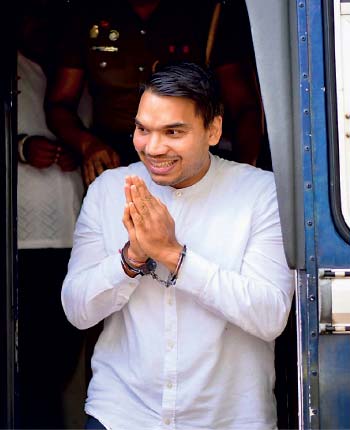
Namal stays cool under pressure |
In a sense, her observation was misleading. The Budget having been presented by President and ruling party leader Anura Kumara Dissanayake, the global practice would be for his counterpart, the Leader of the Opposition and the largest single Opposition party, to open on behalf of the alternative Government. That’s Sajith Premadasa, not Dr Harsha de Silva. It was an anomaly, absurdly and counter-productively resorted to by the SJB since 2020, to permit the latter to open the debate for the Opposition. Sajith opening this time was a correction of that deviation—though Harsha stridently complained in his speech during this debate that “my speech was delayed by three days”.
Most revealing is the PM’s question as to “a shift in the SJB’s economic policies” (from Harsha’s?) and whether the SJB parliamentarians “shared the Opposition Leader’s position on these economic matters”.
What would the NPP Government prefer—that the SJB does or doesn’t share its leader’s position on economic matters?
Sajith’s speech showed consistency in his long-standing rejection of ‘trickle-down’ in favour of balancing ‘growth with equity’ articulated during Budget debates going back 15 years. Furthermore, he has been advocating ‘social democracy’ in Parliament since November 2022. Sajith’s speech this time was a more full-blooded elaboration of his basic economic doctrine and critique of Government policy. By opening for his side, the SJB leader signalled that his progressive-centrist economics would be the banner under which he would campaign—and run—against the Government.
The surreal irony of Harini’s question regarding SJB economic ideology was that all the speeches on the Government side including her own, reflect the degeneration of JVP-NPP economic ideology to a monolithic, dogmatic defence of liberal economic orthodoxy under the rubric of ‘stabilisation’ and ‘transformation’.
If the JVP leadership retained a residue of a Marxist critique of capitalist economics, and the NPP the slightest trace of progressive economic thinking (Stiglitz-Krugman-Reich-Sachs-Galbraith et al), the JVP-NPP Govt would know that the economic strategy and model it is determinedly following will only further polarisation, deepen the affordability crisis, and is doomed to fail.
Clearly, the ruling JVP-NPP rather than Sajith’s SJB or Namal’s SLPP, has become the main agency of neoliberal economic doctrine, strategy and policy in Sri Lanka.
Harsha’s hype
Dr Harsha de Silva’s argument is that economic stabilisation has been positive and successful, the NPP Government’s ‘reform agenda’ and ‘direction’ are laudable, but insufficient because growth is now needed. The NPP comfortably concurs, calling it ‘transformation’. His critique of the Government’s economics is tactical and managerial: ignorance and incompetence in implementation.
Harsha adds an absurdity: the lingering Marxism-Leninism of the JVP foredooms it to failure at generating rapid, sustainable growth in a market economy. He should identify and prove the existence of the ‘Marxist-Leninist’ component instead of taking Handunetti’s word for it. (Sunil should know it isn’t meant to be ‘lodged in the heart’, but the head.) Harsha clearly doesn’t agree with Sajith that the JVP has betrayed Marxism/socialism and converted to neoliberalism.
Harsha’s contention on Marxism-Leninism and economics is vaporised by the achievement of the Communist Parties of China and Vietnam. His position is different from Sajith’s contestable yet understandable declaration that China and Vietnam’s economies are capitalist. (I’d say they are better understood as ‘hybrid systems’ or a ‘systemic fusion’.) Sajith wisely never contradicts the fact that the foundations and core convictions of the Chinese and Vietnamese CPs are Marxist-Leninist.
Harsha de Silva should read Kevin Rudd or Shiran Illanperuma on China, to comprehend whether Marxism-Leninism is an intrinsic obstacle to an economic miracle, let alone sustainable rapid growth—or is a very real part of the mix in China. But then again, Harsha the economist never mentions the Chinese economic miracle, unprecedented in economic history.
Harsha doesn’t get the JVP-NPP’s dark dualism: ultra-capitalist economics, one-party (‘Marxist-Leninist’) political rule.
‘Poor made poorer, rich made richer’
Sajith’s Budget speech was a masterclass; intellectually, substantively, the best on both sides of the aisle. (https://youtu.be/T_Ss7xsvxrQ?si=FrsjJmNKfUYGQYnw)
He refused to give AKD – and Ranil Wickremesinghe—a free pass on ‘economic stabilisation’. Instead, he de-constructed the ‘economic stabilisation’ itself:
“…Therefore, indeed, when you claim conditions have normalised, I wish to state that normalisation has occurred to the advantage of multi-trillionaires and the ultra-rich—to the disadvantage of the poor, the common public, the working class, and the middle class…”
The Daily FT report of his speech prefaces the text with key takeaways as bullet-points:
 Says poorest 20%’s real household income fell 19.6% in 2019-2025, richest 20%’s rose 6.8%
Claims only $ 1 b FDI came in 2025 as several projects exited
Says Lazard gave SL worse debt deal than Ghana and Senegal
Only 5 of 17 IT sector pledges for 2026 delivered, he says
Urges vehicle permits for professionals to stem brain drain
(https://www.ft.lk/front-page/Sajith-brands-Budget-2027-a-string-of-lies/44-800098)
‘…Opposition Leader Sajith Premadasa yesterday…charged that the 2027 Budget widens inequality, fails to draw foreign investment and offers no relief to farmers, small businesses or public servants.
…Premadasa said income had shifted from the poor to the rich between 2019 and 2025. Real household income of the poorest 20% fell by 19.6%, while that of the richest 20% rose by 6.8%, he said, widening the average income gap between the two groups from 11.2 times to 14.8 times. He said the richest 20%’s share of income had risen to 55.8%, which he blamed on inadequate wages, soaring inflation and the erosion of living support. He tabled the survey in Hansard.
“The poor were made poorer, and the rich were made richer,” he said.
… The Government had failed to change the debt sustainability analysis (DSA) agreed with the International Monetary Fund (IMF), as promised in its manifesto “A Thriving Nation – A Beautiful Life”. He said Lazard, the firm that brokered the deal with international sovereign bondholders, had also handled restructurings for Ghana and Senegal, which secured better terms.
He took issue with the macro-linked Bonds in the deal, under which debt relief shrinks as economic growth rises.
“Then what incentive or motivation do we have as a country to increase the economic growth rate? As the growth rate rises, the amount of foreign debt we have to repay also increases. Lazard defrauded Sri Lanka,” he said.
He said there had been no debt restructuring for the 263,000 micro, small and medium enterprises (MSMEs) in distress in 2022, a number he said had since grown. The promised development bank for them had not been set up. The Government had suspended the parate law, which lets banks auction pledged property without going to court, but had not restructured MSME debt, he said.
…He said farmers were promised Rs. 150 per kg of paddy, but prices had fallen to a maximum of Rs. 95. He said the promised interest-free loans and price support through small and medium millers had not materialised, and that cultivation of big onions, potatoes, chillies, upland crops, fruit, export crops and upcountry vegetables had collapsed.
“You have not provided even an atom of support for agriculture through this Budget,” he said.
Premadasa accused the Government of spending hundreds of billions of rupees of public money on thermal power at the expense of renewable energy…and said the promised LNG had not materialised. He challenged the Government to name a single production industry it had initiated.
He said a World Bank report of October 2026 found that 60% of the country was poor, while the UNDP Multidimensional Poverty Report showed poverty had escalated severely. He said the Government and the Department of Census and Statistics wrongly used a blanket average of 2,030 kilocalories per person per day, when the Medical Research Institute showed needs vary by gender and activity. This error led to the claim that Rs. 17,742 a month was enough for one person, he said.
…He asked why the 15% interest on savings promised to senior citizens had not been granted, and said retirees’ core problems remained unresolved.
Premadasa said the Budget had no proposal for the promised 33% cut in electricity bills, and that pledges of a Rs. 1.2 million Vitz car, a Rs. 50,000 motorcycle and fuel at port landing prices had not been kept.
He said schools could not secure smart boards or computers, and the health sector faced severe shortages of drugs, equipment and staff. He asked what had happened to the promised fish-locating app and the plan to develop marine resources in the 200-nautical-mile exclusive economic zone. To stem the brain, drain, he urged the Government to grant vehicle permits to professionals, including doctors, rather than to MPs.
Premadasa…described it [the Budget] as one that “strikes the stomach of the common man and the poor”.
He urged the Government to reject neo-liberalism and extreme Marxism and adopt “the middle path, social democracy, and the social market economy”.’ (https://www.ft.lk/front-page/Sajith-brands-Budget-2027-a-string-of-lies/44-800098)
Socio-economic model
The statistics and diagrams that Sajith tabled reveal that the seismic shift of real income from the poor and working people to the very rich began in 2019. This establishes the truth: the model which enables the unprecedented dominance of “the multi-trillionaires, the ultra-rich”; the tectonic shift in policy paradigm, began with Gotabaya Rajapaksa, ran through Gota’s choice (unelected) Ranil Wickremesinghe, and reached the next level with Anura Dissanayake.
I was there with Sanja, seated behind Mahinda Rajapaksa, when it happened in May 2018 at the Viyath Maga 2nd Convention at the Hotel Shangri-la. The top corporate owners and head-honchos were all present. As I noted at the time:
‘…we were able to see the heaviest hitters of Colombo’s corporate class…Ken Balendra, Harry Jayawardena, and Merrill Fernando among them. The heavy hitters weren’t lurking on the flanks, hedging their bets. They didn’t mind being up front, literally and metaphorically. The bourgeoisie had just defected from a UNP Government.’
(https://www.colombotelegraph.com/index.php/gotabayas-operation-shangri-la/)
The content of the proceedings constituted an ideological-policy coup, displacing Mahinda’s policies. The line and line-up of the inaugural Viyath Maga Convention at Golden Rose Battaramulla March 2017, was replaced. I recall MR over the phone the next morning expressing incredulity and horrified disagreement with the ideas aired by the speakers (except Nalaka Godahewa) the previous evening. Two years later, MR’s powers as PM were removed and vested in the President through the 20th amendment, by those who came into office riding on his shoulders. Two years after that, they were overthrown by the Aragalaya (2022).
I called it, in the Daily Mirror, 22 May 2018:
‘…The GR model as unveiled at Viyath Maga gave no importance to poverty, the peasantry, landlessness, inequity, poverty reduction, and social upliftment. It had no place for the people or social justice. The goal was high economic growth with law and order. Social questions and public welfare were conspicuously absent and the assumption seemed to be ‘trickle down’. The vision is socially ‘thin’, ungrounded; a holographic projection with little social ‘thickness’, inclusivity, depth or rootedness in complex social reality…’
(Re-posted in https://www.lankaweb.com/news/items/2018/05/22/gotabayas-breakthrough/)
I proceeded to predict contradictions that would be generated along three axial routes, which subsequently materialised, triggering the Aragalaya:
(I)‘The South-South axis, where social insensitivity, inequity and structural marginalisation will trigger clashes with students, workers, peasants, fisherfolk and neighbourhood communities.
(II)The North-South axis, where tokenistic integrationism/assimilationism in place of a geopolitically sustainable political equation, will render the Tamil Question utterly intractable.
(III)The Democracy-Autocracy axis, where the top-down technocratic model itself requires authoritarianism …and will thereby erode legitimacy and trigger resistance…’ (Daily Mirror, 22 May, 2018)
At Viyath Maga-2 (2018), the ultra-rich shifted from Ranil’s UNP to Gotabaya. When the Aragalaya ousted Gota, they shifted back to his nominee Ranil. From Ranil they transitioned to Anura and obtained the greatest and most direct policy influence since Independence.
The three contradictions I projected in May 2018 have begun to manifest themselves and characterise AKD-JVP-NPP rule too, proving the continuity of the model.
The pivot
Sajith Premadasa’s deconstruction of the 2027 Budget and the AKD administration’s trajectory since 2024 (preceded by Ranil Wickremesinghe’s), is the first ideological and doctrinal departure in the democratic political mainstream from the hegemonic elite consensus dating from 2018, and the first pivot to a social democratic centrism.
Sajith’s Budget speech (belatedly) approximates the advice given to him (on camera, reported in the media) by the finest Finance Minister we had, Ronnie de Mel, when Sajith and Harsha paid a call on his 91st birthday: “[to revive the Open Economy] bring the whole thing under the control of the ideas you hold, and infuse it with a strong dose of socialist values.”
This year Sajith explicitly critiqued neoliberal right-wing economics and asserted the imperative of ‘Middle Path-Social Democracy-Social Market Economy’ to an audience of Opposition (not merely SJB) politicians at a Pre-Budget Workshop in Colombo. (https://youtu.be/4u_NNpIrCj4?si=l6sxaaIELwR-EoLn)
Namal’s nationalist modernity
Namal Rajapaksa’s fact-armed, ‘Ninja’ assault on Government performance in the Budget debate (14 Nov.), highlighted multiple broken promises and the tax policy that suctions wealth from the poor to the rich. Immaculately attired and coolly self-assured, he displayed ‘grace under pressure’--the quality legendarily commended by Ernest Hemingway. (https://www.youtube.com/live/2aB7RE_adR4?si=FV4L4gzAMMTBM0xJ)
If Sirima Bandaranaike wasn’t disenfranchised and Aung San Suu Kyi jailed, there wouldn’t have been an armed uprising in Sri Lanka and wouldn’t be one in Myanmar.
It being suicidal for the Government to cancel/postpone elections 2029, and profoundly counter-productive to face a one-party dominant Opposition at any election, I’m guessing Namal will be free, probably on the Appeal, in time for 2029.
A wide space for progressive populist-centrism is opening up as the Government relentlessly moves further Right in its economic policies and public discontent mounts over affordability.
Resting on the legacy of stellar economic achievement of paternal Presidents, Sajith and Namal are scornful of the Government’s mediocre performance and exude confidence that each could revive rapid development. Sajith’s discourse is more social-democratic and pluralist, parsing Buddhist scripture to present its rational core; Namal’s is more hard-charging, bearing a nationalist religio-cultural sub-text. Voters will have two credible options for change.