Saturday Nov 14, 2026
Saturday Nov 14, 2026
Saturday, 14 November 2026 00:52 - - {{hitsCtrl.values.hits}}
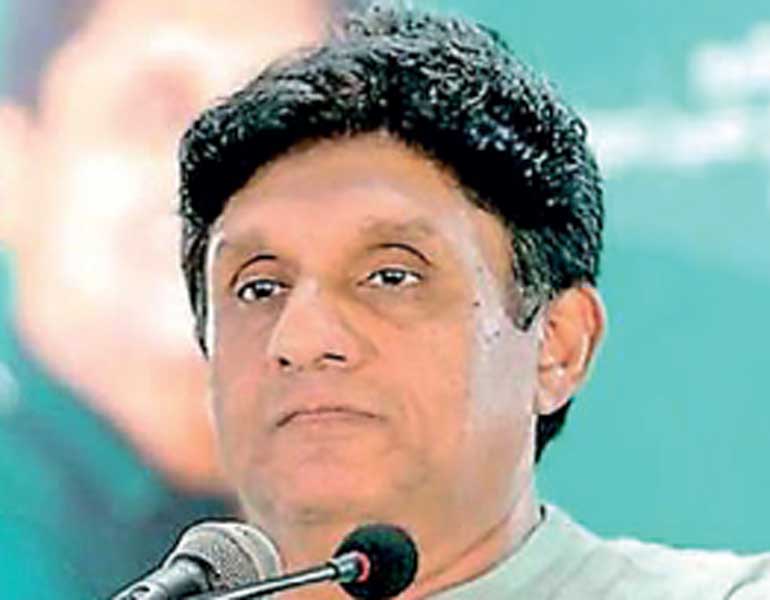
Opposition Leader Sajith Premadasa
Opposition Leader Sajith Premadasa yesterday accused President and Finance Minister Anura Kumara Dissanayake of abandoning Marxism for neo-liberalism. He charged that the 2027 Budget widens inequality, fails to draw foreign investment and offers no relief to farmers, small businesses or public servants.
“This is not a budget; it is a budget of sheer lies,” Premadasa told Parliament in response to the President’s Budget speech on Thursday.
Premadasa said income had shifted from the poor to the rich between 2019 and 2025. Real household income of the poorest 20% fell by 19.6%, while that of the richest 20% rose by 6.8%, he said, widening the average income gap between the two groups from 11.2 times to 14.8 times. He said the richest 20%’s share of income had risen to 55.8%, which he blamed on inadequate wages, soaring inflation and the erosion of living support. He tabled the survey in Hansard.
“The poor were made poorer, and the rich were made richer,” he said.
He said actual foreign investment in 2025 amounted to only $ 1 billion, while projects including the Merchants Logistics Hub, the Petronet Kerawalapitiya project and the Floating Energy Terminal had exited. He questioned how many MAS, Brandix and Hirdaramani factories, pioneers of the 200 garment factories program, had closed in Sri Lanka while those companies opened industrial zones abroad.
“Nothing is coming in; everything is outgoing. Everything is leaving,” Premadasa said.
He said the Government had failed to change the debt sustainability analysis (DSA) agreed with the International Monetary Fund (IMF), as promised in its manifesto “A Thriving Nation – A Beautiful Life”. He said Lazard, the firm that brokered the deal with international sovereign bondholders, had also handled restructurings for Ghana and Senegal, which secured better terms.
He took issue with the macro-linked Bonds in the deal, under which debt relief shrinks as economic growth rises.
“Then what incentive or motivation do we have as a country to increase the economic growth rate? As the growth rate rises, the amount of foreign debt we have to repay also increases. Lazard defrauded Sri Lanka,” he said.
He said there had been no debt restructuring for the 263,000 micro, small and medium enterprises (MSMEs) in distress in 2022, a number he said had since grown. The promised development bank for them had not been set up. The Government had suspended the parate law, which lets banks auction pledged property without going to court, but had not restructured MSME debt, he said.
On the digital economy, Premadasa said Rs. 28.5 billion had been allocated, but only five of 17 IT sector promises for 2026 had been delivered. He said the Digital ID promised for the third quarter of 2026 still had no contractor, though one was to be selected by March, and that the IT parks promised in Digana and Nuwara Eliya had not been built.
He said farmers were promised Rs. 150 per kg of paddy, but prices had fallen to a maximum of Rs. 95. He said the promised interest-free loans and price support through small and medium millers had not materialised, and that cultivation of big onions, potatoes, chillies, upland crops, fruit, export crops and upcountry vegetables had collapsed.
“You have not provided even an atom of support for agriculture through this budget,” he said.
Premadasa accused the Government of spending hundreds of billions of rupees of public money on thermal power at the expense of renewable energy, citing the Yugadanavi, Swabhadhanavi and Sahasadhanavi plants, and said the promised LNG had not materialised. He challenged the Government to name a single production industry it had initiated.
He said a World Bank report of October 2026 found that 60% of the country was poor, while the UNDP Multidimensional Poverty Report showed poverty had escalated severely. He said the Government and the Department of Census and Statistics wrongly used a blanket average of 2,030 kilocalories per person per day, when the Medical Research Institute showed needs vary by gender and activity. This error led to the claim that Rs. 17,742 a month was enough for one person, he said.
He said 1.5 million public servants were now treated as a cost by a President who had held them in high regard before the election. Farmers, once called gods and kings, had been branded kasippu (illicit liquor) brewers after the election, he said. He asked why the 15% interest on savings promised to senior citizens had not been granted, and said retirees’ core problems remained unresolved.
Premadasa said the Budget had no proposal for the promised 33% cut in electricity bills, and that pledges of a Rs. 1.2 million Vitz car, a Rs. 50,000 motorcycle and fuel at port landing prices had not been kept.
He said schools could not secure smart boards or computers, and the health sector faced severe shortages of drugs, equipment and staff. He asked what had happened to the promised fish-locating app and the plan to develop marine resources in the 200-nautical-mile exclusive economic zone. To stem the brain drain, he urged the Government to grant vehicle permits to professionals, including doctors, rather than to MPs.
Recalling the JVP-backed “Saradiel Budget” presented by Sarath Amunugama, which promised to take from the rich and give to the poor, Premadasa said the Government, now holding the presidency, a two-thirds majority in Parliament and most local authorities, had instead presented “a Muhammad Ali budget”. He described it as one that “strikes the stomach of the common man and the poor”.
He urged the Government to reject neo-liberalism and extreme Marxism and adopt “the middle path, social democracy, and the social market economy”.




