Thursday Oct 15, 2026
Thursday Oct 15, 2026
Thursday, 15 October 2026 03:49 - - {{hitsCtrl.values.hits}}
 The ugliness of what’s happening now, in peacetime, cannot be hidden behind the façade of law. Some years ago, there were two fascinating legal re-enactments, one the trial of Socrates and the other, those of Jesus Christ. Both re-enactments concluded that given the laws at the time, the sentences were legally valid though phenomenally unjust. Slavery, segregation in Southern US, and apartheid in South Africa were legal in their time. Humanity and history put justice above unjust laws
‘The magistrate had permitted Shiranthi to visit her doctor at Nawaloka Hospital on Thursday, but the prison’s doctor said they wouldn’t be able to allow her to go to a private hospital…’
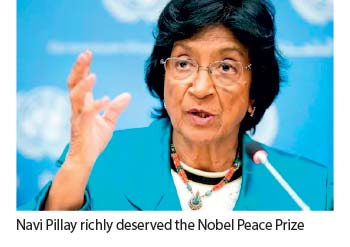
 Navi Pillay deserves the Nobel Prize for Peace because of the sincerity of her continuous, combative commitment to Human Rights, which made Nelson Mandela urge her to strive to be South Africa’s first non-white woman judge. She won the Nobel Prize because her juridical argumentation made the definitive case establishing Israel’s genocide against Gaza’s Palestinians.
My applause is despite her strong critique of Sri Lanka during the decisive diplomatic battle at the UN Human Rights Council in Geneva in May 2009. She opened that Special Session with a forceful video address on a big screen to the Council from the UN in New York, calling for “an international investigation”. Speaking immediately after her, it was my task as Sri Lanka’s Ambassador/Permanent Representative to resolutely oppose her call and persuade the Council. We prevailed, 29 to12. South Africa voted with us.
Our relationship had no animosity. Before I left Geneva, Navi Pillay hosted my wife Sanja and me to a farewell lunch. Her parting pronouncement was: “Ambassador Jayatilleka, during your term here you performed a great service for your country, but a great disservice to the cause of human rights”.
The way we were
 The Aristotelian term ‘ethos’ has come to mean the customary character, comprised of the constellation of morals, values, sentiments and guiding beliefs, of a community or collective entity.
The JVP took up arms unilaterally in 1971 and 1986. On neither occasion were its followers being killed by the State when it initiated warfare.
The State defeated the JVP militarily. After each rebellion and a number of years in jail, the surviving JVP leaders were released by the State.
JVP General Secretary Tilvin Silva who was incarcerated for participation in an armed attack on a high-value target, was among those released in 1994.
No Asian State has been so flexible and forgiving against those imprisoned for organised civil war. Despite the extra-judicial execution of Rohana Wijeweera who was responsible for the murder of Vijaya Kumaratunga among thousands of others, his wife and children were safeguarded, housed and educated under State auspices, by Sri Lanka Navy.
That was the bipartisan ethos of the Sri Lankan democratic State.
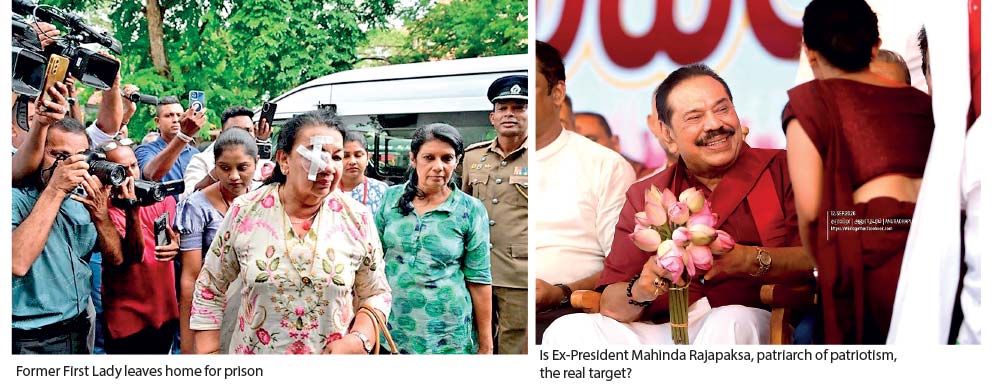
TV images of the 73-year-old former First Lady, who never had the reputation of a Madam Marcos, and stayed by the side of her husband President Mahinda Rajapaksa throughout the war, not knowing when he would fall victim to an LTTE assassin as did President Premadasa, Rajiv Gandhi and others, being bundled into a prison bus while wearing an eye patch after recent medical treatment in Singapore, demonstrates the huge difference between the ethos of the AKD-JVP-NPP dispensation and that of Sri Lanka’s State leadership since 1948.
The ugliness of what’s happening now, in peacetime, cannot be hidden behind the façade of law. Some years ago, there were two fascinating legal re-enactments, one the trial of Socrates and the other, those of Jesus Christ. Both re-enactments concluded that given the laws at the time, the sentences were legally valid though phenomenally unjust.
Slavery, segregation in Southern US, and apartheid in South Africa were legal in their time. Humanity and history put justice above unjust laws.
In 1983/1984, my father Mervyn de Silva interviewed President JR Jayewardene, which involved an exchange on the Referendum of 1982 (reproduced in his magazine and newspaper columns). JRJ emphasised that the Referendum was “legal”. Mervyn responded with “But was it legitimate?”. The answer was silence.
The law isn’t coterminous with either justice or legitimacy, both of which are held as higher values.
A law which allows prolonged incarceration even when a person has not been convicted of any wrongdoing and may never be found guilty of one, is questionable from the standpoint of justice, fair-play and legitimacy.
Moreover, the letter of the law must be observed without risking violence to the “spirit of the law”.
A law, the spirit and logic of which aim to punish egregious fraud of public funds (such as the Central Bank bond scam), shouldn’t be deployed as ‘massive retaliation’ for misdemeanours which warrant a slap on the wrist and a fine. One doesn’t use a legal cannon to swat a fly of an offense.
But then again, ‘overkill’, in its quite literal sense too, has been the JVP’s habit throughout its history. ‘Overkill’ proved the JVP’s undoing.
Code of Chivalry
On an island which holds four major world religions, there is a crosscutting, intermeshing, underlying sense of right and wrong, good and bad, that we are introduced to as children. This provides for a moral and ethical reflex that antedates knowledge of the letter of the law. It furnishes us with a basic sense of fairness and unfairness; indicates what one should be ashamed of and averse to. We develop a conscience.
We absorb or form a code of conduct: what’s done and not done; what’s honourable and dishonourable. This ‘code’, probably introduced by parents, is reinforced or modified by what is taught in school and university, as well as our exposure to literature, theatre and cinema, and examples we encounter.
The first book that the new State published in enormous numbers after the Cuban Revolution of January 1959 was a beautifully produced version of Don Quixote by Cervantes. This despite Karl Marx’s wry observation that the great novel revealed the impossibility of maintaining a noble, knightly code of chivalrous courage in an economy which was no longer medieval-feudal and had commenced transition to capitalism.
The values of chivalry and courage to ‘tilt at windmills’ were components of the code of conduct of Fidel Castro and Che Guevara. Fidel kept insisting that “one must be chivalrous even when fighting the most wretched of enemies” and attributed his ‘code’ to his Spanish Jesuit teachers. In his last letter to his parents, Che mentioned that he ‘can feel once again the ribs of Rocinante’ between his heels—Rocinante being Don Quixote’s skinny old horse.
‘Chronicle of a Death Foretold’
A leadership with the slightest sense of honourable conduct; of things decent as opposed to mean-spirited and vicious, would know that a 73-year-old former wartime First Lady being taken from her home, and a few hours later, bundled into a prison bus, just doesn’t sit right; is downright ugly. There is a huge difference between decisive and ruthless; strict and wicked; sternly and sadistic.
The Mafia had a code of not harming or taking hostage, wives, children and parents of rivals, but the Latin American drug cartels which came later don’t have such compunctions. The movie Scarface shows Al Pacino’s character Tony Montana, a Cuban deportee and gangster, angrily refusing to go through with the execution of the man designated for death by his Bolivian drug lord partner/patron, because the intended victim’s wife and kids had climbed into the car. Consequently, the cartel sends an armed band which executes Tony Montana by shot-gunning him in the back after he puts up a monumental gunfight.
Under the AKD-JVP-NPP ‘power-cartel’, the State isn’t circumscribed in the matter of permissible targets, even by the parametric code of the movie’s anti-hero played by Pacino. No relative is off-limits, as seen in the collective treatment of the Rajapaksas, including a wife, mother, and grandmother/grand-aunt.
AKD and his comrades seem ignorant of ‘soft power’; of moral and ethical hegemony, of the moral high ground. You don’t intrinsically own the moral high ground. You occupy it or not according to how your discourse, conduct and character are widely perceived by universal norms. Even if you hold power, if you lose the moral high ground, you lose power—as Gotabaya Rajapaksa did. But if you don’t have power and yet occupy the moral high ground, you eventually win.
AKD argues that all these persons are incarcerated because they are under investigation for various allegations of crimes according to existing laws. But proportionality is an indispensably crucial aspect of justice (as in Just War). Going by the Kalama Sutta, we must not rely on the authorities but ourselves inquire rationally whether the harsh treatment meted out to a septuagenarian former First Lady (and cardiac patient) is proportionate to the alleged offense. If not, we must question what really is going on.
Under the AKD administration, the target menu of ‘lawfare’ constitutes two concentric circles.
 The Rajapaksa family.
The war-winning/wartime establishment extending from the Rajapaksas through ex-military top brass, to the State’s Tamil allies Douglas Devananda, Karuna Amman and Pillaiyan.
Connect the dots, and it seems punishment is being imposed for having won the war, defeated Prabhakaran.
The object of all strategy being ‘the mind of the opposing commander’, it is deductively discernible who the ultimate target of all these exertions is: former president Mahinda Rajapaksa. Maverick MP Ramanathan Archchuna, medical doctor, speculatively raised in Parliament the likelihood that the legal witch-hunt against MR’s family and the shock of his wife jailed at Welikada could (intentionally) trigger a heart attack in Mahinda.
Mahinda Rajapaksa is being besieged, his wife taken away, incarcerated, maltreated (denied her regular eye-specialist) so as to break his spirit and hasten his final exit. Already not in the best of health, sadness could weaken MR further and end him through emotional attrition—heartbreak.
Does Mahinda really deserve what he is suffering emotionally and physically today, having liberated Sri Lanka from a thirty years war, reunified the island’s territory and restored peace and normalcy, not to mention vastly expanded the island’s infrastructure?
Is this what his family members—whatever their mistakes and misdeeds—deserve for standing by him throughout the war years of extreme daily danger? A suicide-bomber, truck-bomb or the LTTE’s fledgling air-arm could have killed or crippled not only Mahinda but also his family.
When making decisions that affect the lives of national personalities, especially aged ones, any fair, reasonable ruler or persons in authority should weigh such a person’s comparative merits and de-merits in the context of the larger role he/she played during one of the most extreme situations and existential crises of Lanka’s long, continuously chronicled history.
Mahinda was there for his country, for us, when we needed him. He did what five previous leaders including four Presidents did not or could not do after the emergence of the threat of armed Tamil separatism. History and future generations will pose the question: where were his country and its citizens when he was besieged and mentally tormented in his old age?
Will the psychological pressure and emotional torture that an old, visibly unsteady Mahinda Rajapaksa is being subjected to, be history’s record of the sense of gratitude of this State and nation?
To my mother’s chagrin, my father never objected to me venturing independent opinions here and overseas even as a boy (Prof Kumari Jayawardena used to amusedly recall me still in school shorts, declaring my preference for Engels over Marx) or questioning my elders and betters at public seminars. However, Mervyn also imparted the importance of respect—for outstanding people who had contributed to their fields or the country (e.g., Shirley Amerasinghe, Gamini Corea, Godfrey Gunatilleke, Pieter Keuneman, N Sanmugathasan, GVS de Silva, Neville Kanakaratne, MDD Peiris, Bradman Weerakoon).
AKD and colleagues have shown no respect, still less appreciation towards his outstanding predecessor Mahinda Rajapaksa whose achievement was historic, titanic.
A Fulbright scholarship winner who abandoned his doctoral studies with Immanuel Wallerstein, Giovanni Arrighi, Mark Selden and James Petras in an irresistible compulsion to turn theory into praxis when JR Jayewardene conducted a coercive plebiscite instead of the scheduled General Election, I returned to a PhD in Brisbane twenty years later, after my parents died. The field being political philosophy, I was co-supervised, with my principal supervisor a profound political theorist, Emeritus Prof John Kane whose works are on Moral Capital, Virtue and Power, and Leadership. My co-supervisor from philosophy, Jeffrey Minson, authored a book on Nietzsche and Foucault.
Jeff Minson’s studies led him to identify a crucial determinant which he specialised in over the next years: what the French call civilité, the quality of civility. Civilité is undermined by what Nietzsche denounced as ressentiment (resentment).
Resentment has always been the animating drive of the JVP. Barbarically murderous towards (handsome, charismatic) Vijaya Kumaratunga, what form does/will it take towards Namal Rajapaksa?
‘History Will Absolve Me!’ was Fidel Castro’s legendary defence speech after the defeat of the 1953 Moncada uprising . History has absolved Mahinda Rajapaksa and rendered him immortal in the nation’s history and collective consciousness. Will History absolve AKD and the JVP-NPP for their callous, cruel treatment of Mahinda Rajapaksa, the patriarch of patriotism?
Today’s legal ‘Great Terror’, non-lethal ‘legal guillotine’ and AKD’s angry, bitter rhetoric, recall Robespierre, whose weaponisation of ‘radical virtue’ and rampant guillotining of the old elite and moderate dissenters triggered such a backlash that he met the identical fate in a few years—the rollback ultimately enthroning ‘a man on horseback’, military hero Napoleon Bonaparte.
In a preponderantly Buddhist country, compassion is an esteemed value, not least in a ruler. What will be the sociopolitical ‘karmic’ consequence in this lifetime, of AKD’s absence of compassion?
Mao Zedong pronounced that not every death is of equal weight. Some are ‘as light as a feather’, while others are ‘as heavy as Mount Tai’. The death of a beloved hero who has served the people and the nation, is tragic and weighs like a mountain on the collective hearts of the people. When Mahinda dies, his death will weigh on the hearts of the people and nation as heavily as a mountain. By contrast, the downfall of “rulers and authorities”, and “wickedness in high places” (St Paul to the Ephesians, 6:12) may prove feather-light.
SJB’s situation
As Dilum Alagiyawanna’s Daily FT piece reveals, from 2020 to 2025, the SJB as party secured 23.90%, 17.66%, and 21.69% respectively. (https://www.ft.lk/columns/Beyond-coalition-arithmetic-Rethinking-Opposition-strategy-after-Aragalaya/4-798481)
That’s:
An average of 21.08%
A drop from 2020.
Stagnation in the 20% silo of the undivided UNP at the Feb 2018 Local Government election.
20%+ is the maximum ‘market share’ of UNP-SJB ideology.
The SJB’s self-imprisonment in the Ranil-UNP economic paradigm caused Sajith to snatch defeat from the jaws of victory in 2024, installing AKD-JVP rule and all its consequences.
Sajith’s loss by 10% each time (2019, 2024) results from the drag effect of his party’s ideology.
Sajith’s performance always betters his party due to a proto-populist ‘legacy’ element.
Sajith must mainstream his social-democratic ideology, in his party.
The SJB’s slew of victories at the Cooperative Society elections through ‘tactical voting’ and consensual leadership of a grassroots Opposition bloc is a viable strategic model.
Constructing counter-power in the public arena to countervail Government dominance in Parliament (as JR-Premadasa did through Satyagraha); battling for democratic space against the JVP-NPP’s authoritarian measures today, thereby enabling free elections in 2029, is the priority.
Never in history has a one-party dictatorship or threat of one, been defeated by one party/entity alone; only by a concert of diverse powers (WWII) or resistance movement of political parties and civic organisations.




