Saturday Oct 31, 2026
Saturday Oct 31, 2026
Friday, 30 October 2026 14:53 - - {{hitsCtrl.values.hits}}
By Madhuri Peiris
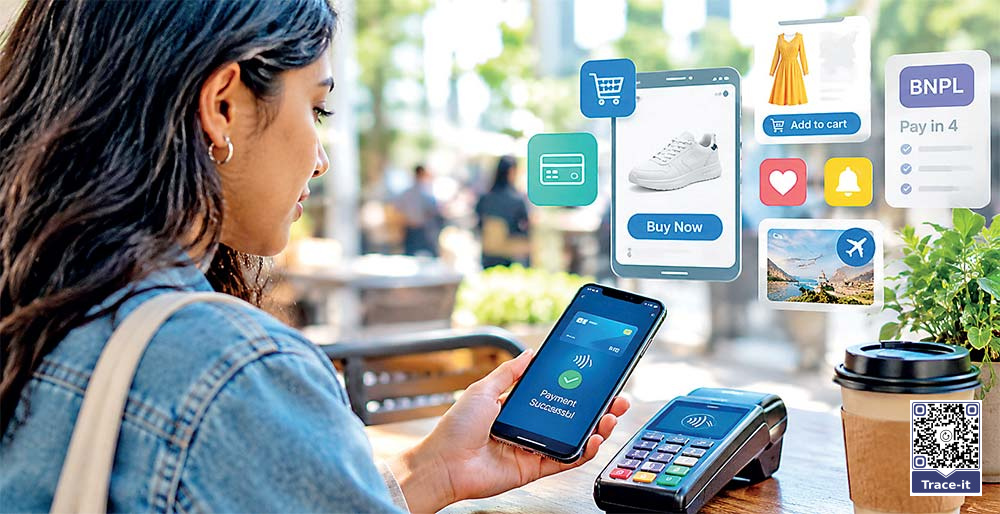
Think about the last time you bought something. Chances are you did not count out notes or watch coins leave your hand. You tapped a phone, pressed a button, or let a saved card do the work. The whole thing took about two seconds, and you may have forgotten it by the evening.
These transactions are wonderful in many ways. It is also changing how we feel about money, and most of us have not noticed.
When you hand over physical money, you feel it. The wallet gets thinner. You see the notes disappear and you stop, even if only for a moment. Researchers who study spending behaviour have long suggested that people tend to part with money more freely when it does not feel real. Paying by card or phone removes that small pang of loss, which psychologists sometimes call the pain of paying.
Digital payments take that idea further. A tap on a screen feels almost weightless. There is no counting, no change, and no moment to reconsider. The money simply moves, and the numbers in your banking app are the only reminder.
Online shopping has simplify the process down even more. Saved card details, stored addresses and a single “buy now” button mean the distance between wanting something and owning it has nearly vanished. Not long ago, a purchase meant travelling to a shop, looking for it, queuing and paying. Each step gave you a chance to change your mind. Now those chances are gone.
Add targeted advertising and the picture gets more interesting. Look at a pair of shoes once, and for the next week they follow you across every app and website. The advertisements are not random. They are built from your habits, your searches, and your moods, and they appear at exactly the moments when you are most likely to say yes. Late at night, after a stressful day, or while scrolling out of boredom, a tempting offer is never far away.
Buy-now-pay-later services have grown quickly around the world, and they are especially popular with younger shoppers. The idea sounds harmless. Split a purchase into small instalments, often with no interest, and enjoy the item straight away.
The problem is psychological. A price that feels heavy as a single payment feels light when it is cut into four or six pieces. People start saying yes to things they would normally have skipped. Because each instalment is small, it is easy to lose track of how many are running at once. A few pending payments here and a few there, and suddenly a large part of next month’s income is already gone.
Missed payments can bring fees and damage to credit records in some countries.
Young adults have grown up with phones in their hands. For them, digital payment is not a new feature but simply how money works. That makes them comfortable with technology, but it also means they have had fewer chances to build the natural feel for money that earlier generations picked up at the shop counter.
Social media adds another layer. Seeing friends travel, eat out, and buy the latest gadgets creates pressure to keep up. Influencers promote products as part of everyday life, and the line between advice and advertising can blur. It is no surprise that many younger people report feeling anxious about money, even when they earn a steady income.
The good news is that technology is not the enemy. Digital payments are safe, fast, and convenient, and nobody needs to give them up.
Check your balance often. A quick look at your account every day or two keeps the numbers real. Surprises are far more painful than regular check-ins.
Wait before you buy. Try a simple rule. If it is not essential, leave it in the basket for 24 hours. Many purchases lose their appeal overnight.
Remove saved card details. Typing in your card number takes thirty seconds, and that short delay is often enough to make you think twice.
Turn off tempting notifications. Unsubscribe from promotional emails and limit shopping app alerts. You cannot be tempted by an offer you never see.
Treat instalments like debt. If you use buy-now-pay-later, write down every plan and its due dates. Ask yourself whether you would still buy the item if you had to pay the full price today.
Set aside savings first. Move a fixed amount to savings as soon as your income arrives. Spend what remains instead of saving what remains.
Use spending limits. Many banks and apps let you set monthly caps or category alerts. Let the technology help you instead of working against you.
Try an occasional cash week. Using physical money for a few days can remind you what spending really feels like.
Beneath all the apps and offers sits a simple question. What do you want your money to do for you? For some people it is security. For others it is travel, a home, a business, or time with family. When spending happens automatically, it can drift far away from those goals without us noticing.
The way we pay will keep getting faster and smoother. That is not something to fear, but it does call for a bit more awareness from all of us.
You do not have to give up your phone or go back to carrying heavy wallets. You only need to slow down at the right moments, keep an eye on where your money goes and remember that every tap represents something you worked for.




