Thursday Nov 12, 2026
Thursday Nov 12, 2026
Thursday, 29 October 2026 09:21 - - {{hitsCtrl.values.hits}}
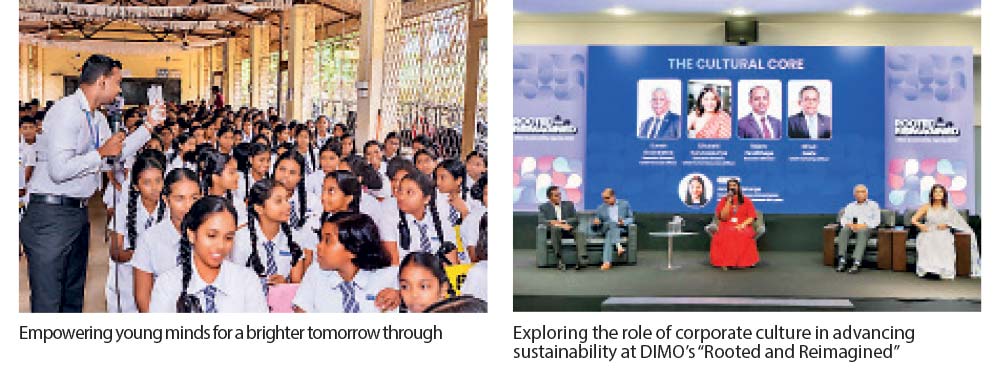
 The future of business will be shaped by its ability to create enduring value in a world of changing expectations, finite resources and interconnected challenges. Financial performance remains essential, but long-term success also depends on how organisations anticipate change, manage their environmental and social impact, and strengthen the ecosystems within which they operate. Sustainability has therefore become a strategic consideration that influences how businesses innovate, invest and prepare for the future.
For DIMO, this perspective carries particular significance. As a diversified conglomerate operating across sectors that support everyday life and national development, its decisions influence a broad network of customers, employees, business partners and communities. This reach creates an opportunity to advance progress through the solutions it delivers, the capabilities it develops and the partnerships it builds.
DIMO’s Sustainability Agenda 2030 provides a common direction across three interconnected pillars: Being a Resilient Business, Conserving a Living Planet and Creating a Resilient Community. Together, they connect commercial resilience with environmental stewardship and social progress, recognising that each strengthens the conditions for the others to thrive.
As World Sustainability Day renews attention on the choices shaping the years ahead, DIMO’s vision to become a role model for sustainability in the corporate sector helps shape its distinct approach to long-term value creation. This approach embeds sustainability into strategy, its business model, capital allocation and decision making. Operational compliance is underpinned by globally recognised International Organization for Standardization (ISO) standards, supporting consistency and discipline across business units. Defined targets and performance measures help translate this direction into accountable action.
Being a Resilient Business: Aligning Growth with Lasting Value
Business resilience requires the ability to anticipate emerging risks, respond to changing markets and invest in solutions that remain relevant over time. DIMO’s approach brings together sustainable entrepreneurship and innovative product design, ethical business conduct, and sourcing and circularity.
A defining ambition is to generate 50% of total Group revenue from sustainable products and services by 2030. These include offerings that deliver environmental, social and economic benefits through energy and water savings, reduced greenhouse gas emissions, responsible material use, sustainable disposal and the protection of public health.
In 2025/26, sustainable products and services accounted for 47% of DIMO’s revenue, compared with 27% in the previous year. The increase was largely supported by passenger vehicles, demonstrating how the composition of the business portfolio influences progress towards sustainability objectives.
DIMO supports this direction through Key Performance Indicators and internal evaluation frameworks, including its Business Sustainability Scorecard, which helps assess businesses and inform acquisition decisions. Its Supplier Code of Conduct extends expectations for responsible and ethical practices across the supply chain, while a Risk Management Framework overseen by the Board Audit Committee connects financial, strategic and ESG risks.
Across its portfolio, DIMO is developing opportunities in renewable energy, electric mobility, technologies that improve energy efficiency and water infrastructure. Its solar operations reported generation of 23,786 MWh in 2025/26, alongside ground-mounted capacity of 30.8 MW and rooftop capacity of 590 MW. Battery Energy Storage Systems further support its contribution to energy infrastructure and grid resilience.
By connecting commercial opportunity with resource efficiency and essential infrastructure, DIMO seeks to strengthen its competitiveness while supporting Sri Lanka’s economic transition.
Conserving a Living Planet: Managing Impact and Restoring Ecosystems
A resilient economy depends on healthy natural systems. DIMO’s Conserving a Living Planet pillar addresses this relationship through two complementary priorities: minimising its operational footprint and restoring and enhancing ecosystems.
Under its Sustainability Agenda 2030, DIMO has adopted science-based decarbonisation targets covering all three scopes of greenhouse gas emissions. Against a 2024/25 baseline, these include a 42% reduction in Scope 1 and 2 emissions and a 51.6% reduction in Scope 3 emissions per unit of LKR value added by 2030.
This approach considers direct emissions, purchased energy and activities across the value chain, such as freight, commuting and procurement. Solar energy, electric mobility and building technologies that improve energy efficiency form part of the wider response, connecting operational improvements with solutions available to customers.
Water stewardship and circular resource use are equally important. DIMO aims to reuse 100% of treated wastewater across industrial facilities and workshops by 2030. Reported reuse of treated water stood at 22.96% in 2025/26, identifying both progress and the further work required to achieve this ambition.
Its zero-landfill commitment focuses on waste segregation, reuse, recycling and responsible partnerships. Four primary facilities, namely Head Office, DIMO 800, Weliweriya and Siyambalape, achieved Zero Waste to Landfill certification from Control Union Inspections (Pvt) Ltd, diverting 99.87% of operational waste away from landfills. Across reported waste management activities in 2025/26, 50% of waste was reused, 46% recycled and 4% directed towards energy recovery.
DIMO’s environmental agenda also recognises the importance of restoring natural capital. Its 1:1 restoration commitment aims to rehabilitate or restore one hectare of natural ecosystem for every hectare occupied by its physical infrastructure. The reported biodiversity restoration footprint reached 38.03 hectares in 2025/26, compared with 27.03 hectares in 2024/25.
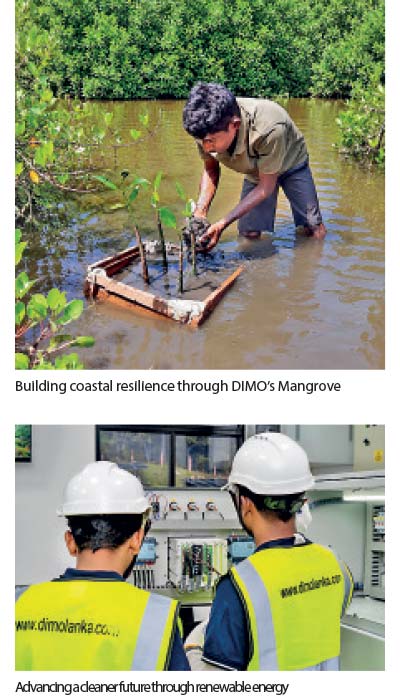
Conservation initiatives include supporting the LIFE project at Kanneliya as a fertiliser partner, mangrove restoration in Galle, invasive species management in Lunugamvehera National Park and the longstanding turtle conservation project in Panama. Together, these efforts extend environmental responsibility from resource management to the protection and recovery of ecosystems.
Creating a Resilient Community: Building Capability and Opportunity
Sustainable progress requires people to have the capabilities, opportunities and support to participate in it. DIMO’s Creating a Resilient Community pillar encompasses employee wellbeing, meaningful employment through diversity, and partnerships that help communities thrive.
Within the organisation, employee development supports both individual advancement and business adaptability. Initiatives such as the DIMO Nature Club encourage awareness, volunteering and responsible action, while Powerfully You and Employee Resource Group conversations help address barriers to inclusion.
DIMO aims to achieve 40% representation of women in decision-making roles by 2030. Representation stood at 19% in 2025/26, compared with 15% in 2024/25. Developing women in nontraditional technical fields forms part of its efforts to broaden participation across engineering, automotive and other business disciplines.
Beyond the workplace, DIMO is working towards creating a positive impact on one million individuals by 2030 through workforce and community action, customer engagement, and youth and educational partnerships. Reported community impact reached 58,887 individuals in 2025/26, compared with 34,734 in the previous year.
Education and vocational development are important pathways towards this ambition. The DIMO Academy for Technical Skills strengthens access to practical training and meaningful careers, while Lassana Hetak supports education and the wellbeing of future generations.
Through the Lassana Hetak power tool training initiative, DIMO partnered with the Vocational Training Authority to reach 415 students, with female participants accounting for 40%. The Divi Eliya programme also reached more than 277 electricians through sessions in Anuradhapura, Polonnaruwa, Batticaloa and Ampara, strengthening technical knowledge, safety and service quality.
DIMO’s contribution to community resilience also extends through its infrastructure expertise. In Kilinochchi, a water treatment facility with a capacity of 4,500 cubic metres per day strengthens access to safe drinking water and supports essential infrastructure in the Northern Province.
These initiatives connect social progress with DIMO’s capabilities, helping build skills, improve access to essential services and create opportunities for lasting participation in the economy.
A Shared Direction Towards 2030
DIMO’s three sustainability pillars establish a shared direction for how the organisation grows, allocates resources and measures progress. A resilient business creates the capacity to invest in people and environmental protection; functioning ecosystems support economic continuity; and capable, inclusive communities strengthen the foundations of future growth.
The journey towards 2030 requires continued investment, consistent execution and accountability for results. Guided by its purpose of “Fuelling Dreams and Aspirations”, DIMO is connecting its commercial capabilities with these wider responsibilities.
For Sri Lanka, the transition towards a greener and more inclusive economy will depend on businesses translating their commitments into sustained action. Through its Sustainability Agenda 2030, DIMO seeks to contribute to that transition by creating value that strengthens industries, supports communities and preserves the natural systems on which future prosperity depends.




