Thursday Oct 22, 2026
Thursday Oct 22, 2026
Wednesday, 25 March 2026 00:22 - - {{hitsCtrl.values.hits}}
 It is tempting – and dangerously so at that – to think that wars fought in distant deserts over faraway skies will remain there forever. That the flames consuming West Asia for over three weeks will flicker out before the embers of a conflict which is clearly not of our making drift over the Indian Ocean Region (IOR). And despite the trumpery – er, temporary – truce.
But history has never been so obliging, or blasé, or based on the whims of madmen; or worse, fools. Conflict has carte blanche over sovereign territories: it travels where it pleases. Wars migrate along trade routes, energy corridors and geopolitical fault lines. And of late it has been inching – and in one shocking case crashing down like a bolt from the blue – towards home waters.
The most arresting development of late is not merely the escalation of hostilities between Israel and Iran, nor even Washington’s mixed messaging on the duration of the war until POTUS called a halt because his British, Japanese and European allies won’t play ball on his side. It is something structural and far more scary: the extension – real and demonstrated – of Iran’s ballistic reach into the IOR theatre. And in case there is a resumption of hostilities, it is a red flag.
That recent (albeit aborted) strike towards the joint US-UK military (naval support) facility in Diego Garcia signalled an ominous redrawing of the conflict’s map. No longer confined to the Levant or the Persian Gulf, the war was probing outward – testing range, resolve and reaction time. It could again.
This is how wars widen their reach to embrace erstwhile non-combatants in the deadly grip of fear, anxiety, panic. And knee-jerk responses. Not always with declarations of intent, but often by insidious deployment of previously unsuspected arsenals.
A region rewritten by range
For centuries, in fact for over a millennium and a half, the Indian Ocean has been framed as a commercial commons – a highway for spices and other treasured commodities, a theatre for trade, and constantly a chessboard for great-power rivalry.
Today, it is poised on the cusp of a sea-change into something rich and strange: a kinetic extension of a Middle Eastern conflict into a troubled maritime theatre close to our home.
 If Iran can threaten enemy installations as far afield as an atoll in the Chagos Archipelago, then every coordinate in the surrounding maritime grid acquires dangerous new significance. Ports, bases, refuelling stations – be they military or civilian or mixed-use – become potential targets, or bargaining chips in the game of oil and fire playing out in a theatre near you.
The Strait of Hormuz, already the world’s most critical energy artery, became not just a vital chokepoint in a valuable corridor but a critical valve – one that can be opened selectively, constricted strategically, or shut altogether. And Iran holds the keys.
It was clear that the Islamic Republic had begun to practice precisely such a canny strategy. Not a full blockade, but a calibrated throttling of energy flows. And it is a tactical move that is drastically affecting Asian economies, as fuel queues – and impending shortages – across the world’s most populous continent indicates. In a world wobbling between a previously tenable bipolarity and a presently tenuous multi-polarity, one that is coalescing every moment, oil in and of itself becomes a weapon of alignment in a war of attrition.
Meanwhile, Israel’s continued strikes against Iranian infrastructure – and of late, seemingly independently of American imperatives and the US-led attack on the Islamic Republic – ensure that escalation remains not nominally a risk, but rather a rhythm drawing more dancers into the tattoo of war. Simultaneously, Tel Aviv was feeling the heat as Tehran retaliated substantially, inflicting severe damage in yon cities of the Jewish Levant.
Now at a theatre near you
There is a persistent myth in Colombo’s strategic geopolitical imagination: that Sri Lanka is too small to be entangled, too peripheral to be targeted, too neutral to be pressured. It is a comforting fiction that threatens to unravel unless we can walk the increasingly taut tightrope with a clearer head and a better balance. Despite the ceasefire. Because of the ceasefire.
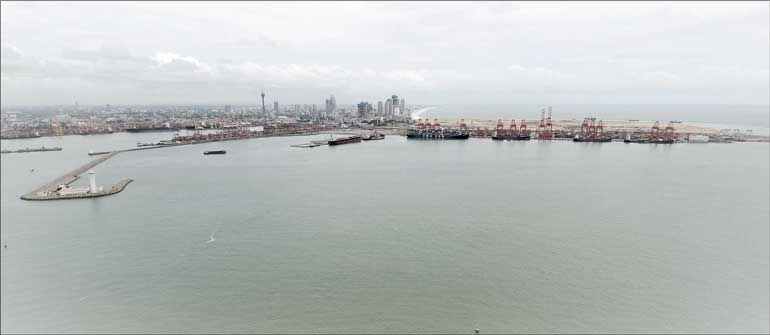
The so-called Pearl of the Indian Ocean – or in a more human image, a teardrop slipping off the mother continent’s hung face – sits astride some of the busiest sea lanes in the world. It is also, interestingly and alarmingly, within operational proximity of Diego Garcia. It is economically fragile, energy dependent and diplomatically exposed. It is just the type of small nation-state that feels the shockwaves from someone else’s war first... and maybe hardest.
 Oil prices are the most immediate mechanism of transmission. Even modest disruptions in Hormuz flows can trigger price spikes that Sri Lanka – still recovering under an IMF program – can ill-afford. Inflation will rise, the Rupee will wobble, fiscal discipline will fray.
Then there is the matter of strategic pressure. Colombo’s decision last week to deny the US military access to Mattala Rajapaksa International Airport while previously having accommodated an Iranian naval presence – however humanitarian its framing may be – placed it in a delicate position. And Uncle Sam, though mercifully at bay now, is also mercurial.
Neutrality in these nerve-wrackingly tense times for geopolitical manoeuvring and safe passage is not merely actively declared and passively received; it must be perceived, appropriated and tangibly felt. And perception, in geopolitics, is often shaped by those with the loudest voice, longest memories and lamentably short tempers.
Should the Indian Ocean theatre heat up in any resumed hostilities, Sri Lanka may find itself courted, coaxed, cajoled or quietly coerced again – asked not to choose players in The Great Game, but permissions: for airspace, ports and docking rights, and the reservation of silent cooperation or collusion. And then come the markets. Already as jittery as a cat on a hot takarang roof, global capital does not always distinguish between proximate and peripheral risk. It simply flees faster than that kitty with the neighbourhood watch-dog on its skittering heels. For a frontier economy such as Sri Lanka is today, that means higher borrowing costs, reduced inflows, and a recovery plan that is perpetually at the mercy of events far beyond its control.
The next steps
First, Sri Lanka must move from mere rhetorical neutrality to more operational clarity. This means articulating – and consistently enforcing – a principled and transparent policy on military access, port calls, and logistical support. Ambiguity invites miscalculation, and inconsistency invites suspicion, to say nothing of enemy action where one ship is a coincidence, and two happenstance. And yet, we were only following international law. Doing our duty.
Second, energy security could well become a national obsession – and not in the sense of dawn patrols in fuel queues longer than the political career of ‘Bibi’  Netanyahu. Diversification and development of alternate energy sources are no longer a growth oriented aspiration but a strategic imperative. So Sri Lanka must accelerate renewables, build reserves and expand LNG options. Every barrel of increasingly dear – in every sense – crude oil (now admittedly slumping after US’s trumping) which is not imported is a measure of some sovereignty and independence regained.
Third, Colombo would do well to deepen its engagement with regional powers – India particularly, but also again China – while maintaining open and cordial channels with all Sri Lanka’s swains and her stakeholders, including tea-drinking Iran and apparel-importing USA. The goal is not balance for its own sake, but a built-in redundancy in relationships. When one channel or strait closes, another conduit must remain open. Fourth, Sri Lanka may well consider positioning her island nation as a neutral convening space –for dialogue, for humanitarian coordination, for de-escalation efforts. This is not idealism or over-reach; it is strategic branding and a timely reassumption of the respected place the tiny republic once commanded in the corridors of regional power. In a rapidly repolariSing world, a neutrality and non-alignment such as we have practised may be judiciously coupled with a renewed vigour as a nation-state with a backbone as well as a top brain. And in the days of the truce left, Colombo may pause to reflect on why – in the clear invasion of its exclusive economic zone (EEZ) by a foreign power to hole and sink a rival’s frigate – it did not do more with the potential powers vested in it. Namely, its moral leadership of the then influential Non-Aligned Movement (NAM), which championed the security of the so-called Zone of Peace in the IOR as far back as 1971, at the 26th sessions of the United Nations General Assembly (UNGA).
Fifth, economic buffers would best be strengthened in the interim in which world oil prices slump ahead of Sri Lanka’s automatic fuel-pricing formula kicking in. Building fiscal resilience, securing contingency financing and preparing for capital volatility are key. The next shock – after a long litany of woes from our own protracted war, through a devastating tsunami and sociopolitical turmoil of decades, to which injury was added the insult of bankruptcy and the unkind cut of Ditwah that traumatised a slowly recovering wound – is not a case of if, but when. One hopes not, but remains prepared, I pray...
Fate, karma, chance – or choice
The truth be told, there is a reality in the final analysis that few will essay or speak out aloud. Sri Lanka does not control its destiny in this – or any other – crisis. But it  does control how exposed and vulnerable it chooses to be. And how instrumental a role it could play in IOR peace and stability, possibly usurping a neighbouring big brother in terms of keeping an eponymous ocean safe from conflict’s fiery fallout?
Wars do not need to arrive on our shores or rain down from darkening skies to devastate us. They arrive in oil prices, in bond yields, in diplomatic cables requesting ‘temporary access’ or ‘routine coordination’. They arrive in the quiet erosion of choice.
And so the question is not whether Sri Lanka can remain steadfastly neutral. It is whether even a principled neutrality such as ours, in a world overshadowed by the vagaries and vicissitudes of war, is still a place to stand and a tenable position to take... or simply a posture.
If the missiles can reach Diego Garcia, they can reach Diyawanna, and they can breach the idea that we are safely out of range.
And not all the tea Iran will buy from us, nor all the oil they promise to supply on Sri Lankan ‘demand’ – as the Islamic Republic’s ambassador said a few days ago, or all the helicopters the US ferries across to bolster our fleet or stroke our egos, will change that.
(The author is the Editor-at-large of LMD, and has a Post-graduate Diploma in Politics and Governance)