Thursday Oct 22, 2026
Thursday Oct 22, 2026
Thursday, 19 March 2026 03:55 - - {{hitsCtrl.values.hits}}
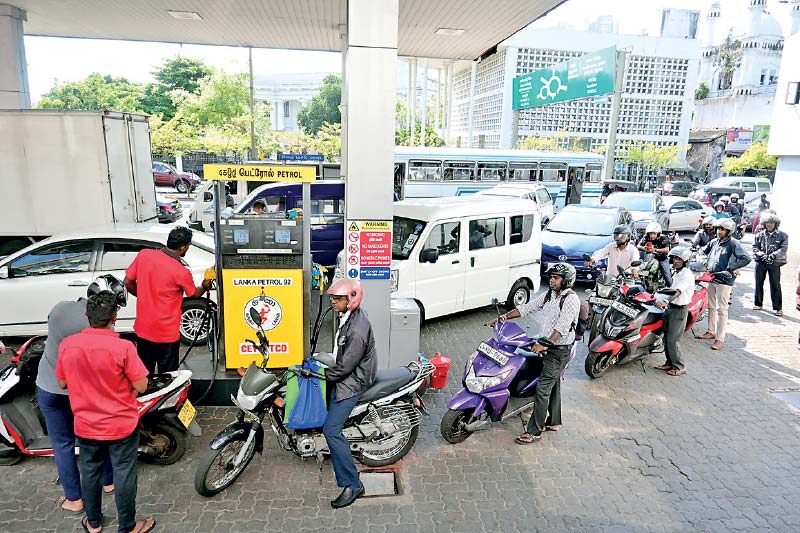
The petroleum factor is the most powerful constraint in the game of oil being played. Motorists in Sri Lanka queuing up for fuel now provided via the QR Code system – Pic by Sameera Wijesinghe
 The questions on our minds these days are manifold. They range from the practical to the philosophical. Where did the good years go? Will fuel stocks be sufficient, despite/because of the fuel quota? And is there a blessed end in sight to this wretched war that arguably heralds a desperate empire in decline?
A US-Israeli war on Iran – or is it another game of oil and fire to choke China and Russia? – has a current strategic shape that holds out some hope in regard to the end of a conflict. Some have characterised the ongoing conflagration as verging on WWIII while others have downplayed it as business as usual: the pursuit of geopolitics by whatever means feasible for a superpower.
This round of a bout that’s been in the making since MAGA came to the fore Stateside began on 28 February 2026, when and since when coordinated US-Israeli strikes targeted Iranian leadership; military facilities; and sadly, shockingly, civilian targets.
While Iran responded with missile and drone attacks on Israeli and US bases, as well as strikes on Gulf infrastructure, the disruption of shipping through the Strait of Hormuz brought other global players into the game.
This latter development halted tanker traffic through one of the world’s most strategic energy corridors, pushing the amplitude button in the Islamic Republic’s cause and dividing the world into sundry ‘us’ and ‘them’ camps: combatants and observers, consumers and suppliers, conspiracy theorists and the straight-laced, the moral right wing and maverick liberals, et al.
A lens through which to view the hybrid war is as a larger game with four primary theatres: Israel vs Iran (missiles and air power); Iran vs US forces (bases and naval power); Iranian proxies vs Israel (Hezbollah, militias); and economic warfare via oil and shipping disruptions.
A time to cease
From the perspective of military balance per se, it might appear that the war cannot last too long, for a concatenation of reasons.
There is, first and foremost, the US-Israeli advantage. Their joint air and naval supremacy, long-range strike capability, missile defence systems, cyber and intelligence domination have seen thousands of Iranian targets being struck already, repeatedly, crushing both civilian spirit and the Iranian military’s backbone.
Iran’s counter-strategy, it would seem, cannot defeat the US and/or Israel conventionally. Instead, the Islamic Republic relies on asymmetric escalation. Ballistic missiles and drones, proxy forces, attacks on energy infrastructure, disruption of global shipping by dint of mines – this attempts to raise the cost of the war internationally, rather than win militarily. An analogue of the game going on after ‘checkmate’ (Persian, ‘shah mat’: the king – the old ayatollah – is dead...).
Current reportage, at least in the western media, suggests Iranian strike capacity may already be decimated, especially according to US military intelligence (if that’s an oxymoron, you know why). So the war is unlikely to become a long conventional campaign. Instead, it will resolve through political pressure once escalation costs become unbearable for all principal actors and their sponsors and stakeholders.
A game of oil
The petroleum factor, meanwhile, is the most powerful constraint in the game of oil being played. For a watching world, the most decisive pressure point is energy. About 20% of global oil supply passes through the Strait of Hormuz, which has already been disrupted by Iran’s blockade of their home waters channel.
Its consequences are already visible – oil prices above $100 a barrel, global production cuts and shipping disruptions, perhaps even widespread strategic reserves releases. And analysts warn that this may become the largest supply disruption in oil markets. Some estimates suggest Gulf output reductions will exceed 10 million barrels per day, and that markets could hit $200 if the crisis persists and Iran plays the game in a particularly strategic way to finesse an early ceasefire.
This matters because the global powers (Europe, China, India and Japan) cannot tolerate a prolonged disruption. They will pressure both sides into a precipitate de-escalation. That historically, wars threatening the Hormuz chokepoint have been brief and heavily mediated must instruct analysts and intelligence operatives alike.
The game of fires
Riding roughshod over battlefield considerations are domestic political timelines in the respective home countries.
Firstly, the US political system strongly limits the duration of long-drawn-out wars. Pressure points include Congressional oversight, financial costs to American businesses and government, global economic fallout hitting citizens Stateside. If energy markets destabilize the global economy, Washington may push towards an ‘operation concluded successfully’ narrative quickly. And if so, the expected tolerance window is 4-8 weeks of high-intensity operations in the Middle Eastern theatre.
Secondly, as regards Israel, its goals are narrower than those of its principal ally, pal or play thing – take your pick, Epstein dimension players especially. Tel Aviv’s hawkish approach is to destroy Iranian missile infrastructure, degrade its putative nuclear programme, and weaken regional command networks. Once these are achieved or plausibly claimed, Israel can declare strategic success. A plus for its pursuit of peace in the Levant and the right to self-exist is that historically, Iran has rarely sought open-ended wars with Israel itself.
Iran’s own leadership calculus differs from this equation. It must show resilience to the Great Satan and his diabolical allies; retaliate symbolically; and avoid regime collapse or internecine warfare between religious and military camps, leading to a possible putsch, triggering America’s desired regime change without a fight. So Iran’s likely endgame is survival plus deterrence restoration, not any military or moral victory as such.
Apocalypse postponed
Like death as the rider on a pale horse, proxy dynamics rides in to play the wild card. Simply put, this means that the war widens if Hezbollah opens a full new northern front for Israel to fight on, Iraqi militias escalate, and Gulf infrastructure collapses like a pack of jokers.
However, proxies appear to be operating at limited levels so far, likely due to regional pressure; and if they remain contained, the war will be short.
Adding a hefty charger to the horsemen of the Apocalypse is the application of global diplomatic pressure. At present, major actors pushing for de-escalation (in their own best national interests, no doubt) include China (energy supply), India (oil dependence), EU (economic shocks), and sundry Gulf monarchies (fear of regional instability and home grown rebellions).
Because the economic stakes are enormous, and perilous for a planet where rogue AI and the spectre of an unprecedented nuclear holocaust haunt the event horizon, intense diplomacy is already underway.
Offering cold comfort in all of this are historical analogues from which interpreters can draw to trump doomsday prophets. Comparable conflicts of the past intimate that this conflagration, too, would not last longer than tenable for principal players or bearable for oil-dependent nation-states.
The sporadic Iran-Israel shadow wars, for instance, were largely episodic, lasting days or weeks. In 2025, a slightly more sustained Israeli-Iran war took 12 weeks to sizzle out. And a generation or two still alive would recall with mixed feelings that the Gulf War of 1991 was over in a short six weeks.
The present conflict resembles Gulf-War-style high-intensity campaigns, not protracted conflict or multi-year wars. For this shade of relief, ye gods and little fish, many thanks! The days are hot and long, and the world needs some succour.
A time to phase out
The most likely timeline may well rehearse a so-called ‘scenario model,’ as follows:
In Phase 1, which we may call ‘shock and escalation’ (28 Feb 28 to mid-March), there were US-Israel strikes, Iranian retaliation, oil disruption. Phase 2, ‘military culmination’, may last from mid-March to early April, seeing Iranian missile capability degraded, proxy escalation peaking, and global economic panic intensifying.
In Phase 3, or a negotiated pause between late March to mid-April, there may likely be welcome mediation by the Gulf states, EU or China, as well as probable back-channel US-Iran talks, resulting in a de facto ceasefire. Phase 4, though, could bring on frozen conflict from April onwards, with sporadic strikes, sanctions and covert operations, as well as extant but possibly dwindling maritime tension.
End game
In the game of oil and fire that is going on, the probability estimates – spurious as they may be – are somewhat reassuring, if that is in fact the right adjective? A short war of three to five weeks will see the military conflict end in late March – a middling prospect, but quite high. A short to medium term conflict of between six and ten weeks will have an end to hostilities in late April to early May, a mid to high possibility. The likelihood of regional escalation up to mid-2026 is mid to low, all things considered. And the horrors of a full-scale open-ended regional war are low to very low, some analyses suggest.
Now to the other question: is the announcement of staggered power cuts the next in the queue?
(The author is the Editor-at-large of LMD, and has a Post-graduate Diploma in Politics and Governance)




