Tuesday Sep 15, 2026
Tuesday Sep 15, 2026
Thursday, 5 March 2026 02:37 - - {{hitsCtrl.values.hits}}
 Sri Lanka also would do well to watch, learn and resist the temptation to project our very personal hopes and aspirations on to other people’s wars. And becoming ‘the next Dubai’ is not a matter of waiting for someone else’s misfortune to materialise our own pot of gold at the end of a rainbow in the desert. But rather, we must work diligently and conscientiously to rectify our own manifold ‘mistakes made’
 When the United and Israel flex their military muscles against Iran, the world divides itself with practised precision: those who exclaim, “About time!” – and those who sigh... “Not again?”
The question ricocheting from Washington to Wellawatte is disarmingly simple: ‘Does Iran have a nuclear weapons program?’ Or is it the ghost of another question that haunted us not so long ago: ‘Did Iraq have weapons of mass destruction?’
We know how that blockbuster ended: with a whimper, after all the big bangs. The props were impressive and the special effects were spectacular – but the script and characterisation were far less so.
“Mistakes were made,” muttered Uncle Sam, in the dismal aftermath of laying waste to some prime acres in the Middle East. And as Baghdad burned way back in 2023, the world woke up to the realisation that ‘military intelligence’ can be quite an oxymoron. The self-appointed “world’s policeman” had blundered, and blotched its copybook to say nothing of misplacing the search warrant for WMDs.
And so we return to the present, where dossiers are dusted off – including the enigmatic Epstein files, elusive missing pages into the bargain. Meanwhile, from Tehran to Tel Aviv, satellites swivel in hostile skies, drones home in with deadly precision, and the rhetoric rises with the desert dust in every theatre of this drearily wearying war.
On the one hand – if Iran is, indeed, inches away from its nuclear Rubicon, the pre-emption of the Western powers and their Levantine ally will be hailed as prudence. On the other hand if the allegations of Israel echo but hollowly when the dust settles on the road to Darkhovin, history may have to add another footnote to the imperialist doctrine of ‘fire first, apologise perhaps later’.
UAE
Meanwhile, closer to home – or at least, nearer to our remittance streams – some Sri Lankans in Dubai and sundry outposts in the United Arab Emirates post serene skylines and stoic assurances on their social media streams: “All good here, no major issue.”
The malls are still open. The brunches are bountiful. The Burj still pierces the sky with enviable indifference. Do official news channels tell a different story? It must be propaganda, there’s no nailing the native narrative to a doomsday agenda!
Yet, drones and missiles have a way of puncturing more than airspace, and geopolitics has a perverse way of turning safe havens into front line disaster zones. The wider swathe of Emirati – and Saudi – territory sits within a volatile neighbourhood where ideology, insecurity and oil mix like a latter-day Molotov cocktail on steroids. Safe is a relative term. So they are stable and secure.
If the increasingly damaging exchange of hostilities between Iran and its adversaries escalates, the Persian Gulf’s aura of volatile invulnerability could be pierced by more than Patriot missiles. It could be punctured by the breaking of a long, peaceful and yet precarious dream that was the more prosperous GCC countries.
Into this uncertainty flies a familiar Sri Lankan fantasy. If capital flees the Gulf, it will surely dock at Port City Colombo. We will be the next Dubai. Like we almost became the next Singapore? The next anything but ourselves: Sri Lanka, a land like no other...
Port City Colombo is paraded as our ace of spades. Tax incentives sharpened, regulations relaxed, red carpet unrolled. And the argument in bright, sunlit corners of X and FB runs like this... jittery international financiers, spooked by nerve-wracking indeterminate hostilities, will desperately seek calmer waters to swim in, rather than thrash towards a distant horizon of peace in the Middle East... enter Sri Lanka with its tax incentives, regulatory sandboxes and the allure offshore banking.
We must realise that economies are not governed by horoscopes, and move beyond the discourse of fate, karma, destiny etc., in which our cosmic ledger is perpetually overdrawn. We must build on solid governance, transparent institutions and policy coherence based on principles that outlive personalities
CPC
It is an intoxicating thesis. Especially for those drunk on the fumes in the air these days. It is also one that begs a minor, inconvenient question: can we manage perception, let alone capital?
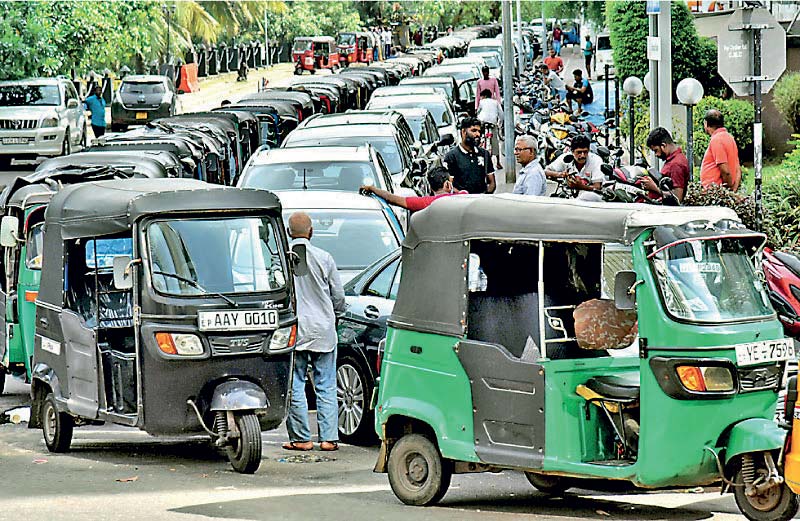
For even as we fantasise about a flotilla of fleeting funds, our motorists queue – some petulantly, others patiently, for a few litres of petrol apiece. Government spokespersons assure us that there are adequate stocks. The CPC reiterates that its supply lines are intact, as are prices at the pump... for now, that is.
And yet the lines at petrol and diesel sheds lengthen like Pinocchio’s nose...
This is not merely about fuel. This is about faith. A people lied to for decades – about war, about debt, about peace with justice and prosperity for all being just one election away – do not readily believe bland bulletins any more. When trust in state actors is in short supply, even petroleum products seem scarce.
So drivers languish in long queues, strumming their pain with their fingers, drumming the ticking minutes away on their steering-wheels while posting angry updates on Tik-Tok. Not because they relish the aroma of diesel at dawn, but because experience has taught them that assurances evaporate faster than lower levels of octane.
In such a climate, can we plausibly pitch ourselves as a haven of predictability to skittish global capital?
The irony is almost wicked. We dream of becoming a big ticket financial sanctuary while struggling to convince our own citizens that the tanks are full. We speak loftily of regulatory certainty while policy zig-zags like a three-wheeler in Pettah traffic.
GCC
To be fair, crises do create opportunity. The war in the Middle East – if it escalates beyond calibrated strikes and shadowy skirmishes – will ripple through oil prices, insurance premiums, shipping lanes and investor confidence. Sri Lanka, perched prettily atop vital sea routes, could benefit from re-routed trade or renewed strategic interest in these geopolitically volatile times.
But we are also exquisitely vulnerable. High oil prices on the road ahead would put the skids on our imports bill. Money coming in by dint of remittances could wobble if Gulf economies slow down or even brake to a halt. Tourism, that skittish spotted deer, may bolt for the bracken at the faintest whiff of regional instability flapping its butterfly wings.
So we should do well... to ask – are we really and truly poised on the cusp of a capital influx? Or bracing for another blow – terrorism, tsunami, pandemic, Aragalaya – to the solar plexus?
FDI
The honest answer is less cinematic than our social media prophets would like it to be. We are poised on neither a golden threshold nor a gallows trapdoor. More prosaically, we are – as ever – at a cross-roads of our own making.
Fate, karma, destiny. We invoke these cosmic forces with theatrical flourish when geopolitical circumstances deal us a rough hand... or a surprisingly good one, with potential for a skilled player to bag that jackpot. But nations are not cosmic playthings, nor powerful global alliances jokers in the pack of a local card-sharp.
Nations – perhaps like our present prospects or perhaps even the envisaged opportunities – are constructs of policy, prudence and political will. So if we wish to sustainably attract capital feeling regional conflicts, we must offer more than tax holidays and glossy brochures.
We must offer institutional credibility, consistent governance, and the dull yet steadfastly dependable virtue of the rule of law. For investors, like tuk-tuk drivers, queue cannily only where they expect guaranteed delivery.
There is also the inconvenient truth that we are not competing in a vacuum. Rival financial centres – from Singapore to Saudi Arabia – that are vying against Sri Lanka’s putative potential are not asleep at the switch. They too would court nervous capital assiduously now: with attractive tax breaks, better stability narratives, and slicker diplomacy than we can perhaps muster at the drop of a hat or fall of a drone.
USA
As for the US and its latest ME misadventures, be that as it might be, history will judge whether this is necessary, pre-emptive containment or déjà vu imperialism in desert camouflage. The world as it is has little appetite for another morality play that may well end in mea culpas.
Sri Lanka also would do well to watch, learn and resist the temptation to project our very personal hopes and aspirations on to other people’s wars. And becoming ‘the next Dubai’ is not a matter of waiting for someone else’s misfortune to materialise our own pot of gold at the end of a rainbow in the desert. But rather, we must work diligently and conscientiously to rectify our own manifold ‘mistakes made’.
Until then, we will continue to ask grand questions about putative nuclear programs and positive imperial overreach – before returning, perhaps inevitably, to the more pressing but practical question: is there going to be petrol tomorrow?
Because in international politics, as at the pump, credibility is the only fuel that drives a welcome change in fortunes. Countries do not become international financial hubs by legislative fiat alone. That requires credibility, consistency, stability, sustainability, and above all, trustworthiness. Trust that can count on a country not to suffer its investors› policy u-turns or populist spasms.
The task of Sri Lanka then is to quietly, painstakingly, make itself eminently investible – if the dream is to become a reality, and the hype and hoopla more than a happy, hooray moment. And we must do this not merely by statute but through building up a solid reputation.
We must realise that economies are not governed by horoscopes, and move beyond the discourse of fate, karma, destiny etc., in which our cosmic ledger is perpetually overdrawn. We must build on solid governance, transparent institutions and policy coherence based on principles that outlive personalities.
Oh, and yes, we must also stop conjuring up artificial fuel shortages out of thin air simply because – after decades of half-truths and whole-untruths – we idle for hours rather than trust a press release in an economy of suspicion.
(The author is the Editor-at-large of LMD)




