Tuesday Sep 15, 2026
Tuesday Sep 15, 2026
Saturday, 7 March 2026 00:16 - - {{hitsCtrl.values.hits}}
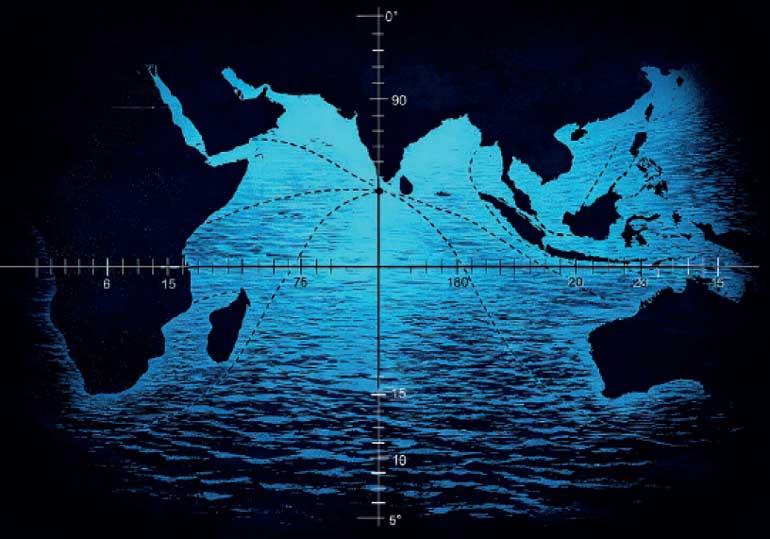
 If geography were any sort of destiny in the revolving atlas of geopolitics, Sri Lanka’s would be a curious one. We sit astride some of the busiest maritime highways like a genial innkeeper on a global trade route: smiling, neutral, and hoping that the caravans keep coming on the silk roads.
But sometimes, hosting those very caravans could court trouble for this legendary stopover on the Maritime Silk Route: Ibn Battuta, Marco Polo, IRIS Dena and those Iranian dead – a sort of second wave of Persian exploration of our shores.
The sinking of the Iranian vessel in waters not far from our maritime neighbourhood – allegedly at first by a US submarine; and then confirmed by the powers that be Stateside, amidst escalating hostilities between the United States, Israel and Iran – is a sobering reminder that the world’s quarrels have a habit of drifting into our backwaters.
From the beleaguered Straits of Hormuz to our patch of territorial waters is but a few hundred leagues.
The fact that the Sri Lanka Navy (SLN) mounted rescue efforts is both commendable and instructive – a cautionary tale. It illustrates the uncomfortable reality that even when we as a country are not combatants, our cohorts may become participants... if only as a humanitarian epilogue in someone else’s war.
Which raises a question that Colombo’s more astute policymakers are not doubt mulling, as I put pen to paper: what happens next when a not-so-distant and ever-widening conflict reaches our shores: in flotsam, jetsam and dead bodies from an unprecedented submarine attack?
IOR
For decades, tensions and sundry conflicts in the Middle East – involving Israel, and Iraq and Iran, and their respective allies, sponsors, and arms and ammo suppliers – played out largely within the periscope range of the Persian Gulf, and a catapult’s shot away in and around the Levant.
Now, that theatre appears to be expanding – alarmingly for nation states in the Indian Ocean Region (IOR)... and beyond.
Naval encounters deep in the IOR suggest that modern warfare, like contemporary trade and commerce, is increasingly globalised. Drones, submarines and long-range missiles have made distance – overland or nautical – a quaint and outdated notion. What happened last week in the Persian Gulf – or the Straits of Hormuz, to be precise – can echo at periscope depth a mere one thousand nautical miles away.
Sri Lanka (inconveniently or providentially, depending on your worldview) lies at the cross-roads of these clogged and contested maritime arteries.
It is where roughly two-thirds of the world’s oil shipments pass within few hundreds of miles of our shores. When tensions escalate along these routes, insurance premiums rise, shipping lanes shift, and fuel prices begin behaving like antagonistic peregrine falcons over a dead body in the desert.
Or to put it another way, even if a single torpedo never again troubles shipping in our neighbourhood, the economic shockwaves of the escalating war will.
Oil
Sri Lanka’s recovery from its recent sociopolitical and economic traumas remains delicate.
Higher oil prices – an inevitable consequence of a protracted conflict involving Iran – would immediately inflate our import bill. Flight and freight rates could follow. Export margins would shrink. The cost of living would begin another slow climb.
That is the economic dimension. But the geopolitical element is subtler. And open to more variations upon a theme depending on the global players in the game and their shifting allegiances.
Sri Lanka has long cultivated the art of balancing relationships among competing powers: the West, the Middle East, India, China, Japan, Russia, et al. It has often been diplomacy by tight-rope, particularly as regards our stance on Palestine vis-à-vis Israel, especially the UN – elegant when it is well executed, perilous when the winds blow hard and death-intent periscopes bear down on their prey.
An incident such as – not one, but two – foreign warships being holed and one sunk in close proximity to our maritime domain places that balancing act on a tight-rope more wobbly than the wheels coming off a Sri Lankan batting attack under a bowling blitz by, oh take any of the teams that sailed past us into the semis of the T20 Men’s World Cup.
Every major power involved in the IRIS Dena imbroglio will be expecting Colombo to be “balanced” and “behave appropriately”. However the problem may well arise depending on whether it is Iran or Israel or some other irritable orange-haired agent doing the defining as to what constitutes “being responsible”.
TGG
Sri Lanka’s safest posture for safe passage through the potentially dire straits remains a taking of the most strategically sensible route we know... principled neutrality – a stance that embraces all things sustainable from non-aligned in politics to humanitarian in practice, as embodied by our able-bodied seamen picking up the survivors off the Sea of Sri Lanka.
But mere neutrality in the labyrinthine maze of 2nd decade 21st century geopolitics is not the passive stance it once was in The Great Game and sundry happy pursuits of diplomacy by other means. It requires clarity of policy, credibility in execution and consistency in enforcement.
And in practical terms that means, inter alia, a strict adherence to maintaining international maritime law – even if, and especially if, “the world’s policemen” blatantly violates the rules of engagement (the US); ensuring our waters are not used (or abused) by any power in the name of military adventurism, or a Nelsonian turning of the blind eye to goings-on for which they could or should take responsibility (India); and cooperating in humanitarian, search-and-rescue operations without becoming entangled in the dragnet of the regional (possibly global, soon enough) conflict (China, Russia).
EEZ
This is easier said in a piece such as this than done in the heat of the moment on the high seas or in the skies above our territorial waters. For great-power rivalry rarely respects the politely insistent boundaries of small-nation-state diplomacy.
If the reports surrounding the sinking of the IRIS Dena prove accurate in all their gory details, they mark an unusual moment in modern naval warfare – and an even more unusual one for Sri Lanka. For rarely does a global conflict leave such a visible wake so close to our island nation.
It should prompt the policy-wonks in Colombo to re-ask of themselves several strategic questions...
How prepared is Sri Lanka to respond to more maritime incidents involving foreign military vessels?
Do we possess the surveillance capacity to monitor marine activity in our Exclusive Economic Zone (EEZ)? Do the relevant agents of action – diplomats, and military and civil branches of government – note the key distinctions between territorial waters and EEZs that make all the difference in terms of how we are bound to treat (in fact, safeguard) ships in distress?
And perhaps, most importantly, as the neutral actor in “someone else’s war” intruding on our sovereignty, do we have a clearly articulated Indian Ocean strategy?
These are no longer academic queries. They are matters of national resilience.
Wet
History offers a gentle warning to countries situated at strategic cross-roads. Ports that attract trade often or usually or almost inevitably attract fleets. Shipping lanes that carry commerce may also cargo ordnance – and with it, transport conflict into our harbours and other formerly safe havens. And islands that sit between rival powers must learn the delicate craft of making and surviving their alliances.
Sri Lanka’s strength has always been being open to all but belonging to none. In turbulent times, that philosophy of non-attachment must be defended with quiet determination – and the occasional dashes of prudence and pragmatism, as if these were some latter-day spices.
After all, when great powers quarrel at sea, it is often the nearest small harbour that gets wet from the first splash of the torpedo cleaving its way through the waters.
And sometimes, we hear the sonar and asdic echo too late.
(The writer is Editor-at-large of LMD, and has a Post-graduate Diploma in Politics and Governance)




