Friday Jul 03, 2026
Friday Jul 03, 2026
Friday, 29 May 2026 03:40 - - {{hitsCtrl.values.hits}}
 1 The UN itself has repeatedly highlighted the Buddha’s message of peace, tolerance and goodwill towards all living beings as if urgently contemporary. He is said to have taught: “Hatred is never appease by hatred; by non-hatred alone is hatred appeased.” In an age of algorithmic outrage, cultural and physical wars, and other forms of permanent agitation, that sounds less like ancient scripture than modern medicine or emergency advice
Vesak is one of the rare religious festivals that has escaped the confines of creed and become something of a civilisational ethic. In Sri Lanka especially, it has evolved into something larger than liturgy.
Now, and for ever, since time out of mind for my generation at least, it has been a season of stillness, lunar-lit tranquillity, memory, cultural artistry, generosity of spirit, and an islandwide mosaic of aesthetics.
Look ahead, and perhaps in our better avatars, we may see its potential to generate and grow a social democracy in our island-nation like never before.
The past is prologue
The provenance of Vesak (often Wesak) lies in the commemoration of the three pivotal events in the life of Gautama Siddhartha the Buddha we know. His birth, enlightenment and death (or parinibbāna, as the devout would have it), traditionally believed to have occurred on the full moon days of the lunar month of Veshāka, thirty five and then eighty years after the first occurrence.
And over the centuries in Sri Lanka, it evolved beyond doctrinal observance into something larger than the sum of its parts: a civilisational fabric, a cultural grammar, a public ethic.
The observance spread from the Indian Subcontinent across South and Southeast Asia, adapting itself to local cultures while retaining its central ethical message: compassion, impermanence, restraint, wisdom.
And the genius of the festival is that one need not be a Buddhist to appreciate it or to appropriate it. For in an increasingly oppressive atmosphere of strife and uncertainty, lies a philosophy with great salvific potential behind the outward rituals, a balm of both moderation and mindfulness.
A local habitation and a name
Yet, Sri Lanka’s adaptation has been distinctive.
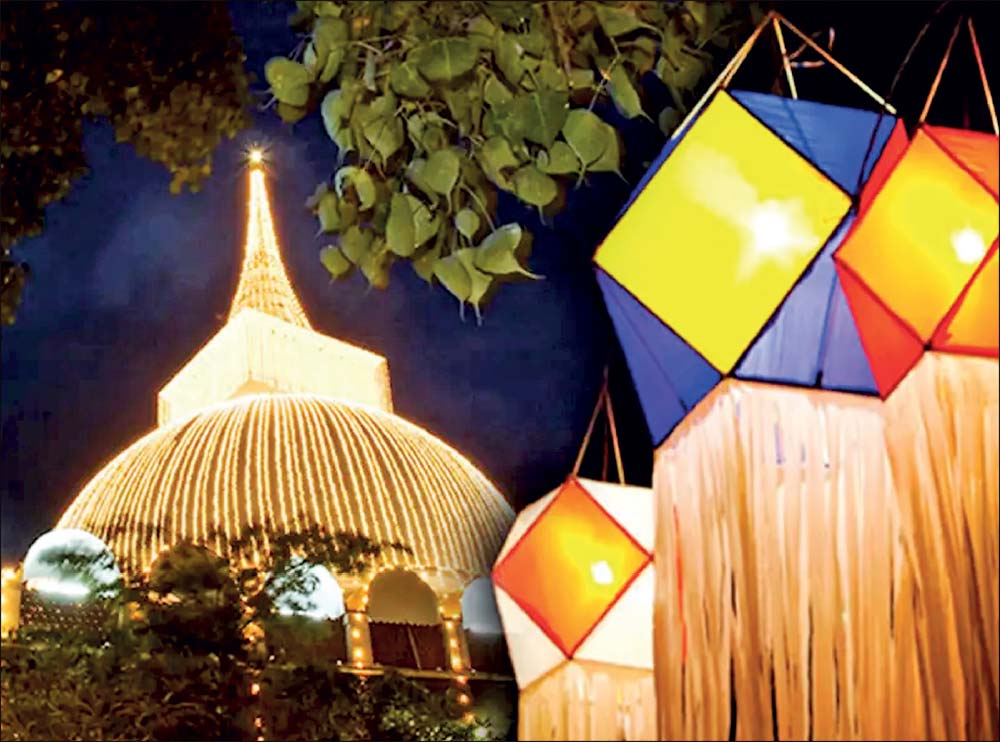
Unlike many religious festivals elsewhere, Vesak in Sri Lanka long ago spilled out of temples into public streets, homes, workplaces, prisons, schools, and villages. Lanterns, pandals, dansal, devotional songs, sil campaigns, almsgivings and public acts of charity transformed it into a participatory civic festival rather than a narrowly religious or ritualistic one.
That democratisation may explain why even so many non-Buddhists in Sri Lanka feel emotionally attached to it. The truth be told – Vesak may be among the few and therefore rare major religious observances around the plane of existence capable of transcending the traps of the planet’s other exclusivist and exceptionalist faiths.
The psyche of nirvāna
There is also something psychologically important about Vesak. Its difference is one of not merely scale, illumination or emotion. With its paper lanterns trembling bravely in the monsoonal breeze and often sodden with rain, its sanguine road-side dansal hosting patient strangers, and its sustained hush embracing even the noisiest neighbourhoods, it is perhaps the closest thing to a collective nirvāna that our republic possesses.
In a noisy and exhausting modernity, it institutionalised the peacefulness of pausing even for the duration of a long weekend.
The illumination of lanterns amidst darkness (often in our land both literal and metaphorical) becomes not merely decorative but contemplative. Those temporary bamboo and paper creations that are dismantled mere days later embody the Buddhist intuition of impermanence – or aniccā, as you might know it to be.
One is reminded of the stanza from the Dhammapada: “All conditioned things are impermanent. When one sees this with the eyes of wisdom, one turns away from suffering.”
Pause. Breathe. Reset.
That insight has resonance beyond religion even as – for a few fleeting days at least – our island race pauses to be, to breathe, to become.
Atheists, agnostics, secular humanists and followers of other faiths can engage Vesak not for its theology but its philosophy. It is an open invitation to mindfulness, ethical conduct, compassion towards all beings and self-awareness that humbles but liberates. The Buddha’s teachings are unusually accessible in this respect because they often function as practical psychology as much as a doctrine of and praxis for salvation.
A peace observed
This universality was recognised internationally due in no small measure to the late great Srilankabhimanya Lakshman Kadirgamar. Addressing the United Nations General Assembly (UNGA) in 1999, Sri Lanka’s then Foreign Minister proposed that Vesak be internationally recognised as a UN observance day.
The proposal was universally adopted as UN Resolution 54/115, placing the island nation that had often boxed above its weight in global diplomacy but never again like that since then. And once again – the truth be told – one would be hard-pressed to cite and quote a more eloquent repudiation of our blessed isle’s sectarian politics.
There was a certain symbolic and even ironic poetry in Kadirgamar’s achievement. A Tamil Christian Sri Lankan diplomat successfully and memorably internationalised a Buddhist observance on behalf of a multicultural nation that had struggled with its plurality in terms of being truly inclusive through its chequered history of race relations.
So in that singular act of accomplishment lay perhaps the best rebuttal to ethno-religious chauvinism. Kadirgamar himself repeatedly emphasised that we islanders must first think of themselves as Sri Lankans, transcending petty tribal or narrow communal labels and senses of identity.
 Their finest avatars
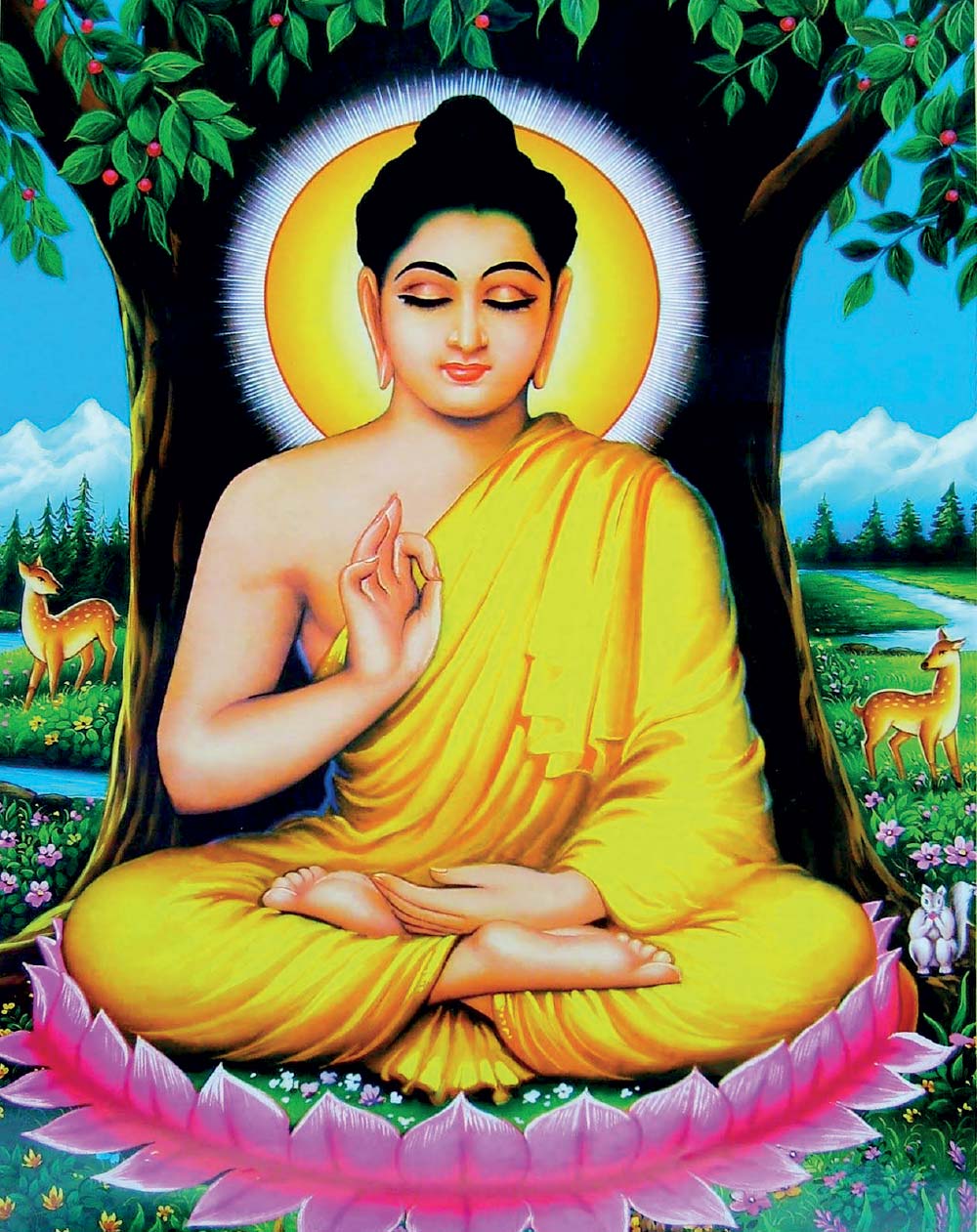
At Vesak, in their best avatars, the people of our land are often moved so profoundly to achieve their true potential as a genuinely compassionate society. In quiet places, and behind the façade of the spectacle, we islanders for a while recognise ourselves: fragile, wounded, hopeful, luminous for a moment against the dark.
On the global stage, in an increasingly fragmented and frazzled world order, nations compete not only with armies and economies but with moral imperatives and culturally loaded imaginations.
Yet, today, the United Nations annually commemorates the International Day of Vesak at its headquarters and offices around the planet, as a celebration of a contrapuntal movement. It explicitly frames this most Buddhist of festivals as a recognition of the philosophy’s contribution to ‘the spirituality of humanity’.
And UNESCO too has moved towards formal commemoration in tandem with intercultural dialogue and peace-building. No wonder, for few global exports are more needed now, planet-wide, than wisdom traditions that teach peaceful restraint in an age addicted to powerful expression and excessive action.
After all, the truth be told, the most authentic and arguably most meaningful Vesak lantern is not made of bamboo, paper and a candle. It is, rather, the illuminated conscience of the truly enlightened being
The gift which gives
The internationalisation of Vesak offers Sri Lanka a rare form of soft power.
Unlike export commodities or geopolitical bargaining chips, this influence arises from moral and cultural capital. Thailand, Vietnam, Singapore, Nepal, South Korea, Japan and other Asian nations also commemorate Vesak publicly, often blending national identity with universal ethical themes.
Singapore, notably, has leveraged multicultural religious observances – including Vesak, Deepavali, Christmas and Hari Raya – as instruments of social cohesion with a pluralistic republic. India, similarly, transformed Gandhi Jayanti into a quasi-civic ethical observance transcending religion. Thailand integrates Buddhistic state rituals with its national diplomacy practice. Bhutan embeds Buddhist values into its Gross National Happiness philosophy. So the lesson across Asia is clear: when religious festivals are framed around shared ethical values rather than sectarian triumphalism, they serve to strengthen civic trust.
The divergent path
But this does not mean that dangers don’t remain and lurk in the dark alleyways of nationalisms gone wrong. Because whenever states formalise religion, opportunists flock to exploit the status quo. And every majoritarian society runs the risks of weaponsing sacred symbols.
Vesak can become vulnerable to performative religiosity, political patronage, racial exclusion or ultra-nationalist appropriation. State-sponsored piety could easily devolve into spectacle without the proper introspection required of a national-minded exercise seeking to unite rather than upset people.
The louder the rhetoric of ‘protecting (fill in the blank)’, the more one sometimes suspects the eclipse of the founding philosopher’s teachings on wisdom, humility, compassion, loving-kindness and non-attachment.
So be warned, anyone wishing to deploy Vesak in the pursuit of a more peaceful and all-embracing national identity! It can easily become captive to performative nationalism, chauvinistic majoritarianism, commercial vulgarity or political theatrics. Hard is it, to replace noisy external piety with quiet internal compassion?
This is the way
Thus safeguards against a good undertaking going wrong matter more than you might think.
First, Vesak’s public language must foreground universal values – compassion, non-violence, generosity, simplicity and (in this day or age) environmental stewardship – rather than ethno-centric narratives.
Second, state ceremonies should visibly include representatives of all faiths and philosophies.
Third, Vesak would do well to remain decentralised and people-driven, rather than bureaucratised into sterile officialdom. The village dansala often embodies Buddhist ethics more authentically than grandiloquent speeches.
There is also scope for Vesak to evolve into a national week of service. Blood donation drives, debt relief campaigns, interfaith meals, prison rehabilitation programmes, tree planting drives, mental health reflection spaces, and public silence initiatives could give institutional form to the ethical core of this socio-cultural festival.
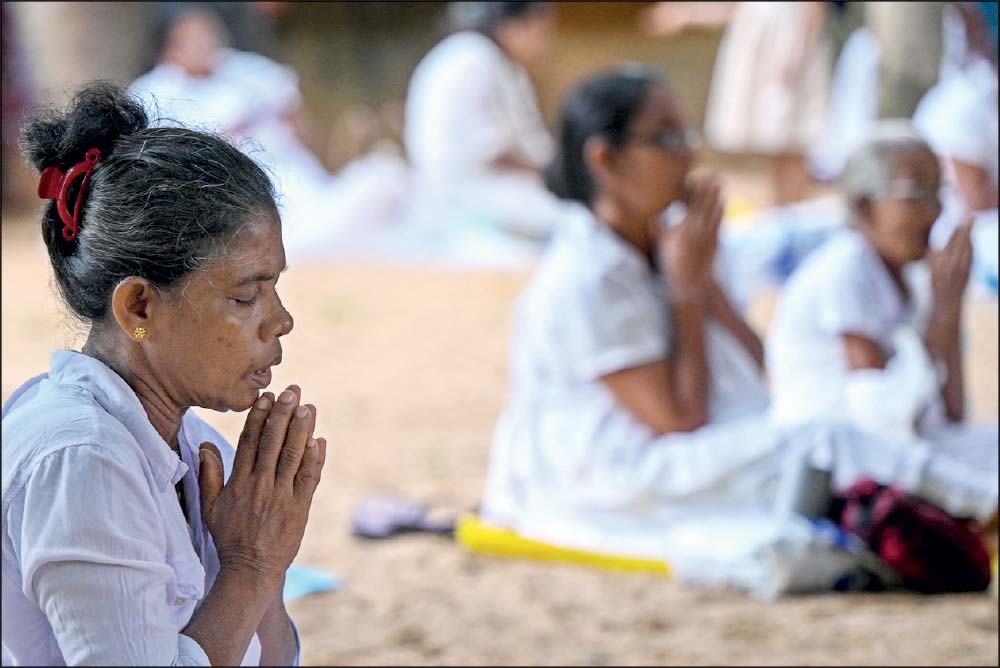
Indeed the most striking feature of Vesak is perhaps that it humanises public space. Streets temporarily cease to be arenas of commerce and become zones of generosity. Rich and poor alike queue at roadside stalls. Strangers offer food and drink to other strangers in an unprecedented show of solidarity. Urban alienation softens for the space of two moonlit nights. Even the frenetic pace of customary capitalism briefly slows or bows out altogether.
May all beings be happy
That is no small achievement in the 21st century. And perhaps that is why Vesak remains deeply relevant in an anxious world fractured by war, hyper-consumerism, loneliness, alienation, and ideological extremisms of all shapes and shades.
The UN itself has repeatedly highlighted the Buddha’s message of peace, tolerance and goodwill towards all living beings as if urgently contemporary. He is said to have taught: “Hatred is never appease by hatred; by non-hatred alone is hatred appeased.” In an age of algorithmic outrage, cultural and physical wars, and other forms of permanent agitation, that sounds less like ancient scripture than modern medicine or emergency advice.
After all, the truth be told, the most authentic and arguably most meaningful Vesak lantern is not made of bamboo, paper and a candle. It is, rather, the illuminated conscience of the truly enlightened being.
As a first step, such a being would begin to separate the form of the philosophy from its function. It would necessitate differentiating between the abidharmic core of Gautama Siddhartha’s teaching and our practice of folklore Buddhism.
The more radical step of separating oneself from the dross and corruption of sorry, sordid, worldly practices of power in places of worship and sanctuary – as we have seen of late – can be a next step.
That speaking truth to power where necessary to reform the three tenets held sacred by us islanders today must follow is not immediately self-evident. It is a tough call yet a necessary one.
(The author is the Editor-at-large of LMD and is a senior journalist with a Post-graduate Diploma in Politics and Governance)




