Saturday Aug 08, 2026
Saturday Aug 08, 2026
Saturday, 8 August 2026 01:20 - - {{hitsCtrl.values.hits}}
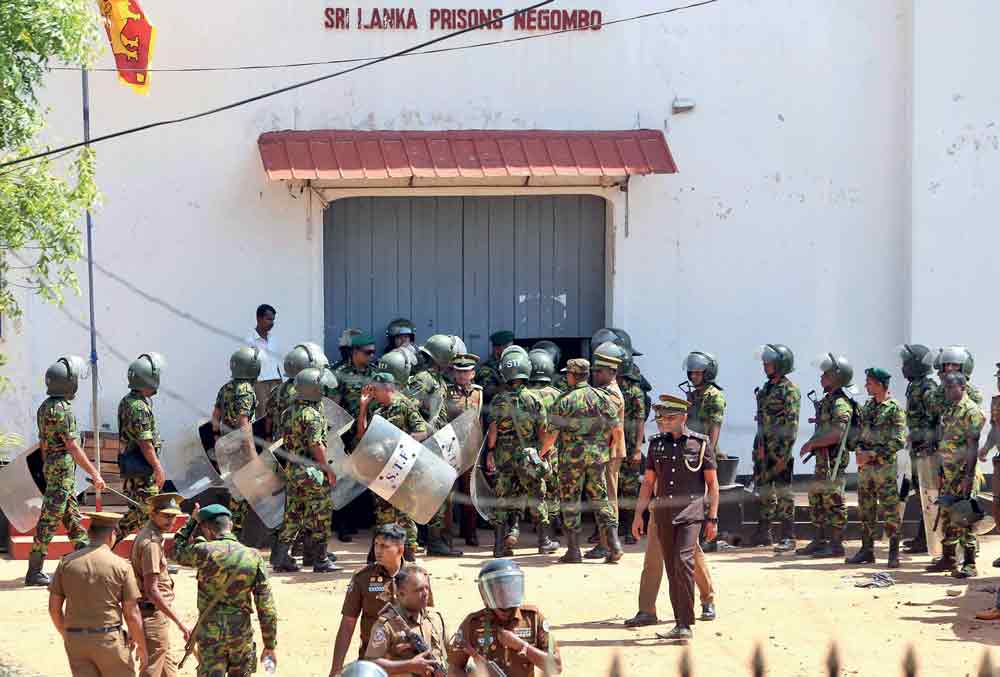
 A thought on many of our minds these days is: “Why did the recent prison riots and ongoing unrest take place as they did?”
Perhaps a better question may well be: “Why has Sri Lanka reached a point where one prison disturbance is no longer an isolated event but appears capable of cascading through the entire prison system?”
The two major disturbances – at the Negombo Prison in July and the Mahara Prison in August – are unlikely to have identical immediate causes (bar conspiracy theories; and there are quite some). But they almost certainly share the same underlying conditions. And the more recent incidents at Borella’s Magazine and Kuruwita Prisons persuade even those who think that conspiracy theorists are paranoid that some perverse persecution is afoot.
Those conditions have existed for years, as anyone even vaguely interested in the state of the nation and not simply consuming the news would know. What changed is that they have now become nationally explosive and escalated into an epidemic to run parallel to dengue and the flu.
Fact: the Prisons Department appears to have gone from chronic dysfunction into systemic instability. Root cause: unknown, but certainly viral.
Brick in the wall
The Negombo Prison fracas was not simply a ‘riot’… it was closer to a cinematic internal battle, the likes of which fans of prison-break movies would be familiar with.
From what the Justice Ministry authorities say, a host of factors combined to create one of the deadliest prison disturbances in decades.
 Sri Lanka’s prisons have evolved into complex criminal ecosystems rather than simply places of incarceration pending the dispensing of justice or rehabilitation to follow. The institution now appears to perform four contradictory functions simultaneously. It is, concurrently and simultaneously, a prison; a remand centre; a rehabilitation service; and a marketplace for organised crime. Those four functions cannot peacefully coexist indefinitely
These span the gamut from rival criminal groups and narcotics gangs, through prison intelligence failures, to deadly attacks on officers, a dangerous seizure of weapons, and an abortive yet clearly attempted prison break.
In the melee, 28 people including prison officers died and over one hundred were injured. The multiple investigations that followed have smacked of shutting the stable door after the horse had almost bolted.
The Mahara Prison incident, meanwhile, was demonstrably less deadly, but still extremely significant. Buildings were burned, administrative offices were attacked, the prison hospital and kitchen were damaged.
The Government deployed a combined force comprising police, military and navy personnel to restore order. That level of response suggests that the authorities feared widespread contagion rather than merely localised unrest.
Their suspicions have proved to be not unfounded. Magazine and Kuruwita on successive days demonstrate to even skeptical Dr. Watsons that – as Sherlock Holmes would say: “The game is afoot.”
Run of the mill
Dare we say these are not ‘normal’ prison disturbances? In ‘ordinary’ prison riots, rioting inmates fight guards and/or captious guards crack down on riotous inmates.
But in these cases, we also saw organised inmate factions and coordinated violence; destruction of surveillance equipment; attacks on inner prison infrastructure and other attacks apparently directed at intelligence sources; and attempts to disable or override prison command chains.
These elements resemble organised criminal operations rather than spontaneous disorder.
There is also the capacity factor to number-crunch into the equation. Overall prisons’ putative capacity is approximately 10,000 to 11,000 inmates. The actual population approximates between 39,000 and 41,000 according to media reports.
Sri Lanka may be witnessing the visible symptoms of a prison system whose internal equilibrium has broken down under the combined pressures of overcrowding, organised crime, institutional weakness, and a justice system that relies excessively on remand detention
While even overcrowding to the tune of roughly four prisoners occupying the space intended for one does not automatically causes riots, it tends to magnify every other problem faced by the prisons system.
The deeper structural issues beneath the iceberg of overcrowding make everything harder to maintain law and order in the prisons ecosystem. These occupy a spectrum from classification and security, through intelligence, to healthcare, rehabilitation and discipline.
Then there is the pernicious monster of the drug economy. Official investigations into prison disturbances in the past repeatedly point toward narcotics. Nowadays, prisons don’t merely contain drug offenders. Rather, evidence suggests that the island’s prisons themselves have become part of the drug distribution ecosystem.
Rabbit-hole
In terms of criminal governance, an emerging question from recent events has been: Who actually governs parts of some prisons? Is it the known Commissioner General of Prisons, or unnamed inmate power structures? This deserves much deeper investigation.
There is also the phenomenon of ‘remand overload’. Sri Lanka regularly imprisons enormous numbers of people, who then await trial. And lengthy judicial delays mean our prisons increasingly function as waiting rooms for the justice system.
Other issues that receive less media attention and yet, may matter more, abound.
Sri Lanka’s prison crisis is fundamentally a governance challenge rather than merely a corrections problem. Sustainable reform will require coordinated action across the prison service, judiciary, police, Attorney General’s Department and Justice Ministry. Without structural reforms, periodic prison riots are likely to remain recurring manifestations of deeper institutional weaknesses
For one, weak intelligence means that if organised groups can mobilise hundreds of prisoners, inter-prisoner communications existed beforehand. This implies either an intelligence failure at best or vital intelligence ignored or suppressed – sounds familiarly sinister!
And staff shortages mean that prison officers supervise numbers far beyond designed ratios. The ensuring fatigue creates fatal vulnerability.
Last not least is corruption. Contraband – phones, money, drugs, weapons – has to move, and someone has to facilitate that movement. The issue is not whether corruption exists, but how institutionalised it has become.
The usual suspects
The familiar recourse for policy discourse is to revert to the political dimension. From gun-running in the past to drug-smuggling in the present and chicanery at all times, the usual suspects in all that is murky in island life have been your friendly neighbourhood elected representatives. But here again we can do well to distinguish evidence from speculation.
The evidence is that Government immediately increased security nationwide and investigations involving multiple agencies were launched. The Human Rights Commission got involved and a judicial inquiry was conducted.
On the sidelines, political allegations abounded in Opposition voices, social media commentary, and cocktail circuit claims.
It was sabotage! This is deliberate destabilisation! The Government is creating a distraction from unrelated political developments! Or is it an organised attempt to embarrass the Government?
Worse still, is it the deep state and the rumblings of a former regime that is proving obstinately unflushable? Or growing desperate at a tightening noose and a rising tide of justice?
The jury is still out. No public evidence proving any of these allegations has surfaced. They remain political claims and public speculation. While the jungle telegraph can often be morbidly
fascinating, it reveals public psychology, even if it isn’t necessarily true.
In terms of criminal governance, an emerging question from recent events has been: Who actually governs parts of some prisons? Is it the known Commissioner General of Prisons, or unnamed inmate power structures? This deserves much deeper investigation
Common narratives include: “This cannot be coincidence.” “Someone – you know who, no – engineered both incidents.” “The prison system is controlled by organised crime led by Fill In The Blank.” “Political interests (wink wink) are manipulating prison gangs.” “These riots are intended to create national instability, so that…”
Sigh. Yes. It was ever thus.
The past is scary, present tense
Be that as it may, there is a historical pattern to prison unrest in which a striking feature is recurrence. Sri Lanka has experienced major prison violence repeatedly. Full dossiers of the following would make instructive reading for impartial observers: Welikada prison massacre (1983): 53 prisoners killed by inmates in collusion with jailers; Kalutara Prison violence (three inmates in high-security detention killed); another Welikada prison massacre (2012): 27 killed, 43 injured; Mahara I (2020) in which 11 died and 117 were severely injured; and Mahara II (2026); and Negombo (2026): 28 dead, 100+ injured. Now, Magazine – where 50 inmates stirred up sufficient trouble on Thursday to bring out the Police, its Riot Control Unit and the STF – and more seriously, Kuruwita: 2 dead and 11 hospitalised.
Different governments with different agendas and worldviews in different decades, but remarkably similar institutional weaknesses, repeating chronically…
Mafias
So Sri Lanka’s prisons have evolved into complex criminal ecosystems rather than simply places of incarceration pending the dispensing of justice or rehabilitation to follow.
The institution now appears to perform four contradictory functions simultaneously. It is, concurrently and simultaneously, a prison; a remand centre; a rehabilitation service; and a marketplace for organised crime.
Those four functions cannot peacefully coexist indefinitely. But eventually one overwhelms the others. And the recent brace of riots may represent precisely that tipping point.
Sri Lanka may be witnessing the visible symptoms of a prison system whose internal equilibrium has broken down under the combined pressures of overcrowding, organised crime, institutional weakness, and a justice system that relies excessively on remand detention.
That those structural failures may be exploited by political or criminal actors remains an open question, and it is one that requires evidence rather than inference.
In the meantime, a policy brief along the lines of restoring stability to Sri Lanka’s prison system may be in better order ahead of more putative unrest.
State of the prisons
The recent disturbances at several main island prisons should not be viewed as isolated law-and-order failures but as symptoms of a prison system under severe structural stress.
Chronic overcrowding, prolonged remand detention, organised criminal networks, inadequate prison intelligence, and institutional corruption have combined to create conditions in which disturbances can rapidly escalate into national security concerns.
Some salient facts demand attention of justice, reform and human rights actors:
Sri Lankan prisons house several times their intended capacity – undermining security, rehabilitation and staff effectiveness.
A large proportion of inmates remain on remand, reflecting broader weaknesses in the criminal justice system.
Organised crime, narcotics trafficking and contraband have become entrenched within parts of the prison system.
Prison intelligence and risk assessment appear inadequate to detect or disrupt coordinated inmate violence.
The recurrence of major prison disturbances over several decades indicates systemic (not merely episodic) failure.
Policy brief details
In the immediate term, say over the next three months, the Government must establish an independent Commission of Inquiry into recent prison disturbances. It must also conduct a nationwide security and intelligence audit of all prisons, and separate high-risk gang leaders and organised crime figures into specialised high-security units. Prisons and police authorities could intensify searches for contraband – particularly mobile phones, narcotics and weapons.
In the medium term of up to a year or two, the State must act to reduce overcrowding through expedited review of remand cases and expanded use of bail for low-risk offenders. It must also modernise prison intelligence through integrated data systems and specialised investigative units. There must be improvements in recruitment, training, remuneration and integrity screening of prison officers, as well as the introduction of independent oversight and stronger anti-corruption mechanisms.
In long term (in which ‘we are all dead’) of over ten years, the State would do well to shift from a custodial to a rehabilitation-focused corrections model. It might expand community-based sentencing for minor and non-violent offences. Reforms to criminal procedure to reduce unnecessary pre-trial detention would be welcome. Investment in modern prison infrastructure designed around classification, rehabilitation and security would be a bonus.
Sri Lanka’s prison crisis is fundamentally a governance challenge rather than merely a corrections problem. Sustainable reform will require coordinated action across the prison service, judiciary, police, Attorney General’s Department and Justice Ministry. Without structural reforms, periodic prison riots are likely to remain recurring manifestations of deeper institutional weaknesses.
(The writer is the Editor-at-large of LMD and is a senior journalist with a Post-graduate Diploma in Politics and Governance)




