Saturday Feb 07, 2026
Saturday Feb 07, 2026
Saturday, 7 February 2026 00:08 - - {{hitsCtrl.values.hits}}
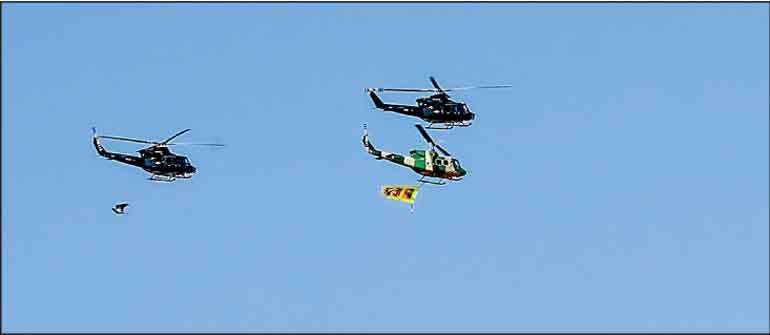
 Change can come in at a crawl. Or it can fly in, overhead, while all eyes are on the ground.
Could it be that more than irony – in fact, integrity with an ambition to deliver on promises made as well as the avowed intention – lies in Sri Lanka’s recently concluded 78th Independence Day celebrations?
There was no flyover for once in a remembered lifetime (from boyhood to more mature business) of the jet engines’ banshee-like wail.
While the traditional march-past of the usual suspects – all the king’s men (and women) in their standard flag-bearing regiments – were present and correct, one significant omission sent strong signals through more than the defence establishment.
Could it be that the tide is finally turning in postwar Sri Lanka? Are we finally prepared, and taking steps, to turn our swords into ploughshares and our spears into pruning-forks?
The past is prologue
Come the fourth
of February every year and Colombo, Sri Lanka, drapes its de facto capital in fluttering flags, booming brass bands and drums, and – until recently – roaring war planes.
For decades, the annual Independence Day parade has doubled as a theatrical flex.
Armoured vehicles grinding past dignitaries, the crisp cadence of jackboots, and fighter and bomber aircraft thundering overhead to cap an ostentatious show of force.
But in 2026, the skies were silent – save for three choppers from No. 6 and No. 7 Squadrons... one flying the national flag, the others flanking it in wing-echelon in an otherwise empty heaven.
No fly past by old-school aeroplanes whistling hollowly past their prime. No clanking whirlybirds twirling above, or paratroopers dangling colourfully – and once, dangerously – over a gobsmacked crowd at Galle Face green and the Old Parliament’s environs.
Just the respectful, grounded march of infantry, artillery and other regiments (no armoured corps?) as well as a host of precision walkers prettied up this year by their women comrades in uniform.
Perhaps a sign that Sri Lanka’s defence story may be turning the page on its more martial chapters and flipping the script to peacetime narratives?
Present concerns
It could have been a decidedly less martial chapter if not for the presence of key senior army, navy and air force officers widely perceived to be instrumental in ending the war – some of them at loggerheads with each other during the last decisive stages of a contentious campaign then, now sitting in stoic, strained silence next to each other in prominent seating. Another signal?
There was also, semiotically, the President’s detour from his previously pacifist script into a conspicuous nod to war heroes, patriots, and saviours of the nation from sundry tyrannies. Such a semaphore must be interpreted as a tectonic shift in the incumbent Government’s stance on matters martial – away from the studied silence of the last year, to an open acknowledgement of the military’s role in our nation-state’s well-being.
So not by any means was the narrative of the most recently concluded National Day commemoration a call to lay down arms en masse. But rather a friendly nudge from a never openly hawkish Executive in the spirit of a nuanced national transformation. And it was not hard – even amidst grateful nods to martial prowess – to conceptualise the pivoting of future programs from parades of tanks to pageants of tractors.
But it behoves the cynical among us who may attribute the scaled down show this year to fiscal constraints alone to take a look at what’s been happening under the budgetary hood since 2009...
The curious case of never-shrinking defence spends
After our long civil war ended in 2009 – a protracted episode that cost this island dear in terms of time, treasure and thousands of lives – many assumed inflated defence spending would take a bow and exit stage left.
Instead, it lingered – but not in the wings – and, in fact, ballooned.
Between 2010 and 2015, annual budgetary allocations hovered around the $ 1.3–1.5 billion mark... increasing in more than nominal terms, even as troop cadres shrank – from over 300,000 to under 135,000.
Further: between the war’s end in 2019 and 2020, over a decade later, the country – ostensibly at peace – spent anything between $ 20-30 billion on its defence; more than during the armed conflict itself, in inflation-adjusted terms.
It was a bit like downsizing your wardrobe because you’re no longer dating – a type of war – but keeping the credit card bill the same... clearly, something was going on between the seams.
Quality v quantity, real v manufactured needs
To be fair, Sri Lanka’s defence budget as a percentage of GDP – between about 1.7% and around 2.2% – is hardly outlandish by regional standards. Many of the island’s South and South-East Asian neighbours such as Myanmar, Vietnam and Cambodia spend in the same ballpark on men and materiel, although it trails the Philippines (c. 1.4%). Our small country’s per-capita defence spend ($ 89 in 2017 for e.g.) is comparable to Thailand and Malaysia though far below city-State Singapore.
But much of that money in the hardly beleagured island nation’s case went towards keeping the military machine merely ticking over idly – salaries, pensions, recurring maintenance and regular upgrades to hardware to fight a war that just wasn’t there – rather than fortifying against any real threat to the security of the realm.
It’s one thing to fund a capable maritime and airborne force patrolling the Indian Ocean’s (sorry, “Sea of Sri Lanka’s”) vital sea lanes. It’s entirely another to keep vast numbers of personnel deployed on never-ending duty long after the existential threat had passed. It was a long decade to do so from May 2009 to April 2019.
Critics of successive regimes – from politico-military analysts to civil society voices – argued that Sri Lanka’s security establishment had become as much a domestic institution as a defence one... with footprints in construction, urban beautification, economics and even political power plays.
Meanwhile, voices on the ground in the north and east as well as from the dispersion overseas, asked out aloud: “Why keep spending so much when the peace has held for over 15 years – a peace without justice or true national reconciliaton , at that – and development (perhaps especially in contrast to paltry investment in education and healthcare) lags in certain areas?”
Moving on
A symbolic shift – goodbye flyovers, hello priorities – seems to have taken place in 2026. So what do we make of no flypast at Liberty Day parade this year? Symbolism is a tricky beast. But this seems to be flux towards modesty and reason – even humility and contrition.
The aerial thrills of a bygone era were iconic – and even exhilarating, admittedly, especially to aviation enthusiasts such as yours truly – but also expensive. And (the truth be told), more than a tad bit passé and borderline cringe in a world where cybersecurity and unmanned systems (think UAVs) carry more value than vintage jet vapour trails.
A willing suspension of disbelief (yes, we could have splurged on it this year, too, even at the price of heavy criticism from the political Opposition and round condemnation from a struggling citizenry) may help.
Perhaps we may be persuaded to think that this is the first public hint of a subtle strategic pivot. After all, this Government – over and above all others before it, and even the regime’s first outing on Freedom Day parade last year – felt national security doesn’t have to scream noisily to ensure national sovereignty.
Maybe, just maybe, but for the rigour of all those other regiments! And not forgetting our Chief Executive’s out of the ordinary bowing the knee to defenders of the realm this year, where that revolutionary stalwart maintained a sterling silence on the matter last year. Maybe the reality of a Government grown less popular due to its many lapses in the interim required that sop to Cerberus?
But yes, also, maybe just maybe, Sri Lanka is finally beginning to embrace a quieter strength: economic stability, diplomatic agility and even versatility despite the debacle in Geneva last year and a relative success at Davos this year, and a people-centric focus on socio-economic development.
This doesn’t mean abandoning the bastion of defence or relegating the bulwark of national security to the backburner. In fact, far from it. A secure Sri Lanka, capable of safeguarding its territorial integrity and maritime boundaries, is vital – as crucial as responding with alacrity to critical events, as the military is wont to do during disasters especially in this region. But the equation needs recalibration: swords into ploughshares, tanks into tractors, jets into... well just about anything else that benefits war-weary, peace and justice loving, ordinary/average Sri Lankan citizens.
Better budget for a more secure future
The IMF has urged Sri Lanka to pursue prudent public spending as part of broader fiscal reforms, pushing for limited or reduced deficits and greater investment in growth sectors. If Sri Lanka can nimbly balance its defence needs with healthcare, education and infrastructure – without compromising national security – then the island nation stands to reap a peace dividend worthy of its hard-won independence.
And who doesn’t want a future where Independence Day parades celebrate engineers and teachers alongside farmers and fire-fighters as much as pilots and provost marshals? Where the loudest roar in the sky might be fireworks for children, not sparks from the decrepit engines of dilapidated jets?
Thus in 2026 Sri Lanka took the chance to rewrite at least part of the script – for whatever reason: purely fiscal constraints or partial fulfilment of the fundamentals of the social contract. To defend the peace for which so many sacrificed life and limb, invest in people, and let the only things flying high be the salutary aspirations of a hopefully united citizenry – as nicely encapsulated in that comprehensive presidential address.
Also in the end, true Independence (liberty/freedom), security and sovereignty aren’t measured by the size of one’s military budget or the inordinate display of an obsolete arsenal – but by the well-being, dignity and contentedness of its people.
(The writer is Editor-at-Large of LMD.)




