Tuesday Sep 15, 2026
Tuesday Sep 15, 2026
Friday, 27 February 2026 00:24 - - {{hitsCtrl.values.hits}}
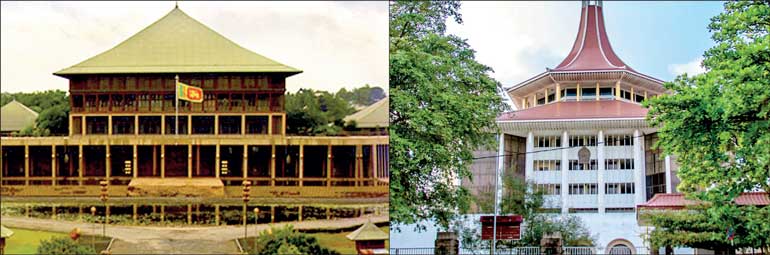
 If the 20th century French philosopher Michel Foucault had been a modern Sri Lankan politician, he might have skipped a schooling at Sorbonne, and tried his hand at stand-up – simply in order to essay his theses on power.
Foucault (1926-84) was less interested in building a grand philosophical system than analysing how power operates through knowledge, institutions and everyday practices. His key philosophical contribution can be summed up as an inquiry into the relationship between power, knowledge and the production of subjects.
He rejected the idea that knowledge is purely objective or neutral. To him, knowledge was always embedded in power relations. Power did not merely repress or permit expression; it produced truths, identities and other realities.
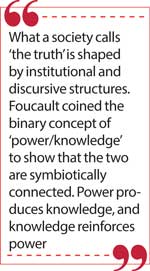
What a society calls ‘the truth’ is shaped by institutional and discursive structures. Foucault coined the binary concept of ‘power/knowledge’ to show that the two are symbiotically connected. Power produces knowledge, and knowledge reinforces power.
For example: medical, psychological and criminological discourses do not simply describe mental illness or criminality – they define and constitute them.
A central concept in Foucault’s work such as the Archaeology of Knowledge is discourse. Discourses are structured ways of thinking about a topic and speaking the truth about the same. These determine not only what can be said, but who can speak, and what – once spoken – counts as the truth.
These discourses shape how individuals understand themselves and the society they find themselves in. So identities such as ‘the mad’, ‘the bad’ and ‘the dangerous to know’ (courtesy Byron) or ‘the delinquent’ or ‘the undesirable’ (à la Foucault) are not merely discovered – they are historically produced within discursive regimes.
Foucault developed two major methods: archaeology and genealogy. Archaeology examines historical layers of discourse to uncover the rules governing knowledge in a particular era. Genealogy – partly inspired by Nietzsche – traces the contingent, often messy and power-laden origins of ideas, institutions and practices. It challenges the notion that current norms are natural or inevitable.
More pertinently for us, perhaps, he argues in Discipline and Punish that modern societies exercise power not mainly through violence or spectacle, but by the enforcement of discipline. For instance, schools, temples, hospitals, prisons, the police and security forces regulate behaviours and beliefs, as do sundry workplaces. In these institutions, surveillance becomes internalised.
Further, Foucault uses the metaphor of the panopticon – a hypothetical prison designed by utilitarian Jeremy Bentham – to illustrate how modern power works. For instance, individuals rule and regulate themselves simply because they might be watched. This produces ‘docile bodies’: efficient, trouble-free and normalised subjects.
 Our philosopher later turned towards how individuals form themselves as subjects. While we are all shaped by power structures, persons can also engage in and employ ‘technologies of the self’... practices that permit and foster critical self-formation.
This is where Foucault’s thinking becomes less diagnostic and more ethical. And he invites his followers to develop resistance through critical awareness of how they are constituted.
I hear you ask, my own patient reader, to summarise his key philosophical thesis in one line, if only so that you could put this paper down, or flip the page to more pressing matters in your day. Very well then... his central premise can be summarised just so – We, as human beings, are historically constituted subjects who are shaped by networks of power and knowledge; but through critical reflection, we can resist and configure those forces.
Sri Lanka in the 2020s
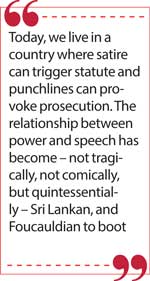
Today, we live in a country where satire can trigger statute and punchlines can provoke prosecution. The relationship between power and speech has become – not tragically, not comically, but quintessentially – Sri Lankan, and Foucauldian to boot...
But, just last week, Sri Lanka’s Supreme Court quietly did something rather remarkable: it compelled a former CID officer to submit a written apology to stand-up comedian Natasha Edirisooriya, for an arrest that should never have happened – ending, with her consent, the fundamental rights petition she had filed over her wrongful arrest.
And, more to the point, the apology tendered was not a grudging bureaucratic nicety, but a judicial acknowledgement that executive power in the form of the eager long arm of the law had over-reached, been spectacularly sloppy in the process, and in doing so cavalierly violated civil rights enshrined in the constitution.
Why does this matter, I hear ye ask – amid the wails of other plaintive worries and pressing concerns? Why, because until recently in the land like no other, it took a comedic routine – not a protest march, not a scathingly satirical op-ed, not an activist poem – to speak truth to power. And in doing so, diagnose the malaise that malingers in the public sphere.
 It was at a stand-up show in April 2023 that this comedienne made a few jokes about the childhood of the venerable Prince Siddhartha, which some found to be egregiously offensive. Within days, a video of the routine went viral.
By late May of the same year, the CID – acting on complaints by certain irate members of the Buddhist clergy and allied officials – apprehended her at the airport as she was on her way out of the country, and detained her under the ICCPR Act – a law meant to safeguard sacred rights, not snare supposedly errant entertainers.
Which brings us back to Foucault, who argued that where there is discourse, there is power. Where there is power, there is resistance. Edirisooriya’s jokes were less a criminal conspiracy than a crack in the veneer of permitted discourse. The sharp response revealed how tightly speech is managed, especially when the bastions of power are stormed – even in words, or perhaps especially in words.
In Sri Lanka in 2023, it was regulated by inter alia the ICCPR Act. In 2026, the Damocles’ sword that hangs over those of the comedienne’s ilk span the gamut from the Penal Code’s more hated provisions, through the odious Online Safety Act (OSA), to the still draconian Prevention of Terrorism against the State Act (PSTA) that has entrenched the dread Prevention of Terrorism Act (PTA).
Again that man Foucault: power isn’t just foggy force; it circulates through discourse – societal and religious and eventually juridical – to define and determine what could be said and done, and by whom. In his analysis, power is both productive and prohibitive. It shapes behaviours before it punishes deviations from the norms.
In Sri Lanka’s case, the power to regulate religious sensibilities became entangled with the power to regulate speech – and, in Natasha’s case, even gender. Foucauldian to the hilt.
Consider the spectre of the prosecution’s own words from previous bail hearings. The state prosecutor argued that it was “unbecoming for a woman, who could one day aspire to motherhood, to disparage the country’s majority faith”.
This prosecutorial rhetoric reads like a Foucauldian archetype of bio-power: the policing of bodies, especially female bodies, on the basis of normative roles in society. Women, it seems, are still expected to contain themselves – especially about matters of religious beliefs – lest they ruffle not merely male feathers but also disrupt the peace and supposed harmony of our nation.
A choppy history of expression vs. power
This is not an isolated incident. In January 2023, social media personality Sepal Amarasinghe was arrested under the ICCPR Act for allegedly insulting the Sri Dalada Maligawa (the Temple of the Tooth) – and detained for weeks before the case was dropped.
A few months later, in May of the same year, Ven. Rajangane Saddharatna Thera, a Buddhist monk, was briefly remanded for some of his remarks about the then President Ranil Wickremesinghe. Media at the time reported that the ICCPR Act was invoked to target elements of his speech deemed offensive to Buddhist sentiments.
In 2019, novelist Shakthika Sathkumara was detained for 127 days under the same piece of law as well as the Penal Code over a short story about the Buddhist clergy – only to be released without indictment.
Amidst all of these, Ahnaf Jazeem – a Muslim poet writing in Tamil – was held under the PTA for over a year... a stark and scary example of how laws about security become laws about sensitivity, and instruments of control.
 These episodes show not just legal whimsy but a pattern of discourse, regulation and control. On matters touching religion, ethnicity or state power, the Sri Lankan pendulum has oscillated between repression and retreat – depending on political winds and leadership pressure – from the Rajapaksa epoch through the Wickremesinghe era.
However rarely had they defended speech that offended the nation’s majoritarian sensibilities until recently. Speaking truth to power in the past had been punished – often swiftly and brutally – for political rather than religious reasons.
But now, enter stage left: Natasha Edirisooriya. A woman who, in her own words, dared to ‘say a joke’. Albeit a risky one. Because the freedom to punch in the air ends where the offensible other’s nose ends... and the law begins – in a panopticon state.
So her case stood at the intersection of speech, faith, offence, policing, and the law. Sent to jail for ostensibly offending majority sensibilities, it underlined a lacunae we note... that a mature republic must distinguish between speech that maliciously incites violence, and speech that merely unsettles belief.
Her recent acquittal by the Supreme Court is not just a legal footnote. It is a Foucauldian parable waiting to be interpreted by society at large. The learned bench’s insistence on a formal police apology – even without a substantive declaration on the illegality of the arrest – is notable. It signals judicial impatience with executive administrative over-reach.
The joke that launched a jurisprudence
Natasha’s prosecution under the ICCPR framework exposed something quietly combustible in Sri Lanka’s regulatory architecture. Namely that legislation designed to protect rights can, in the wrong interpretive climate, police speech.
Foucault had already warned us: power does not merely repress; it produces effects. It produces categories, boundaries, and in some cases, defendants.
When satire is recast as sacrilege and dissent reframed as disorder, the state does not simply enforce the law – it defines the parameters of permissible interpretation.
The Supreme Court’s determination of Natasha in the case as innocent, therefore, matters. It signals that constitutional guard rails, while occasionally rickety, are not decorative. The robe, this time, leaned towards liberty.
Under former President Ranil Wickremesinghe, governance leaned towards the technocratic: fiscal consolidation, IMF compliance, the grammar of macroeconomic sobriety. Stability, recovery and restructuring were the watchwords once the jackboot came off the latter-day Aragalaya.
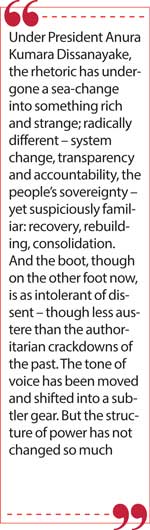
Under President Anura Kumara Dissanayake, the rhetoric has undergone a sea-change into something rich and strange; radically different – system change, transparency and accountability, the people’s sovereignty – yet suspiciously familiar: recovery, rebuilding, consolidation.
And the boot, though on the other foot now, is as intolerant of dissent – though less austere than the authoritarian crackdowns of the past. The tone of voice has been moved and shifted into a subtler gear. But the structure of power has not changed so much.
Sri Lanka’s political landscape in general and media – particularly social – continue to be shaped by contested discourses about power, truth, permissibility and prohibition. So Foucault’s insights into how power and knowledge are co-constitutive continue to have currency in the socio-political exchange and enforcement of ideas.
Seek to understand how state institutions, regulatory frameworks and digital media dynamics shape what counts as legitimate journalism and legally non-combustive jokes? So much rests on the Foucauldian paradigms of who gets to speak, what can be safely said, and how citizens at large interpret the jokes – whatever house the comedians may be in!
Also yet to learn that offence is subjective while incitement is measurable, the state conflated the two to produce what Foucault may term ‘a dangerous subject’. The citizen whose words are policed not for harmful danger but for humiliating discomfort.
It was very clear that Sri Lankan public discourse once operated under a regime – now gone underground but still lurking and always dangerous for being subterranean – where certain topics (religion, nationalism, majority identity) are taboo or even sacred. Satire or critique that disturbs those sensibilities risks backlash... online, offline and in a cell.
The joke may be on us
 Because we are still a republic debating our anxieties over discourse in public in general and social media in particular. Power has swung from technocratic sobriety to reformist zeal. The political opposition continues its rehearsed indignation in elevated speech no one much knows about; or when it does understand the point being made, ignores the same because it is absurd. Only the judiciary – dare one essay it – oscillates between caution and courage. One manacle, the Online Safety Act – born in ambiguity under another administration – remains operative. And then again – need we rehearse how the new broom PSTA smuggles in the dirt of that PTA to re-hoist the old Damocles’ sword over your head and mine. The definitions in both of these laws, elastic enough to stretch across ideological divides, remains to test the boundaries between power and expression, between harm prevention and harm production.
We have a choice in the dichotomy between power and expression. It depends on which way we’re willing to tug and pull the swing of the Foucauldian pendulum as to who will have the final word – comedians we love, or other political actors we like less.
As the curmudgeonly John Cleese said, “There are people just sitting there, deliberately waiting, for the thrill of being offended.”
And Rowan Atkinson, the redoubtable Mr. Bean, would agree in spirit: “The clear problem with the outlawing of insult is that too many things can be interpreted as such. Criticism is easily construed as insult by certain parties. Ridicule, easily construed as insult. Sarcasm, unfavourable comparison, merely stating an alternative point of view to the orthodoxy can be interpreted as insult.”
Also Sir Stephen Fry into the fray to essay, “It’s now very common to hear people say, ‘I’m rather offended by that.’ As if that gives them certain rights. It’s actually nothing more than a whine.”
Again let a girl have her say: “I did something bold. Something that no woman has ever done in Sri Lanka. I told a joke. And I got heckled by...” fill in the blank. It is the sorry tale of how a comedy set became a criminal case in Sri Lanka, how a joke escalated into a national security concern. And sent a woman who told that joke to prison for 39 days, which the liberal – and the sensible, I dare say, among us – would consider a heavy price to pay for the liberty of speech.
Anti-free-speech regulations may well still create a society of extraordinarily authoritarian and controlling nature. But Sri Lanka is not quite yet that dystopia although the pendulum at times is swinging in that direction. Comedians, digital activists and journalists or even policy reforms advocates operate in a climate of anticipatory caution – largely because ambiguity lingers in our laws...and the Natasha episode heightened that ambient anxiety. If a joke can be judicially parsed, even a witty aside or catty comment sounds like evidence for the prosecution.
Her acquittal does not entirely eliminate that anxiety. But it punctures the inevitability of persecution for daring to speak truth to power. In Foucauldian terms, the judiciary becomes a counter-site – safe space for contesting regimes of truth to collide, clarity to emerge, and errors to be corrected. The test going forward is consistency. For liberty cannot be episodic like a shadow comic act.
So bring on – and back – the dancing girls, the comedians, and the speakers of truth to power.
(The author is the Editor-at-large of LMD)




