Monday Jul 13, 2026
Monday Jul 13, 2026
Monday, 13 July 2026 02:12 - - {{hitsCtrl.values.hits}}
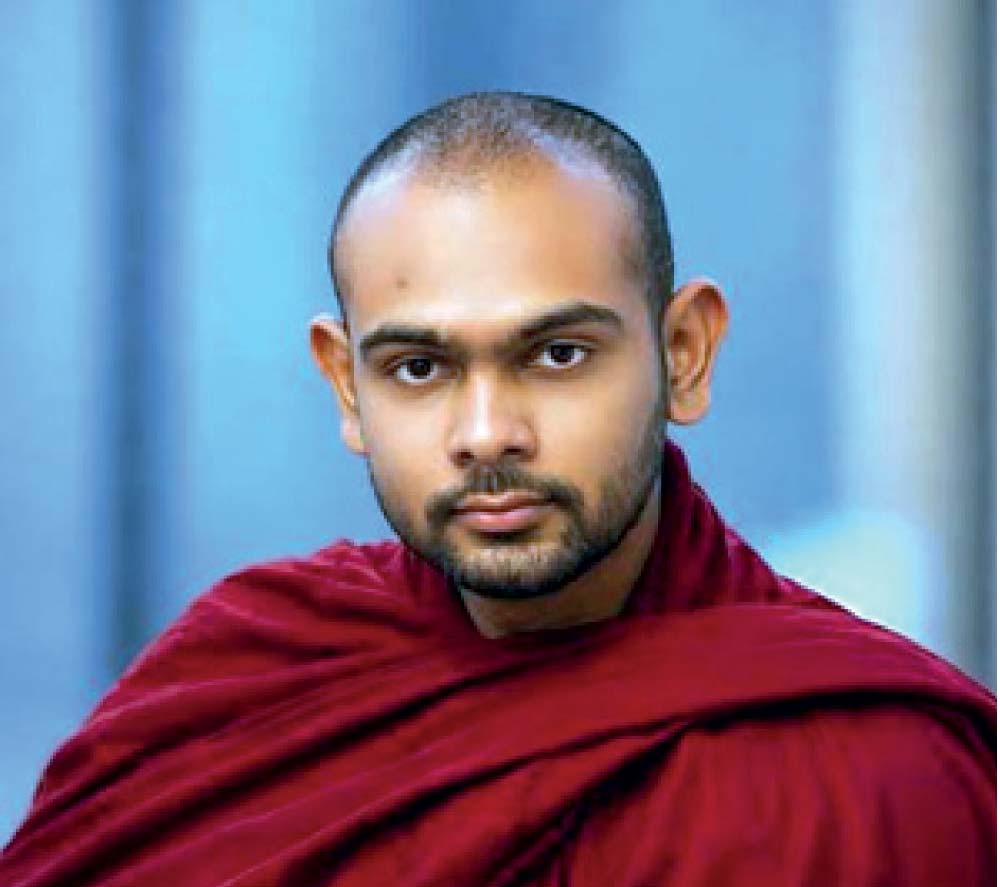
Ven. Panadura Ananda Thero
 By choosing the accessible form of a romantic, historical novel, Venerable Ananda has performed a great service for general readers. He has taken the abstract, sometimes heavy doctrines of karma and rebirth and turned them into a deeply moving human reality that anyone can easily read, feel, and understand
 Unique book
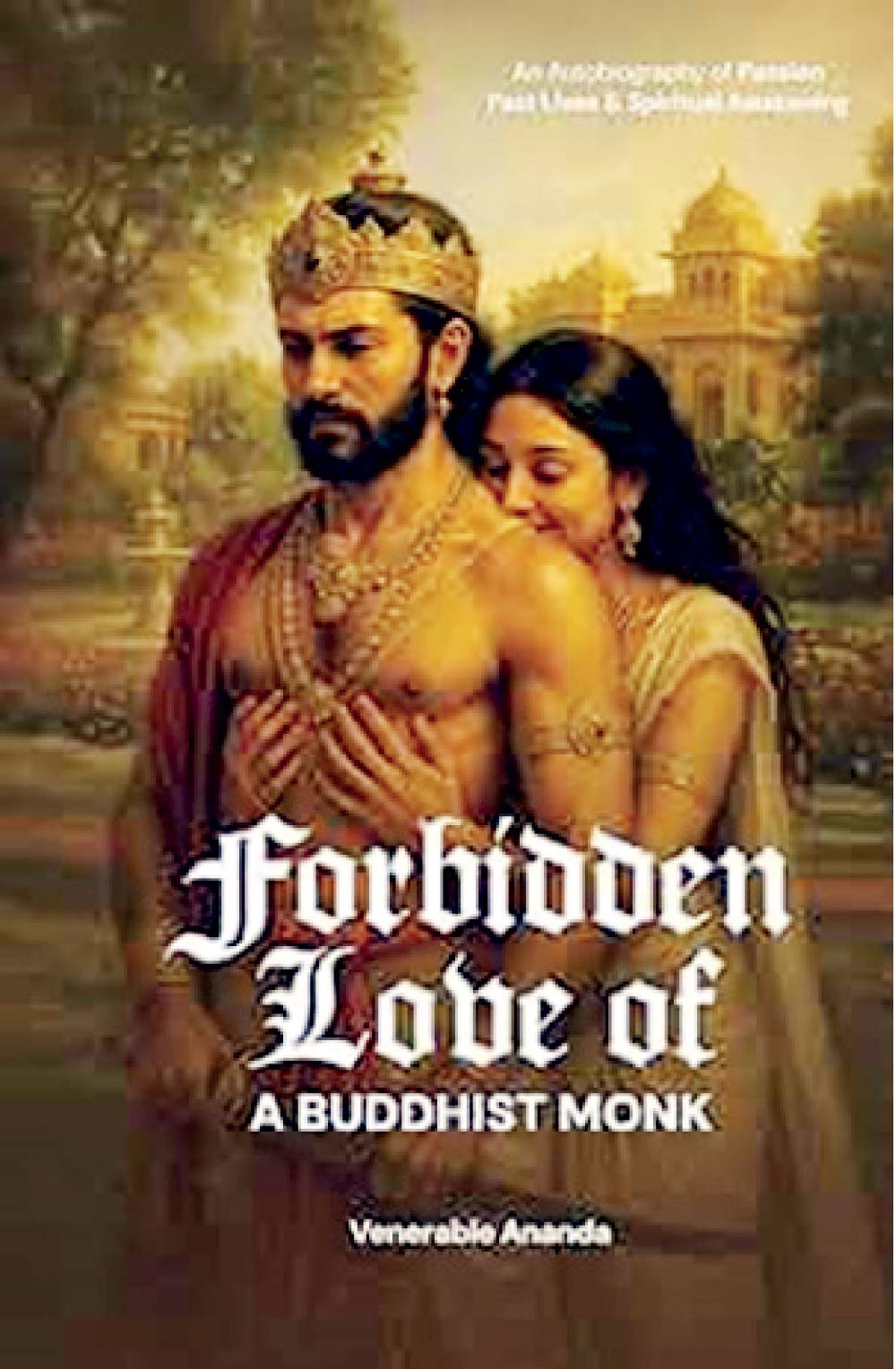
A recently published book that explores profound human experiences on the unseen spiritual side of life is Forbidden Love of a Buddhist Monk, written in English by the young Sri Lankan monk Venerable Panadura Ananda Thero.
The work is unique for two reasons. First, it is rare for a Buddhist monk to write a true autobiography in the form of a gripping, emotionally charged novel. Second, the author fearlessly opens up a subject usually shrouded in strict institutional silence: the raw, unfiltered emotional struggle of a monk wrestling with vivid memories of his past lives.
Venerable Ananda could embark on such a bold enterprise because, from an early age, he had inhabited this spiritual world even before he took to the saffron robes. Today, he is well known for the large following he commands across Sri Lanka as a teacher of spirituality and meditation.
No relation to provocative title
The provocative title of the book might cause an uninitiated reader to make the wrong conclusion that it is a confession of a romantic scandal. Venerable Ananda has not violated any of the monastic principles or vows that a Buddhist monk must follow.
Instead, the "forbidden love" he describes is a profound, innocent spiritual devotion to an elder sister from a previous birth. The book is a courageous act of mental excavation, showing how deep emotional attachments can travel across lifetimes and haunt a person in the present day.
From Christianity to Buddhism
Before he wore the sacred saffron robes, the author was an ordinary boy named Yohan. Born into a non-Buddhist family, Yohan was a highly intelligent, quiet, and introspective child. While his classmates spent their school intervals chasing soccer balls and playing cricket, Yohan preferred to stay inside the classroom. He found standard social interactions exhausting, telling his teachers that he preferred to live with an empty mind. He was academically brilliant, consistently ranking first in his class, and had only one close friend, a boy named Sahan. Together, these two twelve-year-olds ignored typical childhood topics, spending their free time discussing complex ideas like simulation theory, quantum physics, the concept of a just monarchy, and the Buddhist philosophy of Nibbana.
 Invisible emotional wound
Despite his brilliant mind, Yohan carried a deep, invisible emotional wound. From his earliest years, he was plagued by a profound, unexplained loneliness. Every night, he was gripped by a recurring dream that felt less like a fantasy and more like a real, haunting memory. In this dream, he would see a beautiful elder sister whose face was a blur, but whose presence was filled with an overwhelming, unconditional warmth. He would reach out for her, feeling a desperate yearning to lie near her heartbeat just to feel safe, only to wake up drenched in sweat as she vanished into the darkness.
For a long time, this strange inner void was shielded by the boundless love of his maternal grandmother. Yohan was her favorite grandchild, born just two days after her husband passed away. She raised him with absolute devotion, tying his shoe laces, feeding him, and wiping the crumbs from his lips. To Yohan, her presence was his ultimate sanctuary. However, tragedy struck when his grandmother fell severely ill with dementia, losing her voice and her ability to recognise him.
One afternoon, after being bullied and threatened by older students at school, Yohan rushed home in tears. He knelt by his bedridden grandmother's side, clutching her frail hand, pouring his heart out about his fear and loneliness, but she could only stare back with distant, unseeing eyes. Shortly after, she passed away, leaving Yohan entirely exposed to his inner grief.
Seeking to fill this massive emotional void, Yohan turned to his mother, craving an exclusive, undivided love. But he quickly realised that his mother’s heart was not his alone to hold, as her love was deeply bound to his father.
The family dynamics shattered further when his father, consumed by a destructive gambling addiction at local casinos, lost a massive sum of money and struck his mother during a bitter argument. Terrified, the thirteen-year-old Yohan begged his mother to flee with him to relatives in London. His mother softly refused, saying she still loved his papa and could not leave like that.
Emotional rejection
Feeling emotionally rejected and deeply isolated, Yohan withdrew completely into himself, moving out of his parents' room to isolate himself in his own bedroom. As he cut his emotional ties with the living world around him, his subconscious yearning for that mysterious elder sister from his dreams intensified into an absolute obsession. He craved someone who would choose him first, someone who would never walk away, and someone whose love did not have to be shared with anyone else.
At the age of fifteen, guided by an elderly layman who introduced him to the practice of insight meditation, Yohan left his family, school, and worldly ambitions behind to enter the path of Buddhist ordination.
Seeking to conquer the persistent emotional attachments that still haunted his mind, he traveled to Myanmar. There, he immersed himself in the rigorous, disciplined training of Samatha, or tranquility, meditation.
It was during these intense hours of deep concentration that his mind broke through the barriers of time. The recurring dreams of his childhood were unlocked, revealing themselves not as random figments of imagination, but as a literal stream of memories from his previous births.
Through the eye of his meditation, Venerable Ananda witnessed his past life in an ancient historical kingdom in India. In that birth, he had been born as a prince who later inherited the crown to become king. Tragically, his royal parents passed away prematurely when he was a mere child, leaving him completely alone to navigate the heavy, dangerous world of royal politics and governance.
The only person who stood between the young prince and absolute despair was his elder sister. She stepped into the void left by their parents, nurturing him, protecting him, and shielding him from the cold realities of the court, becoming the centre of his universe.
Past lives
The book beautifully details the episodes of this past life, illustrating a bond that was profoundly emotional, intensely protective, and pure. He describes scenes of absolute innocence and deep devotion, where his sister fed him with her own hands under the shade of palace trees, playfully styled his hair, and read ancient historical epics to him while he sat safely at her feet.
At night, she would wrap him in her arms, kissing his forehead, and singing soft royal lullabies to banish his fears, whispering that he was her precious gem and she would never let him go.
As he grew into kingship, this intense psychological and emotional reliance solidified into a massive karmic knot. He did not look at her with lust; rather, his soul clung to her as its ultimate home, its only source of safety and peace in a treacherous world.
When she eventually passed away in that lifetime, the king was plunged into an inconsolable grief that lit his entire world with sorrow. His heart was so profoundly broken that he vowed he could never love another soul again.
When Venerable Ananda returned to the present reality from his meditative recollections, the cosmic puzzle pieces finally clicked together. The severe loneliness he felt as Yohan, the deep grief over his grandmother’s illness, and the vivid, aching childhood dreams of an elder sister were all the psychic residue of that ancient royal lifetime. The intense longing had traveled across oceans of time, surviving death and rebirth, presenting itself as a phantom ache beneath his monastic robes.
For the general reader, the idea of past-life memories flowing into a child's mind might sound like pure folklore, but this is exactly where we must bridge the gap between religious experience and modern scientific research. In my previous columns, I highlighted the groundbreaking work of local researcher Tissa Jayawardena and his global research partner, the late Professor Ian Stevenson of the University of Virginia.
For decades, these researchers conducted strictly controlled social experiments on thousands of children between the ages of three and six who claimed to remember previous births.
Scientific examination of rebirth events
The scientific protocol used by Stevenson and Jayawardena mirrors the meticulous work of a judge examining a witness.
First, every single claim made by the child regarding names, places, and modes of death is recorded in minute detail before any investigation begins. Second, the child is taken to the exact distant locality they describe to see if they can naturally navigate the landscape or recognise past relatives. Third, researchers look for striking physical anomalies, such as birthmarks, scars, or deformities, that precisely correspond to fatal wounds or bodily features documented in the medical records of the deceased person.
When these factors align perfectly, science concludes beyond reasonable doubt that the child’s consciousness carries information that could not have been acquired through normal sensory means in this life.
Importance of GABA
Why is it that children easily remember these stories, while adults almost always forget? Modern neuroscience provides a fascinating clue through a neurotransmitter known as Gamma-Aminobutyric Acid, or GABA, discovered in the early 1950s.
Our brains are constantly bombarded by millions of data streams from the universe, and GABA acts as the brain's ultimate internal control device or filter. It functions like a radio dial, filtering out the chaotic background static of the universe so that we can focus purely on the immediate, practical tasks of our present physical reality.
In early childhood, a child's brain is still developing, and their internal biological filters are highly porous. Because their analytical filters are wide open, a young child can sometimes easily tune into past memory streams or non-somatic information stored outside the physical body. As a child grows older, their brain naturally boosts its filtering capacity, locking down the gates of the subconscious, which is why childhood memories of past lives almost always fade completely by the time a child reaches school age.
Venerable Ananda’s experience perfectly bridges this scientific reality with spiritual practice. While his childhood memories faded into vague dreams as he grew into his teenage years, he discovered that the human brain can intentionally bypass its daily biological filters.
By entering the deep states of Samatha meditation, a practitioner can systematically quiet the brain's standard cognitive chatter, naturally elevating focus to a single point. This specialised training allows an adult to consciously open the vault of deep consciousness and retrieve clean, chronological data streams from past lives.
Venerable Ananda’s book is a masterpiece of spiritual transparency. It gently reminds us that true freedom does not come from running away from our past wounds, but from having the immense courage to look directly at them until they finally turn into light
Lessons from Rohitassa Sutta
This profound link between individual consciousness and the wider cosmos is beautifully illuminated in the Rohitassa Sutta found in the Anguttara Nikaya.
In this discourse, the Buddha tells the deity Rohitassa that one does not need to travel to the far edges of the physical universe to discover the end of suffering or to understand the nature of the world. Instead, the Buddha reveals that the entire cosmos, its origin, its cessation, and the path to its ending are all contained right within this very fathom-long physical body, when paired with a conscious and perceiving mind.
Venerable Ananda's meditative excavation perfectly validates this sutta; by looking inward at his own body and mind rather than searching the external world, he managed to map the vast, cosmic footprints of his previous lives.
Historian Yuval Noah Harari reminds us that no human civilisation or value system can survive without a deep repository of stories to justify its core truths. Furthermore, the Nobel laureate in economics, Robert J. Shiller, established the branch of Narrative Economics, proving that human beings are naturally wired to absorb complex knowledge through stories rather than cold, abstract data.
By choosing the accessible form of a romantic, historical novel, Venerable Ananda has performed a great service for general readers. He has taken the abstract, sometimes heavy doctrines of karma and rebirth and turned them into a deeply moving human reality that anyone can easily read, feel, and understand.
Ultimately, Forbidden Love of a Buddhist Monk is a story about breaking illusions, not breaking monastic rules. It documents the supreme triumph of wisdom over lingering worldly desire. According to the Buddha's Doctrine of Non-Self, or Anatta, there is no permanent, unchanging soul that travels from body to body. Instead, what we call the soul is a constantly evolving stream of consciousness, beautifully compared to the flowing waters of a river or the shifting flame of an oil lamp.
One cannot step into the same river twice, nor is an evening flame identical to the afternoon flame that birthed it. Consciousness is a continuous forward evolution.
Childhood longing
Venerable Ananda realises that his intense childhood longing for an elder sister was simply his mind mistakenly trying to grasp onto an old, extinct flame. The king is dead and gone; the sister he once worshipped has dissolved back into the currents of samsara. Clinging to that memory in this lifetime would be like chasing a mirage in a vast desert.
Instead of suppressing his emotional pain or hiding it behind religious pretense, Venerable Ananda took the bravest path a human being can take, which was stepping directly into the fire of his own feelings with his eyes wide open.
Illusion of identity
Through the systematic practice of Vipassana, or insight, meditation, he carefully analysed the deep structural patterns of his mind's attachments. By looking at his ancient grief with unwavering honesty, he deconstructed the illusion of identity across lives. He realised that the sister of his dreams was an imagined anchor for a mind that was afraid of being alone.
Through this profound psychological seeing, his ancient longings naturally dissolved, turning his inner conflict into absolute stillness, clarity, and ultimate spiritual liberation.
Venerable Ananda’s book is a masterpiece of spiritual transparency. It leaves the reader not with a sense of scandal, but with a profound sense of therapeutic peace. It stands as a shining, universal road map for any human being who has ever loved too deeply, lost too heavily, or carried a silent, unexplained ache in their heart across the fabric of time.
It gently reminds us that true freedom does not come from running away from our past wounds, but from having the immense courage to look directly at them until they finally turn into light.
Venerable Ananda’s Forbidden Love of a Buddhist Monk is book which should be read by every Buddhist.
(The writer, a former Deputy Governor of the Central Bank of Sri Lanka, can be reached at [email protected] )



