Friday Jul 17, 2026
Friday Jul 17, 2026
Monday, 1 June 2026 00:24 - - {{hitsCtrl.values.hits}}
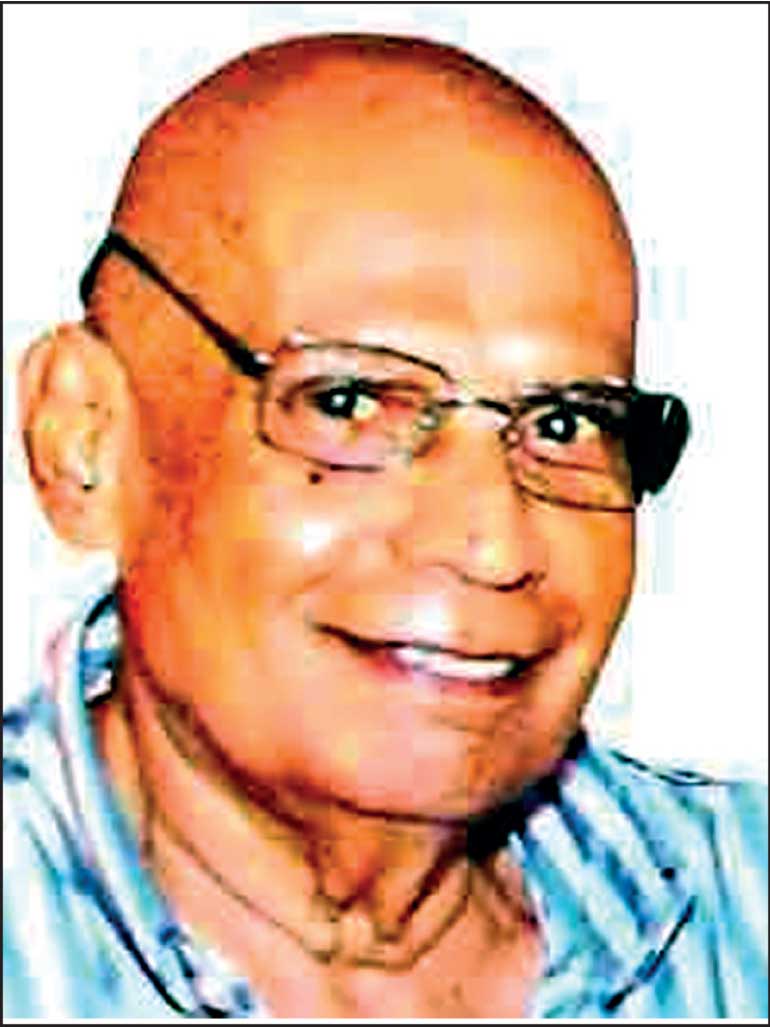
Dr. Wimal Hettiarachchi
 Dr. Wimal Hettiarachchi who had completed a full career in the Central Bank of Sri Lanka in numerous capacities is no longer with us. He completed his life journey last week.
From non-staff officer to a university degree
Hettiarachchi joined the Central Bank as a non-staff officer in the early 1960s immediately after he finished his school career. Though he was eligible to join the University of Ceylon to complete an undergraduate degree, pressed by economic hardships, he chose the Bank in preference to a university degree. But this could not stop the young Hettiarachchi from his quest for pursuing an academic career. When the then Vidyodaya University, predecessor to today’s University of Sri Jayewardenepura, announced in 1959 the commencement of two pioneering degree programs in Business and Public Administration for those who were already in employment, he sat for the admission test and was accepted to the four-year honours degree program in business administration.
The owl student
Since the course was for those who were already in employment, lectures were conducted after office hours. Hettiarachchi told me that he got one hour’s study leave from the Central Bank that was available to public servants doing a university degree as an incentive for further education and proceeded to attend the lectures which had been conducted in a rented premises in Maradana. But toward the final year, the new premises of the university at Gangodawila were open and the lectures were shifted to the new premises in the evening. Since they had attended lectures in the night, Hettiarachchi told me that they had been derogatively called ‘owls’ by daytime students.
Passing out from the University with flying colours
At that time, there were only two permanent lecturers at the university, namely, Professor Lenus Silva who headed the program and Prof. K. P. Mukerji, an Indian academic famous for his scholarship and publications in political science. Therefore, the University had to depend on a group of visiting lecturers. Among these visiting lecturers were Warnasena Rasaputra, Neville Karunatilake, and A.S. Jayawardena. All three were senior Central Bank officers who were fresh from their postgraduate studies abroad and all of them ultimately attained the office of Governor near the end of their careers. The subjects which Hettiarachchi studied for the degree like accounting, management, law, economics etc. were new to him. Yet, Hettiarachchi, displaying his inborne brightness as a scholar, passed out from the university with a first class, the first student to do so in business administration in 6 years.
Academic career at Oxford University
Armed with this first-class degree, Hettiarachchi had competed with outsiders who had applied for joining the Bank. Based on his performance at the interview, he was selected for appointment as a staff officer and assigned the work of a bank supervisor. But his goals in life did not stop at bank supervision. He proceeded to Oxford University to do his postgraduate studies in economics. He was registered for the MPhil degree initially and commenced his research work under the supervision of two leading economists at the time. One was Max Corden, a globally renowned international trade economist credited for the discovery of the trade theory known as the Dutch Disease – an economic malaise a country would get if its currency appreciated due to better performance of one sector thereby displacing the other sectors. The other was Lady Ursula Hickes, wife of the Nobel Laureate Sir John Hicks and a pioneer in public finance and development economics. She specialised extensively in the budgetary and monetary problems of newly independent developing countries.
Based on Hettiarachchi’s high performance in research in the first year, his registration was upgraded to the DPhil degree. He submitted his thesis in 1974 titled The Growth of Central Banking and Monetary Policy in Ceylon [1] covering the period from 1950 to 1972 and was awarded the DPhil Degree by Oxford University. Prior to Hettiarachchi, the Peradeniya University economics don, H A de S Gunasekera, had completed the monetary history of Ceylon from mid 1800s till 1952 in a thesis titled From Dependent Currency to Central Banking in Ceylon submitted for the PhD degree at the London University [2].
Writing on Sri Lanka’s monetary history
 Though Hettiarachchi covered the evolution of central banking in the post-independence period, he analysed the transition from the currency board system that prevailed in the colonial period to true central banking in independent Ceylon. In my view, this is an extension of the work done by Gunasekera in his research [3]. Thus, it is left to future researchers to complete Sri Lanka’s monetary history from 1972 onwards, specifically in a free-market economy environment. Gunasekera had touched Sri Lanka’s currency board system extensively and transitioned to central banking briefly because he had completed his research in late 1950s and did not have full experience of the working of the new central bank in the country. But Hettiarachchi’s work covered extensively the operations of the new central bank in the first few decades of its existence, especially how it tackled many external and internal economic shocks during that period.
Promoter of development central banking
Making a forward-looking recommendation to the central bank, Hettiarachchi had argued that a central bank in a developing country cannot just act as a passive ‘stabiliser’ like the Bank of England which was under the control of monetary hawks at that time. Hettiarachchi seems to have been influenced in making this recommendation by his main supervisor Ursula Hicks who also believed in developmental central banking in developing countries [4]. In her 1965 book on development finance, Hicks had argued that a central bank in a developing country, conforming to the government’s general economic policy, should promote investments through selective credit controls, development of capital markets, and building of internal banking structure from scratch. One of her recommendations was that the state should promote commercial banks out of state funds which in turn should sell banking even in remote areas [5]. Therefore, it was not strange for Hettiarachchi to argue in his thesis on Ursula Hicks’ lines.
Embracing true central banking principles
However, when he was posted as the Head of the Money and Banking Division of the Economic Research Department, the unit responsible for handling monetary policy and price stability, there was a complete turnaround in Hettiarachchi’s thinking. Like a practical and theoretical central banker, he argued most forcefully that the main job of the central bank was to stabilise the prices because inflation was considered the public enemy number one in the country. Any other developmental role should be played by the central bank without compromising that goal. The internal papers he wrote for the guidance of the Monetary Board, the policy making body of the now abolished Central Bank, made this argument. Therefore, there was no conflict between Hettiarachchi thinking and the core objectives of the Central Bank. However, Hettiarachchi in his thesis detailed the limitations of standard central banking tools like the Bank rate or the statutory reserve requirements in a country prone to heavy structural deficits and volatile prices of its main exports, namely, tea, rubber, and coconut.
The lone worker
My association with Hettiarachchi started in 1977 when I was posted as an economist to the Money and Banking Division to work under him. Despite his academic brilliance, Hettiarachchi had one weakness. That was, he was a lone worker and not a team player. He did not consider it necessary to consult the other two economists in the Division, Rani Jayamaha and me. Hence, both of us were kept completely in the dark about what he did as the Head of the Division. When he wrote papers, he did it all alone and we were not privy to them. However, when the Director of Economic Research, A.S Jayawardena, discussed those papers, he used to call us also to get our views. We were at a disadvantage because we were clueless about what Hettiarachchi had written.
A Master of English
 To overcome this difficulty, I recall bribing the head of the typing pool to make two additional carbon copies of the papers which Hettiarachchi was writing so that we could read them in advance and participate in the discussions actively. Reading his papers helped me learn not only practical monetary economics but also improve my style of writing. So, in a way, Hettiarachchi was one of my Gurus in the Bank. Hettiarchchi, with his studies in English medium throughout his academic career and exposure to such economic giants like Max Corden and Ursula Hicks at Oxford, had developed special skills in the use of the language to convey his views to others effectively. Without his knowing it, both Rani and I were able to benefit from his mastery of English through this, unapproved but a necessity from our view, espionage operations.
The costly management habit
Thus, working alone was a weakness which he had cultivated in him. In any organisation, the ability to work in a teamwork environment was a necessary management skill which one should have when he reaches the top for driving it towards its goals. Hence, the lack of team spirit during this initial period cost him dearly because he was denied the due promotion as the Director of Economic Research when it was his turn to assume that high post in the Bank. This weakness had gone to the ears of his superiors that he could not manage a department without knowing how to solicit support from others. But I recall Hettiarachchi amending his way of working alone later when he was warned by Governor Warnasena Rasaputra that he would not be promoted to the next grade unless he amended his strange management habits. As a result, when Hettiarachchi was made the Director of Economic Research in 1988, I did not have any problem working with him collaboratively as his Deputy.
Wading through an economic crisis of giant proportions
At one stage when only the two of us were there as senior officers in the Department, we were able to run it smoothly by marshalling all in the Department into a single team. Hettiarachchi, abandoning his lone-worker mode, actively supported the move to develop a single working team within the Department. The success of this move was amply demonstrated by the fact that the Department, under Hettiarachchi’s leadership was able to fulfil its tasks amidst mounting economic issues faced by the country due to the second youth insurrection in the South and insurgency in the North. The situation was similar to what Sri Lanka had undergone in 2022. The foreign reserves had fallen to a critically low level (about 5 weeks of future merchandise imports), Inflation rate had accelerated to about 21%, real growth rate had fallen to 2.3%, the Budget deficit had risen to about 12%, and the three-month Treasury bill rate had moved to 18%. The Department had the responsibility for managing the macroeconomy by pushing it in the right direction, while giving the necessary advice to the Government. It was a time when all the resources in the Department needed to be marshalled to achieve a single goal. Hettiarachchi performed this job well and within two years, the economy was brought back to normalcy with a structural adjustment facility from the IMF that ran from 1988 to 1991.
The fearless fighter for accepted economic principles
Hettiarachchi was a fearless fighter for the rights of the Central Bank and for good economic principles. He did not agree with the top management of the Bank if unsound policy directions were given to him. He fought back fearlessly against such actions. For a second time, it cost him due promotion to the next grade in the Bank. This was corrected when the management was changed in 1992. He was promoted as an Executive Director and released to serve IMF as the Alternative Director there, representing the constituency made up of India, Bhutan, Bangladesh, and Sri Lanka. From his successful stint at IMF, he retired from the Bank in 1993. It did not end his professional career. He was appointed as Chairman of the Securities and Exchange Commission and later a member of the semi-official policy think tank, the Institute of Policy Studies. He continued to make his academic contributions, and his papers were published in the peer-reviewed South Asia Economic Journal. I recall that he was a regular attendee at the Central Bank’s monthly public lecture series and an active discussant sharing his thoughts and knowledge with others.
In my view, Dr. Wimal Hettiarachchi was an unsung hero of the Central Bank.
(The writer, a former Deputy Governor of the Central Bank of Sri Lanka, can be reached at [email protected] )
Endnotes
[1] Hettiarachchi, W, (1974), The Growth of Central Banking and Monetary Policy in Ceylon, Unpublished DPhil Thesis, University of Oxford.
[2] Gunasekera, H A de S, (1962), From Dependent Currency to Central Banking in Ceylon, C Bell and Sons, London.
[3] For details of Gunasekera’s work, see: Wijewardena, W.A, 2023, Central Bank Independence and Other Orations, Author publication, Pp 143-171.
[4] Hicks, Ursula Kathleen, (1965) Development Finance: Planning and Control, Oxford University Press.
[5] Ibid, pp 54-7.



