Thursday Oct 22, 2026
Thursday Oct 22, 2026
Monday, 30 March 2026 04:01 - - {{hitsCtrl.values.hits}}
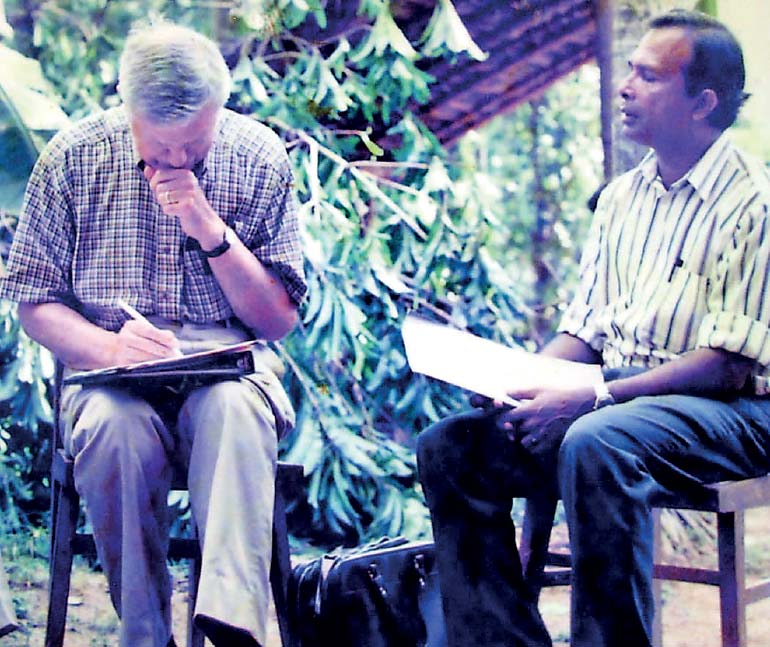
Tissa Jayawardena (right) and Ian Stevenson conducting a field interview in Sri Lanka
 According to a section of quantum physicists like the Nobel laureate Roger Penrose, consciousness is present in the vast universe, and a human being, to be born, simply borrows it from the universe at the time of birth, and returned at death
 Tissa Jayawardena, Ian Stevenson’s local research collaborator
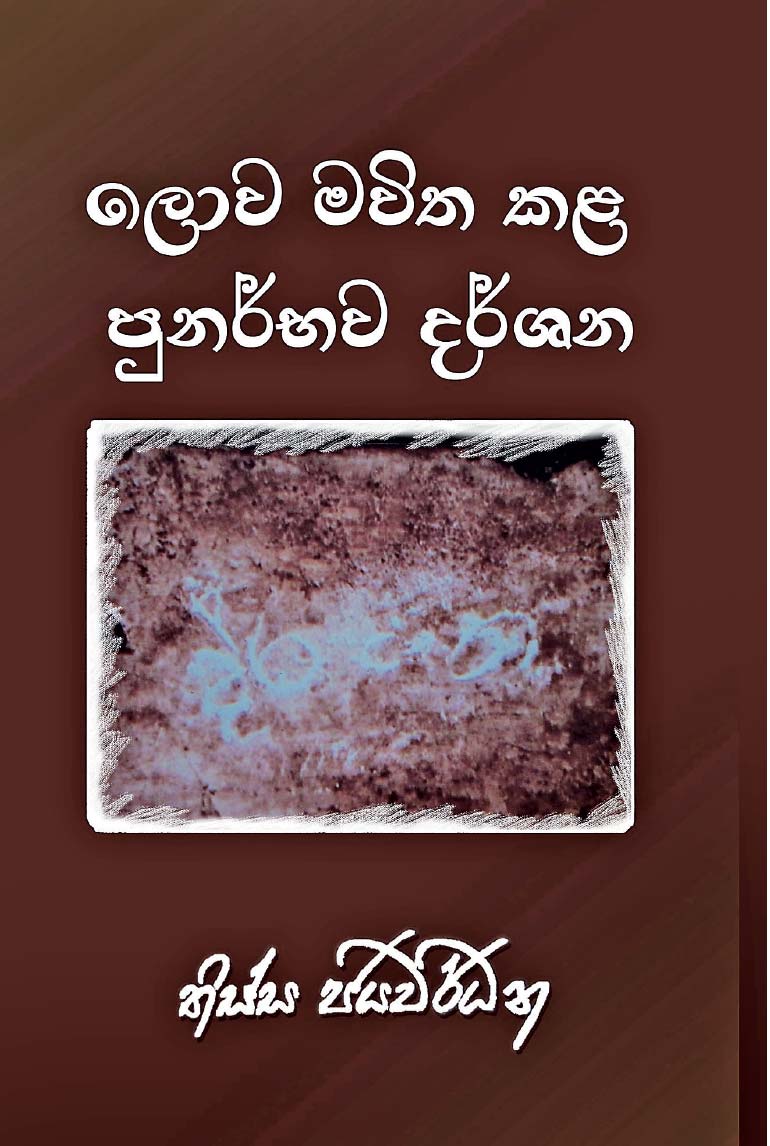
The veteran Sri Lankan researcher and writer on rebirth and reincarnation, Tissa Jayawardena, in his latest book containing research outcomes relating to amazing body signs of children who have spoken of previous births, has brought 35 stories suggestive of rebirth to Sinhala readers.
These stories had originally been published by their main researcher, the late Professor Ian Stevenson of Virginia University in the USA. Jayawardena had been Stevenson’s local research partner and, hence, a person privy to the background of these instances and the methodology used for arriving at the conclusions in the research. Jayawardena has published several dozens of books on the subject, and the current one is his newest.
Methodology adopted by rebirth researchers
The methodology used by rebirth researchers differs from the normal research methodology adopted in natural sciences, which provides an opportunity for other researchers too to test the results of the original experiment in repeated exercises.
As Austrian-British philosopher Karl Popper had established for identifying a scientific theory, those results will remain valid until another researcher disproves the same. However, the researchers on rebirth and reincarnation who operate in the realm of social sciences would first identify a person, usually a child of 3–6 years, who has spoken of a previous life and conduct a ‘controlled social experiment’ to establish whether the child’s revelations are suggestive of a previous birth.
This controlled experiment, which is similar to the procedure adopted by a judge who examines a witness in camera, takes the following form.
What the child reveals is documented in minute detail, checked with adults who had been associated with the revelations for accuracy and consistency, and a field experiment is conducted by exposing the child to the environment and the locality about which the child still remembers. Specific investigations are conducted about the physical appearance of the child in his/her present birth, like scars or deformities, to identify whether they have any connection with what he/she had undergone in the previous birth. If all these factors match, it is concluded beyond reasonable doubt that the story of the child is suggestive of a previous birth.
Unfortunately, these controlled experiments cannot be repeated by other researchers since the child who had remembered some incidents relating to the previous birth loses his/her memory of the same with the advancement of age. Hence, all these are single experiments that do not come within Karl Popper’s norm for a scientific theory. But it does not mean that they are unscientific. Anthropologists Bronislaw Malinowski in the 1930s and Jared Diamond in the 1960s completed ‘living-in-research studies’ in the Pacific Islands when they studied anthropological developments relating to the people living there.
The human soul in Buddhism is subject to continuous change, and the soul that leaves the body of a person is not the same as that which he had possessed earlier in life
|
Tissa Jayawardena latest research on rebirth
|
Buddha’s ever-evolving soul hypothesis
The stories which Jayawardena has presented in his book had happened in Sri Lanka, which has a majority Buddhist population that believes in rebirth. According to the Buddha, it is an evolved consciousness that transfers from one birth to the other and not a permanent or fixed self or soul. The Buddha’s Doctrine of Non-self or Non-soul means that there is no fixed soul in human beings as believed in many other religions. According to Him, what we know as the soul is subject to constant evolution, like the flowing waters of a river or the burning flame of a lamp.
The Buddha’s metaphor to describe this is that one cannot step into the same river twice or one cannot light a lamp by using the same flame that had existed an instant before. He has further paraphrased this with a paradox: the consciousness is not the same, but one cannot say that it is a different one either. Thus, the human soul in Buddhism is subject to continuous change, and the soul that leaves the body of a person is not the same as that which he had possessed earlier in life.
Those children who had spoken of a previous birth in the stories presented by Tissa Jayawardena had referred to experiences of children which had been close to or at the time of their death. Hence, rebirth stories refer not to previous lives in the distant past but those which they had lived just before their present birth.
Another important observation is that they do not talk about lives which they had lived as other species but only as humans. This is also compatible with Buddha’s continuous evolutionary theory of consciousness, which says that the evolution takes place in a forward direction and not in a backward direction. Hence, contrary to the sayings of some, a human being cannot be reborn as an animal, however many sins he may have committed in the present life. The future life will be a human life with poor evolution.
Entry of quantum physics
According to a section of quantum physicists like the Nobel laureate Roger Penrose, consciousness is present in the vast universe, and a human being, to be born, simply borrows it from the universe at the time of birth. For them, the human brain is simply a vehicle to accommodate, nurture, and evolve that consciousness. At the time of death, he returns it to the universe. In this model, the consciousness remaining in the universe is also subject to continuous evolution, just like the one within a human body.
Hence, what is being borrowed by a person who is to be born is not the same consciousness which had left a human body previously. Hence, there is a relationship between the consciousness within a human body, an objective phenomenon, and the vast universe out there, which is a subjective phenomenon. The Buddha has built a bridge between this objective world and the subjective world in the Rohitassa Sutta in the Anguttara Nikaya. He told the God Rohitassa that one should not go to the vast universe to find its characteristics; one could do so just by studying this fathom-long human body.
This poses a basic challenge to rebirth research. It is the continuously evolving consciousness within the physical body in the present life or out there in the universe which shows the continuity of a species belonging only to the category of Homo sapiens. The challenge is how to identify it.
In 2013, Nobel laureate Economist Robert J. Shiller demarcated a new branch of economics called Narrative Economics to analyse issues in mainstream economics by using stories. Thus, economics based on stories today remains side by side with economics that uses quantitative techniques to measure subtle economic relationships
A worry chosen to be resolved through religion
For many thousands of years, a worry which has pestered human beings is that ‘from where he had come, what is his purpose of living, and where he will go after his present life’. This consciousness is typical only to human beings, and it is one of the differences he shares with other species. For instance, a dog does not worry about these issues.
To answer these questions, mankind has created religion, which explores things beyond what we see in this physical world. Since they cannot be seen, touched, or experienced, they are relegated to a powerful spiritual entity which is beyond the reach of the modern scientific apparatus of human beings. They are left to human imagination, and all those stories about previous births fall into this category of imagined human experiences.
The power of stories or narratives
Stories are created to share those imagined human experiences with others and are passed from one generation to another to build up the general value system in societies. Thus, they are fundamental to the development and evolution of human civilisations or the shaping of value systems in man-made cultures.
As American psychologist David McClelland has told us, stories that are related to children by mothers and grandmothers serve to develop the achievement motive, which he coded as n-Ach or need for achievement, in their later life. When this happens society-wide, creating generations with high achievement motives, the human society concerned prospers. If mothers and grandmothers go on strike, keeping the stories to themselves, the low achievement motivation inculcated in posterity over a period will cause that society to begin to decline and eventually fall. McClelland has said that this was how civilisations like Rome gradually collapsed after reigning over the world for more than a millennium.
This general phenomenon relating to stories led Oxford-trained historian Yuval Noah Harari to conclude that no civilisation can exist without a repository of supporting stories to justify its existence. In this sense, presenting a theory by way of a story is not unscientific at all.
Its scientific foundation was developed by the 2013 Nobel laureate in economics, Robert J. Shiller, by demarcating a new branch of economics called Narrative Economics to analyse issues in mainstream economics by using stories. Thus, economics based on stories today remains side by side with economics that uses quantitative techniques to measure subtle economic relationships.
Narrative economics is in no way considered inferior to quantitative economics. Since Homo sapiens, Man the Wise, is wired to listen to stories rather than to absorb knowledge based on quantitative relationships, stories are better suited to impart knowledge within the extant society as well as from one generation to another. In this sense, episodes relating to rebirth and reincarnation presented in the form of stories by Tissa Jayawardena and Ian Stevenson cannot be categorised as unscientific.
What GABA tells us is that when our brain receives numerous pieces of information, it acts as a control device to filter that information and let us know only what we should know, while blocking the rest. It is like a radio which we can tune into a given frequency and receive radio transmissions
Problem of retrieving knowledge from the cloud or cyberspace
But after one’s death, where do these imaginations rest? Within the human body or outside? The human brain and its billions of neurons have a capacity limitation, like the computer which one uses. Hence, they cannot be stored within. The plausible explanation is that they are stored outside, like the present-day cloud in which we store data that we cannot store on our computers. Like this procedure, it is believed that all the images, words spoken, and experiences which we go through are stored in the cloud or in cyberspace, which is outside human bodies. It is known as non-somatic knowledge. Then, there must be a possibility of retrieving that information for our use at will, like a computer retrieves information stored in the cloud by using a password or that which is available in cyberspace by logging into the internet.
The co-founder of the Apple empire, Steve Jobs, while addressing an international designers’ convention in 1983, gave a clue to this. He expressed his frustration after reading Aristotle’s work because he wanted to ask some questions, but Aristotle was not available to hear him. He said that his future research activities would seek to build a machine which enables us to converse with those who are dead and gone. In this revelation, he implied that all that information is available out there, and it is the job of that machine to tune into that information and retrieve it. Unfortunately, Steve Jobs could not live long enough to deliver this machine to us.
The discovery of GABA
It is unlikely that such a machine will be developed in the foreseeable future. But there has been another path through which we will be able to tap that information available in the cloud. That is the development of the human brain and its capacity to tune into such knowledge available out there. The path to this has been cleared by the discovery of a neurotransmitter known as Gamma Aminobutyric Acid, or GABA, in the early 1950s.
What GABA tells us is that when our brain receives numerous pieces of information, it acts as a control device to filter that information and let us know only what we should know, while blocking the rest. It is like a radio which we can tune into a given frequency and receive radio transmissions. If it is not tuned properly, all the signals get mixed up, and we cannot hear what is being transmitted clearly. In that case, it is garbled. In the same way, if the GABA level is low, our brains fail to filter out the information they receive, and as a result, we do not get a clear image or a voice that helps us to understand the working of the real world. In the same way, if the GABA level is high, our brains can filter the information and let us know only what we should know. It is now known that mental diseases like chronic depression or physical diseases like epilepsy are caused by low levels of GABA in the brain.
There is a reason why only children speak of rebirth and not adults. Adults could say so confidently if they have developed their brainpower to focus on a single point, as in the case of those who are deeply ingrained in meditation or well trained in focus-improving techniques
Boosting GABA levels through training or meditation
GABA levels in the brain can be boosted by feeding the body with GABA-containing chemicals. But the brain has a barrier that blocks unnecessary chemicals from reaching it, called the blood-brain barrier or BBB. Then, the effectiveness of taking GABA chemicals externally to help one improve focus is diluted.
What can be done instead is to train the brain to boost its GABA levels naturally through focus-improving techniques like meditation or the development of brainpower through training. If this technique can be used, one will be able to tune into the vast knowledge available out there. It will help one to speak to Aristotle without relying on the unfulfilled wish of Steve Jobs.
Future rebirth research directions
In my view, Tissa Jayawardena and other researchers on rebirth should pursue this to find out whether what is being told by those children who talk about previous birth incidents refer to their own experiences or to the experiences of others which are available in the cloud by tuning into the same. This is a situation in which GABA levels are low. If it can be proved that the information revealed by the children relates to their own previous births, then the rebirth theory is established scientifically. But if they relate to incidents that are already available in cyberspace, then what is being revealed is due to low GABA levels in the brain.
But it is not a situation about which we should be worried because, with age, GABA levels start improving, and the person concerned will gain the ability to erase that from his memory. That is why only children speak of rebirth and not adults. Adults could say so confidently if they have developed their brainpower to focus on a single point, as in the case of those who are deeply ingrained in meditation or well trained in focus-improving techniques.
Recommendation
The book published by Tissa Jayawardena contains these limitations because he or Ian Stevenson did not have access to modern scientific discoveries at the time they conducted their research. There is a vacuum, and future researchers who are equipped with more sophisticated scientific apparatus should fill that vacuum. In my view, the research done by Tissa Jayawardena and Ian Stevenson will provide a foundation for such research.
(The writer, a former Deputy Governor of the Central Bank of Sri Lanka, can be reached at [email protected] )