Tuesday Sep 15, 2026
Tuesday Sep 15, 2026
Monday, 19 January 2026 03:32 - - {{hitsCtrl.values.hits}}

Dr. Nimal Sanderatne (right) receiving a copy of the book ‘Development Not By Economics Alone: Non-Economic Factors in Development’ from Sri Lanka Economic Association President Prof. Sirimewan Colombage
 Both the Government and the people have to be more pragmatic. We should look to future gains rather than indulge in incessant debate about the past. Economic policies must be formulated in relation to current domestic conditions and a realistic appraisal of the global situation. A new work ethic must emerge to enhance labour productivity, and at the same time, more incentive-oriented management systems that ensure greater sharing of gains between owners, management, and employees must be worked out. Employment policies that are flexible must be instituted to enable private enterprises to take risks as well as enforce discipline
 Looking holistically at development
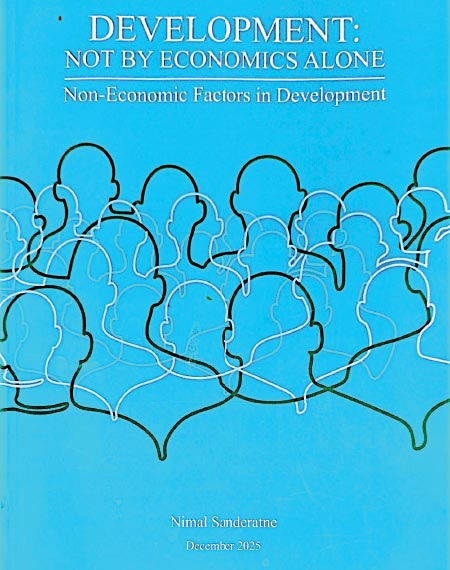
The prestigious economist and Central Bank’s former Economic Research Director, Dr Nimal Sanderatne has ventured into exploring issues relating to development in the form of a compressed thesis titled ‘Development Not By Economics Alone: Non-Economic Factors in Development’ [1] published by the Gamani Corea Foundation of which he had been a former Chairman. His latest publication challenges readers to revisit the concept of development which has become an issue not only for development policymakers but also for philosophers and social reformers.
Writing a foreword to the Sanderatne thesis, Sri Lanka’s veteran development planner cum founder of the non-state sector economic think tank, Marga Institute, Dr Godfrey Gunatilleke, qualifies Sanderatne’s work as follows: “Sanderatne is writing the book as an economist, keeping in mind the proclivity in his own discipline to give primacy to the economic component when dealing with development. He therefore takes pains to correct this bias. He does this with a fine scholarly restraint without any undue derogation of the economic factor. What he seeks to emphasise throughout the book is that each of the different components of development, economic and non-economic, has an autonomous existence and processes (of) its own independent value, contributing to the total wellbeing of the individual” [2].
Thus, Sanderatne has presented to us the concept of development from a holistic point, deviating from the more recent treatment of the subject purely as an economic phenomenon. The purpose of his treatise has been to identify the so called non-economic factors – social, political, cultural, environmental and so on – that contribute to the well-being of people as individuals and as members of society.
|
Cover of ‘Development Not By Economics Alone: Non-Economic Factors in Development’ authored by Dr. Nimal Sandaratne
|
Kautilya: Final goal of living is self-perfection
In my view, the dichotomy created in the analysis of the well-being of people as economic and non-economic is a recent development. About 2300 years ago, the Indian Sage Chanakya, writing under the pen name Kautilya, presented to us the oldest but still surviving treatise of economics titled ‘The Arthashastra’ or the Science of Economics [3]. The Arthashastra is a textbook prepared for educating the prospective rulers in the fine arts and the science of statecraft. There is evidence that rulers even in a far island like Sri Lanka had been trained in statecraft by using the philosophy of Chanakya. For instance, Chulavansa, Part II of the Great Chronicle Mahavansa reports that King Parakramabahu I who ruled Sri Lanka from Polonnaruwa as the seat of administration in the 12th century CE had been well equipped with ‘the power of the wisdom of Chanakya’ when he was being trained as the future ruler of the country [4].
According to the treatment of the subject in the Arthashastra, the science of economics in ancient times included not only the subject which we learn as economics, but also politics, religion, culture, social sciences, international relations, public finance, human resource development, warfare, internal and external trade, and justice and punishment, to mention but a few. Kautilya says that the final goal of a person as an individual or as a member of society is to attain Moksha or self-perfection [5].
There are three pillars in society that will help a person or society to reach self-perfection. They are Dhamma or a moral code, Artha or provision of material goods and services, and Kama or living a happy and fruitful householder life that includes the rearing of children as worthwhile citizens of society. Though all these three pillars are equally vital for the sustenance of society, Kautilya has further elaborated on the role of the Artha or the economic side of the pillars in human development.
Says Kautilya: “The root of wealth is economic activity and lack of it brings material distress. In the absence of fruitful economic activity, both current prosperity and future growth are in danger of destruction” [6]. Therefore, it is the duty of the king, or in the present-day, the State, to promote the welfare of his people since it helps him augment his power, since power comes from the countryside which is the source of all economic activity [7]. Thus, in ancient times what had prevailed in society had been a holistic treatment of the well-being of people. In modern times, economic Gurus and policymakers have tended to ignore this vital aspect of prospering human societies. Sanderatne’s present work is a revisit to this important requirement.
Long conviction of need for holistic approach
Sanderatne says that the present work is the outcome of his long conviction as a professional economist – in my view it spans for over six decades – that development should be approached from a holistic point considering economic as well as non-economic factors.
Says Sanderatne: “Therefore, for quite some time, my perspective has been one of attempting to understand economic problems as social issues with many non-economic dimensions. This book is the result of that way of thinking. My approach has been as a social scientist rather than an economist. This led me to study a number of issues that were an extension of economics. The political economy of agrarian change, the impact of demography on development, and education as a key factor in social change are among these explorations. This book reflects these interests of mine within the framework of thinking that economic growth and development cannot be achieved by economics alone” [8].
He, thus, goes onto present the preconditions that are needed for rapid development. For that, a country should undergo cultural, political, and social transformation, providing the factors conducive for development to take place. Any country that fails to attain this conducive transformation, according to Sanderatne, will be eternally grappling with the issue of attaining development. An exception is Singapore which was able to implement the needed transformation under the visionary leadership of its founding Prime Minister, Lee Kuan Yew. This visionary leadership is a non-economic factor contributing to development and even in Kautilya’s Arthashastra that responsibility was assigned to the king.
Sanderatne’s argument is that even the economic factors that contribute to economic development like efficiency of factors of production or quality of investment are dependent on cultural, political, and institutional factors. They are necessary preconditions for development and in the absence of these preconditions, it is unlikely that a country can foster rapid economic development. According to Sanderatne, cultural factors help economic development on two counts
Necessary prerequisites of development
Sanderatne, then, goes onto explain those non-economic factors that contribute to economic development. Sanderatne’s argument is that even the economic factors that contribute to economic development like efficiency of factors of production or quality of investment are dependent on cultural, political, and institutional factors. They are necessary preconditions for development and in the absence of these preconditions, it is unlikely that a country can foster rapid economic development. According to Sanderatne, cultural factors help economic development on two counts.
First, they stimulate the economic factors. Second, they influence even the determination of the size of these economic factors making them more productive. He has defined the cultural factors as attitudinal, social, cultural, religious, political, educational, administrative, legal, and institutional phenomena that are conducive for economic development.
Colour of the cat issue
Cultivating correct attitudes in people to work, save, invest, invent, innovate, compete etc. are as important as instilling in them technology, and work skills. Sanderatne says that attitude toward work, work ethics, punctuality, honesty, social cohesion, and modes of thinking determine key economic prerequisites for development. If they are in the right direction, they are helpful to development. If they are not, they are inimical to development. In this context, he has hailed the need for adopting a pragmatic approach to opinion making thereby shedding hard-held dogmatic views.
An example he has quoted is the shedding of socialistic dogmas by both China and Vietnam for the sake of rapid economic advancement. He has attributed a saying that ‘do not care whether a cat is black or white, as long as it catches mice’ to Chinese Premier Xi Jinping. But as quoted by Daniel Yergin and Jospeh Stanislaw in ‘The Commanding Heights’, it had been made by China’s reformist leader Deng Xiaoping when he transformed China from communism to State capitalism in 1979 [9]. But this statement is eternal since it is an attack on dogmatic addictions that stunt growth momentum.
State sector bribery and corruption
Sanderatne has drawn our attention to the incidence of bribery and corruption in the public sector as a deterrent to economic development. Says Sanderatne: “Bribery and corruption in the public services is another serious impediment to development. The notion that corruption lubricates economic growth has been jettisoned, and the widely held view today is that it is a significant deterrent to development. Bribery and corruption, inter alia, distorts public decision making; increases the cost of the public projects, especially the large ones like infrastructure; compromises on the quality of public projects; increases the private sector costs; and is a disincentive to foreign investment. Levels of corruption have to be reduced drastically to provide an environment conducive to proper decision making, efficient project implementation, and to attract foreign direct investment” [10].
Sanderatne has presented to us the concept of development from a holistic point, deviating from the more recent treatment of the subject purely as an economic phenomenon. The purpose of his treatise has been to identify the so called non-economic factors – social, political, cultural, environmental and so on – that contribute to the well-being of people as individuals and as members of society
Importance of private sector bribery and corruption
Though Sanderatne has referred only to public sector bribery and corruption, it is now widely held that private sector bribery and corruption, also called private to private corruption, are also a significant problem for rapid economic growth with its severe economic and social consequences. A report issued by the UN Office on Drugs and Crime under the title ‘Knowledge Tools for Academics and Professionals’ has noted that the occurrence of private sector corruption is also high [11]. Private corruption affects the entire supply chain, as it distorts markets, undermines competition, and increases costs of firms. It is a serious problem for the well-being of societies since it prevents a fair and efficient private sector, reduces the quality of products and services, and leads to missed business opportunities. In this connection, although Sri Lanka’s new bribery and corruption laws have included private sector bribery and corruption too as punishable offences, a report published by Sri Lanka’s non-state sector think tank Verite Research, in 2025 has identified nine key gaps in the country’s legal framework compared to best practices recommended by UN Convention Against Corruption or UNCAC [12]. Hence, it is necessary that Sri Lanka’s legal system should be strengthened to address these issues if the absence of bribery and corruption is to stimulate economic development of the country.
Although Sri Lanka’s new bribery and corruption laws have included private sector bribery and corruption too as punishable offences, a report published by Sri Lanka’s non-state sector think tank Verite Research, in 2025 has identified nine key gaps in the country’s legal framework compared to best practices recommended by UN Convention Against Corruption or UNCAC. Hence, it is necessary that Sri Lanka’s legal system should be strengthened to address these issues if the absence of bribery and corruption is to stimulate economic development of the country
Need for changing attitudes and values
Commenting on Sri Lanka’s attitudinal and value systems that hinder economic development, Sanderatne has emphasised that there is an urgent need for transforming these values to usher economic development.
Says Sanderatne: “The excessive politicisation of society and its divisive character are detrimental to economic growth and have to be addressed. A more national outlook with long-term perspectives should replace the current partisan, individualistic, and short-term approaches to fundamental issues. Both the Government and the people have to be more pragmatic. We should look to future gains rather than indulge in incessant debate about the past. Economic policies must be formulated in relation to current domestic conditions and a realistic appraisal of the global situation. A new work ethic must emerge to enhance labour productivity, and at the same time, more incentive-oriented management systems that ensure greater sharing of gains between owners, management, and employees must be worked out. Employment policies that are flexible must be instituted to enable private enterprises to take risks as well as enforce discipline” [13].
Unproductive debate over education reforms
This is a fine advice to Sri Lankan people, their political leaders, businessmen and civil society activists. They should learn how to debate and what to debate. This should not be an offending suggestion to Sri Lankans, the majority who follow the preaching of the Buddha. Emperor Asoka who was responsible for transmitting the teachings of the Buddha to Sri Lankans some 2300 years ago had advised in one of the Rock Edicts that if criticism is needed it should be done in a mild way, always honouring the opponent [14].
A pertinent example is the educational reforms being proposed by the present Government. The Government has failed to communicate its program well to people who have also failed to apprise them in the correct perspective. As a result, as Sanderatne has observed, Sri Lankans have been engaged in unproductive debate, postponing the issue of education to the future. Above all, criticisms by both the advocates from the Government side and the opponents to education reforms have not been mild at all. This is only one example, and it is typical of Sri Lankans’ bad attitudes and values.
Sanderatne should be commended for publishing this book for the country’s readers.
(The writer, a former Deputy Governor of the Central Bank of Sri Lanka, can be reached at [email protected] )
Endnotes
1Sanderatne, Nimal, 2025, Development Not By Economics Alone: Non-Economic Factors in Development, Gamani Corea Foundation, Colombo.
2 Ibid, p 1.
3 Kautilya, The Arthashastra, L N Rangarajan Translation, 1992, Penguin Books. Kautilya has recognised the work of 14 previous Gurus of economics, but their works are not available today.
4 Mahavansa Part II, Mudaliyar L C Wijesinha Translation, 2000, Asian Educational Services, New Delhi, p 127.
5 The Arthashastra, op cit., p 13.
6 Ibid, p 177.
7 Ibid, pp 180-1.
8 Sanderatne, op cit., p 5.
9 Yergin, Daniel and Stanislaw, Jospeh, 1998, The Commanding Heights: The Battle for the World Economy, A Touchstone Book, p 187.
10 Sanderatne, op cit., p 22.
12 Handy, Michelle et al, 2025, Gaps in the Guardrails: A Review of Laws on Private Sector Corruption in Sri Lanka, Verite Research, Colombo.
13 Sanderatne, op cit., pp 32-3.
14 See Edict 12 in https://www.accesstoinsight.org/lib/authors/dhammika/wheel386.html