Tuesday Sep 15, 2026
Tuesday Sep 15, 2026
Monday, 9 March 2026 04:30 - - {{hitsCtrl.values.hits}}
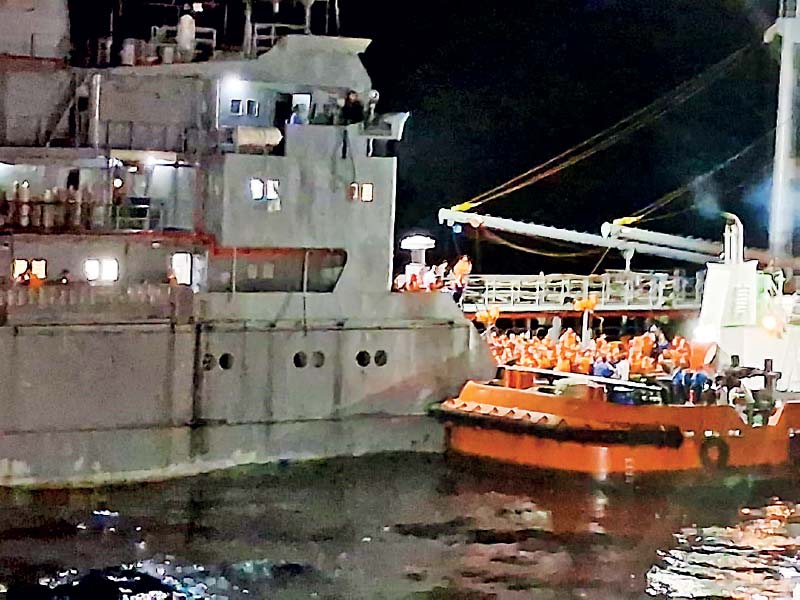
While the economic fallout of the Mideast war is likely to cause real harm to Sri Lanka’s economy, the rescue of Iranian naval personnel has also placed the country at the centre of global attention
 The present estimate is that the oil prices will advance to about $120 per barrel soon. If this happens, Sri Lanka’s oil bill will go up from the current $ 2.5 billion to $ 5 billion. This is an unaffordable cost increase in Sri Lanka’s case. In addition to the direct increase in costs, there is a cascading increase in the costs of all other economic activities from transport to electricity generation and more, killing Sri Lanka’s slowly recovering economy as remittances, tourism earnings and FDI take a hit too
 Slow-recovering economy hit again
In the last four years, Sri Lanka was hit by three devastating economic shocks – two external shocks and one internal man-made shock. The external shocks in the form of the COVID-19 pandemic and cyclone Ditwah were delivered from outside the country, while the internal shock in the form of an unprecedented economic crisis was the country’s own making. I have written about all the three shocks in this series previously and interested readers can log into the link given in the endnotes to know more [1].
All the three shocks were responsible for creating macroeconomic imbalances like high inflation, depleted foreign reserves and falling exchange rates, balance of payments difficulties, and worsened public finances leading to unsustainable public debt on the nominal side of the macroeconomy and negative or low economic growth contributing to the elevation of poverty levels, unemployment, and the collapse of the micro, small, and medium enterprises in the real side of the economy.
Fortunately, with the support from the International Monetary Fund and friendly nations, Sri Lanka began to recover from the crises slowly but steadily. The recovery from a crisis is a long process, and as the IMF representative in Sri Lanka, Martha T Woldemichael, had correctly pronounced in a recent public address, it is ‘not a finished story’ yet [2]. She had highlighted the need for sustained reforms, fiscal credibility, and policy consistency to translate the emerging poor macroeconomic stability into lasting improvements in living standards and to build investor confidence. What this means is that the economy is not yet off the hook and Sri Lankans should continue the painful suffering for some more time until the crisis levels are brought to a control.
Sri Lanka presently imports about 44 million barrels of crude oil annually to meet its current demands from transportation as well as electricity generation. If oil prices increase by $ 10 per barrel, it would mean an additional expenditure of about $ 420 million. Within a week of the commencement of the war, oil prices have gone up by about $ 20 per barrel. If this persists during the whole year, the additional oil bill will be about $ 820 million
Far reaching economic consequences
In this background, the US-Israel coalition-led attack on Iran in late February 2026 is forcing the country, along with other global nations, to undergo another external crisis. The initial assertion by President Donald Trump was that the goals of the conflict would be attained in two to three days [3]. This was soothing news for world nations which were already suffering from the initial heat of the disastrous economic fallout from the Mideast crisis like rising energy prices and disruption to the global trade flows including remittances and earnings from tourism. However, when defiant Iran fought back valiantly despite the annihilation of its Supreme Leader and 48 of top leaders, expanding the war to regional neighbours, Trump soon revised his end-date to four to five weeks or longer [4].
A prolonged war in the Mideast that is also dragging other nations into the fray is not a welcome sign for the global economy as highlighted by the IMF’s Managing Director Kristalina Georgieva in a recent international conference held in Bangkok [5]. She said that if the war is prolonged, it will obviously deliver a global economic shock by increasing energy prices, downgrading market sentiments, hurting global economic growth, and raising presently subdued inflation levels, thereby making new demands on policymakers. If these adversities are placed in terms of severity on a line, Sri Lanka’s wounded economy stands at the farthest end.
This war is not creative destruction
All wars are destructive in terms of human life, accumulated wealth and capital stocks. Unfortunately, they do not meet the requirements of a favourable side of destruction, creative destruction, a situation referred to by the 19th century French economist Frederic Bastiat in 1850 [6] and coined more recently by the Austrian American economist Joseph Schumpeter [7]. People of the countries which are directly involved in the war will have to bear the war bill. Each passing day, they would sacrifice their welfare to replenish the used-up or destroyed arsenal of weapons. Given the current high costs of sophisticated modern weaponry, this is an unaffordable high cost. Then, there is the loss of life which cannot be replenished, and the destruction of property. People who had been leading a comfortable lifestyle are immediately converted to paupers. Look at the high-rise buildings and the modern infrastructure that have been destroyed by continued missile attacks in Tel Aviv or Teheran or Dubai or Abu Dhabi, to mention but a few.
Modern civilisations have invested heavily in their talents, creativity, and foresight to build themselves up. But now it is a pathetic scene to observe that they are simply ghost-infested skeletons of buildings, with debris scattered all over. This is the direct destructive cost incurred by those who are directly involved, as well as by those who are merely bystanders. And the economic fallout, as described by the IMF Chief, will affect and damage other countries as well.
A country like Sri Lanka, which does not have the internal capability to emerge from an externally enforced crisis, is likely to suffer the most. Until now, Sri Lanka has depended on friends for support. But now those friends are also equally affected and are not in a position to extend a helping hand.
Getting dragged into war
Sri Lanka has been far from the conflict zone. In every global conflict, it has always maintained a neutral stand. Even in the present war between the USA and Iran, Sri Lanka’s Foreign Minister is reported to have advised his counterpart in Iran to resolve the issue through diplomatic dialogue [8].
But two events that had taken place in the recent past has put the country at the centre of global attention. One was the distress call which Sri Lanka’s coast guards received on 4 March 2026 from a ship which had allegedly been sea-wreaked in international waters but within Sri Lanka’s extended economic zone [9]. Later, it was revealed that the ship in question was an Iranian frigate which had been on its way to Iran after participating in a naval exercise at the invitation of the Indian Navy. The frigate, as revealed by US authorities, had been hit by a torpedo fired by a US submarine, instantly destroying it. Sri Lanka had rescued 32 sailors and recovered about 87 bodies. The other was the rescue of 204 crew members from a second sea-wreaked Iranian war ship that had allegedly developed engine trouble within Sri Lanka’s economic zone [10].
In both cases, Sri Lanka had afforded to the affected crew members of those ships, humanitarian assistance in terms of its obligations under international conventions. So far, it has managed the situation professionally without taking a side. It is reported, as revealed by President Anura Kumara Dissanayake in a recent press briefing, there had been a request to Sri Lanka from Iranian authorities for allowing three Iranian ships to be docked in a Sri Lankan port, but the Government had not given a final word about it [11]. But international media has compared it to a strange situation where Sri Lanka now finds itself ‘hosting the human wreckage from a war fought on its doorsteps’ by other hostile parties [12]. This is inevitable when you are caught up between two powerful enemies who are at war with each other.
To prove this point, it is reported by Reuters that it has seen an internal US State Department cable which pressurises Sri Lanka not to repatriate the survivors from the Iranian warship it sank in the Indian Ocean as well as the crew of the second Iranian ship that is in Sri Lanka’s custody [13]. This is a diplomatic battle, and it is best for Sri Lanka not to get dragged into it as a party and get itself hurt. It is encouraging that Sri Lanka’s Foreign Minister Vijitha Herath has reiterated Sri Lanka’s stand on the issue that it will follow international laws and conventions regarding the repatriation of the sailors in question [14].
Oil price shocks
The Mideast war immediately affects Sri Lanka’s economic performance. The negative economic fallout could be contained within manageable limits if the war ends within the next few weeks. That fallout taking the form of high energy prices, reduced remittances flows, low tourist arrivals will have a deleterious effect on the country’s foreign exchange management efforts.
Sri Lanka presently imports about 44 million barrels of crude oil annually to meet its current demands from transportation as well as electricity generation. If oil prices increase by $ 10 per barrel, it would mean an additional expenditure of about $ 420 million. Within a week of the commencement of the war, oil prices have gone up by about $ 20 per barrel. If this persists during the whole year, the additional oil bill will be about $ 820 million.
India’s case is more precarious since it imports about 1.9 billion barrels of oil annually. An increase of oil prices by $ 20 per barrel means that India will have to spend additionally about $ 76 billion. With the closure of the Strait of Hormuz to tankers that carry oil and the attack on major oil refining facilities in the Mideast, there will be a shortage of oil in global markets. The present estimate is that the oil prices will advance to about $120 per barrel soon. If this happens, Sri Lanka’s oil bill will go up from the current $ 2.5 billion to $ 5 billion. This is an unaffordable cost increase in Sri Lanka’s case. In addition to the direct increase in costs, there is a cascading increase in the costs of all other economic activities from transport to electricity generation and more, killing Sri Lanka’s slowly recovering economy. India will be hit deeply if oil prices reach $ 120 per barrel because it will increase its current oil bill from around $130 billion to about $ 228 billion which is several times more than the total GDP of many countries in the world.
The economic fallout from the Mideast war is a ‘national disaster’ for Sri Lanka. It is a disaster that should be tackled through a united effort by all, rather than through efforts based on narrow partisan lines. If Sri Lankan leaders could shed their ideological and political differences at this crucial hour, the country could rise together
Remittances and FDI shocks
With the Mideast war getting prolonged, those countries which get remittances from that area of the globe will also be severely affected. At present, Sri Lanka gets about 40% of its remittances from the Mideast countries [15]. This works out to about $ 3.2 billion out of a total of $ 8 billion which the country received in 2025. Therefore, any decline in the remittances flows will be a severe blow to the country’s ailing but slowly recovering balance of payments.
India is also worse affected in this context because it also receives about 38% of its total remittances from Mideast countries. A report filed by the Mint media says that a prolonged war will affect about $ 51 billion from the Mideast countries out of a total of about $ 135 billion received in 2025 [16]. These risky developments in India will have a cascading effect on Sri Lanka since it will not be able to support Sri Lanka by way of forex loans as it had done in the past. So, Sri Lanka has been hit by a double whammy due to the unanticipated Mideast war.
The Government seeks to claim full credit for the economic rescue efforts being made in the country. The Opposition, while paying lip service to those efforts, has not resolved to offer wholehearted support to make them a success. This is pathetic and, in my view, both the Government and the Opposition should work together to bring the country out of the ongoing economic malaise for which Sri Lanka is not responsible
Impact of tourism flows
The Mideast war will kill Sri Lanka’s economy on two other counts too. One is its impact on tourism inflows. The other is how it will cause a curtailment of foreign direct investment flows. Presently, Sri Lanka is jubilant about the record number of tourists visiting the country adding foreign exchange to the country’s reserves and creating direct as well as indirect employment through various activities associated with the hospitality trade. The disrupted air travel as well as the decline in incomes will place a spanner in the country’s tourism development works. The slow progress in these two areas will create an unfillable dent in the country’s economy.
A national disaster needing full cooperation from all
Hence, the economic fallout from the Mideast war is a ‘national disaster’ for Sri Lanka. It is a disaster that should be tackled through a united effort by all, rather than through efforts based on narrow partisan lines. If Sri Lankan leaders could shed their ideological and political differences at this crucial hour, the country could rise together.
The Government seeks to claim full credit for the economic rescue efforts being made in the country. The Opposition, while paying lip service to those efforts, has not resolved to offer wholehearted support to make them a success. This is pathetic and, in my view, both the Government and the Opposition should work together to bring the country out of the ongoing economic malaise for which Sri Lanka is not responsible.
(The writer, a former Deputy Governor of the Central Bank of Sri Lanka, can be reached at [email protected] )
Endnotes
1Log into: https://www.ft.lk/w-a-wijewardena-columns/885
2https://economynext.com/imf-rep-warns-sri-lankas-success-is-not-a-finished-story-at-investor-forum-262282/
3https://www.theguardian.com/commentisfree/2026/mar/03/trump-iran-war-emergency-powers
4https://www.youtube.com/watch?v=QhoMsfcJJhg
5https://www.chinadailyasia.com/hk/article/629887
6Bastiat, Frederic, 1850, Selected Essays on Political Economy, Example of Broken Window, at https://www.econlib.org/library/Bastiat/basEss.html?chapter_num=4#book-reader
7 Schumpeter, J A, 1942, Capitalism, Socialism and Democracy, Harper & Brothers, Chapter VII.
8https://www.facebook.com/share/p/1AA2yadGo7/
9https://www.reuters.com/world/asia-pacific/sri-lanka-rescues-30-people-board-distressed-iranian-ship-foreign-minister-says-2026-03-04/
10 https://www.aljazeera.com/news/2026/3/5/sri-lanka-evacuates-crew-of-second-iranian-vessel-after-us-sunk-iris-dena
11https://economynext.com/sri-lanka-was-assessing-irans-request-for-3-ships-since-feb-26-before-us-strike-president-263126/
12https://www.aljazeera.com/news/2026/3/5/sri-lanka-evacuates-crew-of-second-iranian-vessel-after-us-sunk-iris-dena.
13 https://www.facebook.com/share/p/18eBMB6PXL/
14https://x.com/wangu_news18/status/2030172495098290328?s=46
15https://www.ips.lk/talkingeconomics/2026/02/06/record-remittances-to-sri-lanka-hidden-realities-behind-the-headlines/#:~:text=Worker%20remittances%20to%20Sri%20Lanka,departures%20experienced%20in%20recent%20years.
16https://www.youtube.com/watch?v=VEn8kSkvrAQ#:~:text=Indian%20Remittances%20Worth%20$50Bn%20To%20Be%20Impacted%20If%20War%20Prolongs&text=Almost%201%20Cr.,.com/c...




