Friday Oct 02, 2026
Friday Oct 02, 2026
Monday, 3 August 2026 00:26 - - {{hitsCtrl.values.hits}}
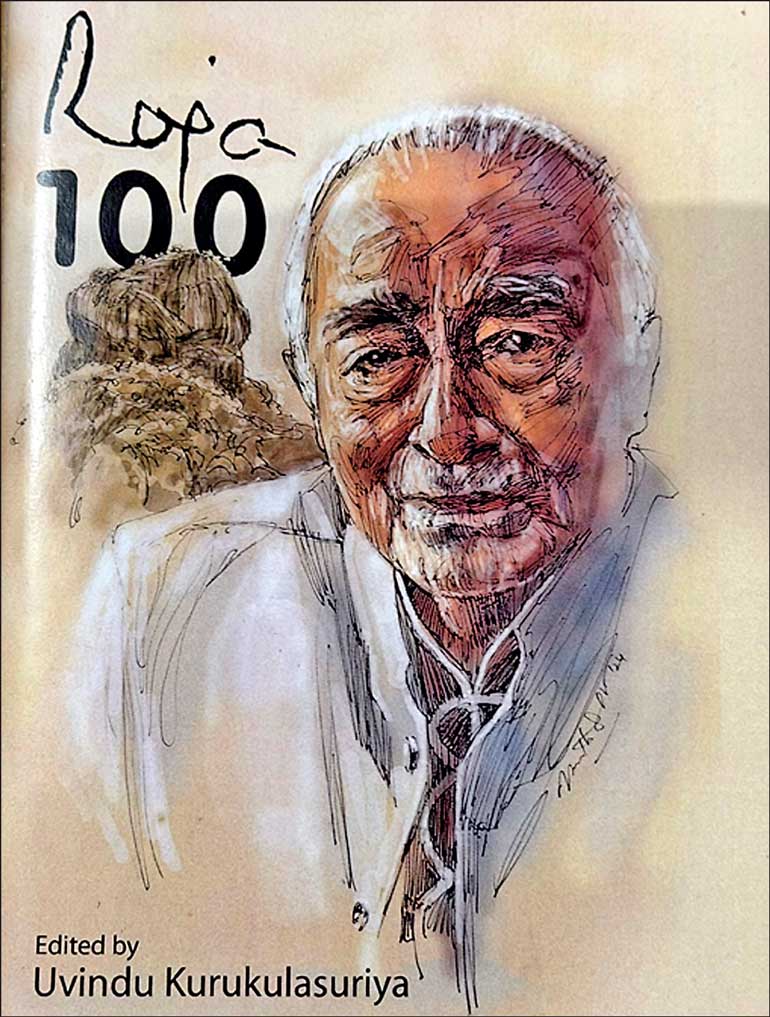
Book cover of ‘Raja the 100’
 A disciplined man in family and work
Two years ago, Dr. Raja de Silva, Sri Lanka’s most prominent archaeologist, celebrated 100 years of life. That itself was a remarkable milestone in a country where the average life expectancy for a male is just about 72 years. Since then, he has passed away. Had he still been with us today, he would have celebrated his 102nd birthday.
To mark his historic 100th birthday, the well-known journalist Uvindu Kurukulasuriya compiled a special publication titled ‘Raja the 100’. He invited Raja’s closest friends, colleagues, and relatives to contribute brief articles and personal essays. They wrote beautifully about him as an affectionate family man, a highly responsible citizen, and praised his immense contributions to uncovering the lost history of Sri Lanka. In all aspects of his professional work, he challenged the orthodox wisdom of history like a true scientist and, hence, dared to be different.
His relatives and children saw him as a deeply dedicated family man who balanced immense warmth with clear, unyielding principles. Within the walls of his home, his children knew him as a strict disciplinarian. He was a father from an older generation who did not believe in spoiling his children; he went to the extent of smacking them on the limbs when they had done something wrong or behaved poorly. However, he never punished without purpose. He always tried to correct them by setting himself as an excellent example to emulate.
He believed that character was built through hard work and quiet determination. He used to tell his children a famous quote from the 19th-century American poet Henry Wadsworth Longfellow to guide their daily efforts: “The heights by great men reached and kept were not attained by sudden flight, but they, while their companions slept, were toiling upward in the night.”
To ensure his children truly understood the value of this dedication, he regularly took them along on his arduous archaeological field trips to different parts of Sri Lanka. Through these journeys, they had a firsthand opportunity to see the harsh conditions under which he worked and to learn exactly what their father had been doing for the country. Because of these rich life experiences, his children consider it a lifetime privilege to have shared his journey and to have wished him on his 100th birthday.
His brother, Chari de Silva, also noted that while Raja was a man of great humour and loved fun, he possessed an intense seriousness about his studies, scientific research, and even his hobbies. For instance, he brought that same fierce focus to the game of table tennis, which he played competitively at both school and university levels. Furthermore, his close relatives fondly noted that he was a master storyteller. He was a true raconteur who could walk into any room, command attention, and entertain an audience for hours with his highly engaging, witty, and educational stories.
Scientific eye in early professional life
In his early professional life, Raja approached the ancient history of Sri Lanka with a unique, revolutionary edge. Equipped with a strict education in the natural sciences, he looked at ancient ruins and artefacts with the unwavering, cold eye of a scientist. 
He strongly believed that history should be based on physical evidence that can be tested, rather than on folklore or emotional stories. Most importantly, he did not want to allow racial or nationalistic undertones to permeate the field and distort the scientific basis of archaeology.
During the mid-20th century, much of the historical writing on the island was influenced by popular cultural biases and emotional narratives. Raja firmly refused to accept any popular wisdom that sought to present the country’s history from a biased or unscientific viewpoint.
He knew that allowing political or cultural agendas to dictate archaeology would destroy the integrity of the science. By demanding hard empirical facts, reproducible chemical tests, and strict stratigraphic evidence over comfortable myths, he proudly dared to be different right from the inception of his career.
Raja’s academic journey laid a rock-solid foundation for this scientific approach. As a bright alumnus of Royal College, Colombo, he pursued his higher studies with great focus and determination. He earned a Bachelor of Science degree in Chemistry from the University of Ceylon and, later, a second Bachelor of Science degree from the University of London.
His passion for deeper scientific exploration led him to the prestigious University of Oxford in the United Kingdom, where he obtained his Doctor of Philosophy. This advanced training in chemistry and material sciences gave him a rare, elite skill set in a field that was traditionally dominated by linguists, monks, and classical historians who focused entirely on reading old palm-leaf chronicles.
In 1949, he officially joined the Department of Archaeology as an Assistant Commissioner. He made history by becoming the very first person with a formal background in chemistry to be appointed to the department. He immediately recognised that Sri Lanka’s ancient artefacts needed physical protection and chemical preservation just as much as they needed historical interpretation. He focused heavily on scientific conservation and established the department’s first proper chemical laboratory. This laboratory played a major role in saving the island’s material heritage, especially through the careful chemical restoration of ancient temple paintings and decaying stone inscriptions.
His sheer dedication, brilliance, and administrative efficiency eventually led him to serve as the Commissioner of Archaeology from 1967 to 1979. During this golden era, he performed a unique service by bequeathing Sri Lanka’s genuine, unaltered historical heritage to the global community.
Uncovering Mahayana Buddhist influence
Among the many tributes in Uvindu Kurukulasuriya’s publication, a highly detailed and enlightening article was contributed by one of Raja’s close relatives, Anuradha Dullewe Wijeyratne, under the title “Vidyajyothi Dr Raja de Silva, One of Sri Lanka’s Greatest Archaeologists”. In this tribute, Wijeyratne sheds light on how Raja’s research radically altered our understanding of religion in early Sri Lankan history. Specifically, Wijeyratne points out that Raja had done substantial, groundbreaking work on the heavy influence of the Mahayana sect of Buddhism during the early centuries of the island’s history.
For generations, orthodox historical narratives tended to downplay or overlook any group outside the mainstream Theravada Buddhist tradition.
However, through careful analysis of artefacts, inscriptions, and architectural styles, Raja showed considerable evidence proving that the Mahayana sect of Buddhism had deeply penetrated Sri Lanka’s Buddhist worship during these early days. It was not a minor, fringe movement; it was a powerful theological force that influenced kings, artists, and common people alike.
According to Wijeyratne’s analysis of Raja’s work, one of the most beautiful manifestations of this Mahayana influence was the widespread worship of Tara Devi (the female deity or Bodhisattva of compassion). In Mahayana theology, Tara Devi represents universal compassion and acts as a saviour who protects souls as they cross the sea of suffering. Raja brilliantly argued that the worship of Tara Devi on the island was a direct reflection of man’s deep-seated, universal urge for protective, divine maternal care.
When life was uncertain due to famines, wars, or diseases, the ancient people of Sri Lanka looked for a comforting mother figure in their spiritual world. Theravada Buddhism was highly philosophical and focused on self-reliance, but Mahayana Buddhism offered the warm, protective embrace of a mother through Tara Devi. Raja discovered that this emotional and spiritual need left a massive mark on the art and architecture of ancient Sri Lanka, most notably at the iconic rock fortress of Sigiriya.
Redefining the mystery of Sigiriya
For nearly a century, orthodox historians and colonial archaeologists had told a romantic, dramatic story about Sigiriya. They claimed it was a secular pleasure palace built by the parricide King Kasyapa in the fifth century, who fled to the rock to hide from his brother’s wrath. The world-famous frescoes painted on the sheer rock face were universally described as King Kasyapa’s beautiful queens, concubines, or court ladies enjoying themselves in a luxurious, worldly paradise.
Raja looked at these claims with his trademark scientific scepticism and found the secular palace theory completely lacking in evidence. Armed with physical data, architectural layouts, and a deep knowledge of Mahayana symbolism, he thoroughly turned this conventional wisdom upside down. He argued boldly that Sigiriya was never a secular pleasure palace. Instead, he proved that it was an extensive, highly sacred Mahayana Buddhist monastery complex.
As highlighted by Wijeyratne, Raja showed that the famous Sigiriya frescoes were painted specifically to reflect the spiritual wishes of the people at that time. They were not portraits of human court ladies or a king’s harem. Instead, they were sacred religious depictions of Tara Devi herself, multiplied in various forms, or celestial nymphs (apsaras) associated with Mahayana devotional practices. The serene expressions, the clouds cutting off their lower bodies, and their symbolic hand gestures all pointed towards the divine, not the earthly.
Furthermore, Raja extended this religious interpretation to the entire landscape of Sigiriya. Wijeyratne notes that Raja identified the extensive networks of water, fountains, ponds, and deep wells in the Sigiriya gardens as an integral part of Mahayana ritual worship. In Mahayana monastic architecture, water was not merely an aesthetic luxury for a king’s bath; it held profound symbolic value, representing spiritual purification, clarity, and the flow of divine wisdom.
The complex hydraulic systems were designed to create a meditative, heavenly environment that mirrored Buddhist descriptions of cosmic paradises. By reinterpreting Sigiriya from a lonely fortress of terror into a bustling, magnificent centre of Mahayana devotion, Raja shook the foundations of Sri Lankan historiography. He faced immense pushback from traditionalists, but because his arguments were rooted in structural and textual logic, his theories could not be easily dismissed.
Miracle of restoring Sigiriya frescoes
Raja’s deep connection to Sigiriya was not just academic; it was also intensely practical and heroic. His finest hour as a chemical archaeologist arrived during a massive national crisis in October 1967. An unknown vandal sneaked onto the high ledges of the Sigiriya rock fortress under the cover of night. In an act of sheer malice, the culprit splashed thick, commercial green paint over several of the priceless fifth-century frescoes and violently scraped away portions of the ancient plaster.
The next morning, the entire country woke up to the shocking news. The nation was devastated, weeping over the catastrophic defacement of its premier archaeological and artistic heritage. Many feared that the ancient masterpieces were lost to humanity forever, as ordinary scrubbing would ruin the delicate, thousand-year-old pigments beneath.
As the newly appointed Commissioner of Archaeology, Raja immediately undertook this massive, terrifying restoration effort himself. The pressure from the public, the media, and the Government was suffocating. Understanding the global value of the monument, he coordinated with UNESCO to bring the top international experts to the island. Among them was the legendary Italian art conservator Luciano Maranzi.
Raja and Maranzi spent weeks living and working on the windy, precarious scaffolds high up on the rock face. Raja’s extensive background in chemistry became the ultimate weapon. They conducted delicate micro-chemical tests to analyse the exact composition of the commercial paint versus the ancient plaster.
Together, they devised a brilliant, highly precise method using specialised chemical solvents. They applied these solvents with extreme care, softening the vandalism layer by layer and gently wiping it away without altering or fading the original fifth-century pigments underneath. Their flawless scientific collaboration was a resounding success, fully restoring the world-famous Sigiriya ladies to their original, breathtaking glory. It remains celebrated as one of the greatest rescue operations in the history of global art conservation.
Pushing back horizons of prehistory
Raja’s contributions to Sri Lanka did not stop at historic Buddhist monuments. His scientific excavations also completely reshaped our understanding of the island’s prehistoric timelines. As Wijeyratne highlights in his writing, Raja discovered and initiated the initial research on the famous Ibbankatuwa megalithic tombs located near Galewela in Matale District.
Before Raja’s systematic interventions, mainstream historical wisdom placed the birth of advanced civilisation in Sri Lanka around the arrival of North Indian settlers, as described in the ancient Mahavamsa chronicle. Anything before that period was often brushed aside as a primitive Stone Age era populated by simple hunter-gatherers.
When Raja excavated the deep burial sites at Ibbankatuwa, he found a massive, highly organised complex of stone cist graves spread across a large area. Inside these tombs, he discovered beautifully crafted clay pottery, iron tools, copper ornaments, and highly sophisticated beads made of semi-precious stones such as carnelian and agate. Some of these stones were not native to Sri Lanka, proving that these ancient people engaged in long-distance international trade.
Crucially, scientific dating methods proved that the Ibbankatuwa megalithic tombs significantly predated the written, chronicle-based history of Sri Lanka. They proved beyond all doubt that a highly advanced, technologically capable, and socially stratified society lived, traded, and buried its dead on the island centuries before the traditional historical timeline even began.
Later, Raja expanded this prehistoric search by excavating another vital megalithic site located in the Wilpattu region, known as Pomparippu. Here, he uncovered unique urn burials that threw further light on the burial customs and complex belief systems of our early ancestors. In all these projects, Raja completely bypassed myths and folklore. He relied purely on stratified soil layers, physical pottery shards, and strict chemical dating. By doing so, he extended the horizons of Sri Lankan civilisation much further back into the dark mists of time.
Legacy of unyielding integrity
Raja lived an exceptionally long, fruitful life characterised by unyielding personal and professional integrity. He was a rare scholar who believed that an archaeologist’s sole duty is to be an honest scientist who seeks the objective truth, not a comforting storyteller who tries to satisfy the emotional or political biases of the public. He stood as a grand bulwark against the politicisation of history, protecting the past from being weaponised by modern agendas.
Through the special collection of articles brought together by Uvindu Kurukulasuriya, the citizens of Sri Lanka are reminded of what made Raja an irreplaceable icon. He was a strict yet loving father who taught his children that greatness is achieved only through tireless, nightly toil. He was a joyful brother and an unmatched storyteller who filled rooms with laughter. Professionally, he was the visionary chemist who saved our finest art from destruction, the bold historian who recognised the deep maternal comfort of Tara Devi in our ancient landscape, and the pioneer who unravelled our deep prehistoric roots.
By challenging orthodox history, rejecting biased traditions, and setting an uncompromising scientific standard for generations to follow, he single-handedly protected the true, multifaceted soul of Sri Lankan heritage. He will forever be missed, but his monumental work ensures that he will always be remembered as the legendary scholar who looked at the past through the clear, clean lens of science and proudly dared to be different.
(The writer, a former Deputy Governor of the Central Bank of Sri Lanka, can be reached at [email protected] )



