Tuesday Jul 21, 2026
Tuesday Jul 21, 2026
Monday, 20 July 2026 03:51 - - {{hitsCtrl.values.hits}}
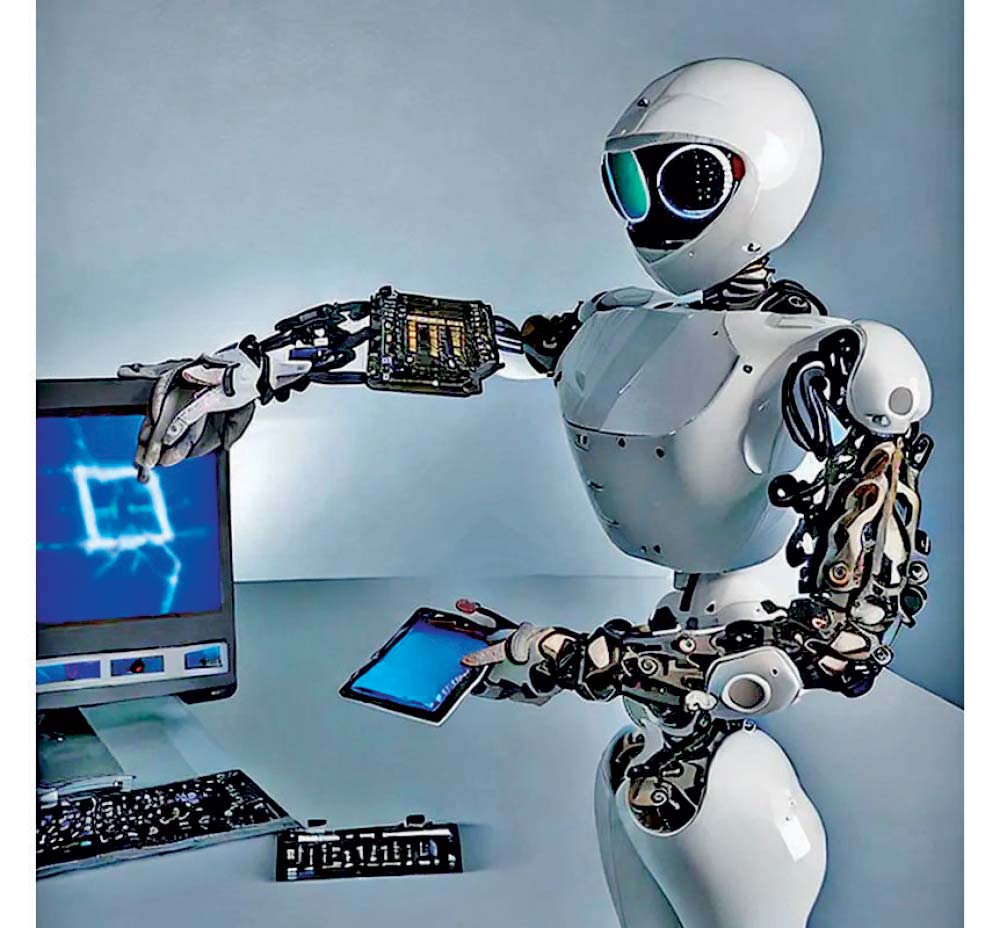
Image generated by the Stable Diffusion model from the prompt “the ability of a digital computer or computer-controlled robot to perform tasks commonly associated with intelligent beings,” which is the definition of artificial intelligence in the Encyclopædia Britannica article on the subject. Stable Diffusion is trained on a large set of images paired with textual descriptions and uses natural language processing to generate an image - Image generated by Stable Diffusion/Encyclopædia Britannica, Inc.
 What our fears tell us today feels right on the surface, but it is fundamentally wrong when we look deeper. Consider the analogy of a motor car. If a man stops walking and drives his car everywhere, his legs will eventually become weaker. He will lose his physical fitness. But is the car the enemy?
 The song, thief’s mother, and motor car analogy
A few weeks ago, I shared a music track with a close friend. The lyrics were mine, but the melody and the singing voice had been generated entirely by Artificial Intelligence (AI). I expected him to admire the technology. Instead, his face filled with deep concern. “Be careful,” he warned me immediately. “Relying on this machinery will rot your brain. Over time, it will diminish your cognitive power until you can no longer think for yourself.”
His warning forced me to examine a fear that has gripped the world. There is an old, wise saying in Sri Lanka that one should not ask about the thief from the thief’s mother. As a visiting lecturer at several universities, am I the wrong person to ask about AI? Am I defending a technology that is secretly stealing our children’s minds?
What our fears tell us today feels right on the surface, but it is fundamentally wrong when we look deeper. Consider the analogy of a motor car. If a man stops walking and drives his car everywhere, his legs will eventually become weaker. He will lose his physical fitness. But is the car the enemy? No. The solution is not to ban the car and walk ten miles to work. The solution is to use the car to cut down travel time so that the time saved can be reinvested in working out at a gym or engaging in a physical fitness program.
AI is just another tool for our convenience. Rather than rejecting it wholesale out of fear, we must find ways to use it productively. We must use the time it saves us to build stronger, sharper, and more creative minds.
Illusion of honest homework
The loudest outcry against AI comes from the field of education. Teachers and professors everywhere are in a panic because students are using AI platforms to write their take-home essays and exam answers. They submit these beautifully polished papers, pass their courses, and graduate. Yet, at the end of the day, nothing has been retained in their brains.
But let us be completely honest with ourselves: is this shortcut really new? Long before Large Language Models (LLMs) existed, a massive underground market thrived in Sri Lanka and across the globe. For decades, desperate or lazy students have relied on parents, older siblings, or hired commercial ghostwriters to pen their assignments. The “homework essay” that the student is expected to write by himself has been compromised for generations. It is not his work that is assessed, but the work of someone else.
If we must choose between these two evils, an AI-written essay might actually be the lesser threat. Unlike a hired human writer who simply hands over a finished product for a fee, AI platforms provide a vast, immediate, and rich repository of source data. The machine can synthesise global knowledge in seconds. The problem is not the availability of this vast knowledge base; the problem is that our current educational system allows students to copy it blindly without processing it. A viable solution should be found to tackle this evil.
AI is just another tool for our convenience. Rather than rejecting it wholesale out of fear, we must find ways to use it productively. We must use the time it saves us to build stronger, sharper, and more creative minds
Turning AI output into starting baseline
Instead of fighting a losing battle to ban AI, we should welcome its rich knowledge base into the open. My suggestion is simple: let us change the rules of the assignment.
Instead of asking a student to write an essay from scratch at home, we should instruct them to generate the base essay using AI first. This AI output becomes their raw material—the baseline of existing public knowledge on the topic.
The real assignment then begins.
The student must take that AI text and write his own secondary essay. His job is to improve it, challenge its assumptions, find its logical gaps, and argue against what the machine has stated. When he submits his work, he must hand in three things: the AI’s base text, his own counter-essay, and a concise summary matrix detailing exactly how he differed from the AI and what unique human contribution he has brought to the table.
This is in line with what the founder Vice Chancellor of Vidyodaya University, the predecessor to today’s University of Sri Jayewardenepura, Ven. Weliwitiye Sri Soratha Thero, advised. The erudite Buddhist prelate is reported to have advised that university students should be critical, probing, and challenging of existing knowledge. This is exactly what, in an AI-dominated world, they should do: challenge what AI has produced critically and probingly.
For us as examiners, this completely revolutionises grading. We no longer need to wade through pages of generalised text. We can look directly at the summary matrix to see exactly how a student thinks. It makes marking remarkably easy because the student’s unique intellect is isolated and exposed.
Loophole of “Second AI”
When I enthusiastically shared this idea with a colleague, she shook her head. “It sounds wonderful in theory,” she said, “but you are forgetting how clever students are. The danger is that a student will simply open a second AI platform, paste the first AI’s essay into it, and command it: ‘Write an essay challenging this text and generate a summary of the differences.’ The student will still cheat and still learn absolutely nothing.”
My colleague’s objection is entirely valid. We live in an era where AI can simulate human critique. Because these systems generate dynamically unique text every single time, traditional anti-plagiarism software is completely useless. Therefore, there is no software algorithm on earth, at least so far, that can definitively catch a student using one machine to critique another.
If education remains a game of digital ping-pong played between home computers, we have no way of knowing who did the work. The student remains a passive bystander in their own education, and their cognitive power will indeed diminish.
AI platforms provide a vast, immediate, and rich repository of source data. The machine can synthesise global knowledge in seconds. The problem is not the availability of this vast knowledge base; the problem is that our current educational system allows students to copy it blindly without processing it. A viable solution should be found to tackle this evil
Remembering the 1960s Sri Lankan classroom
To defeat this modern digital trap, we do not need futuristic technology. We simply need to look backward. I was schooled in Sri Lanka during the late 1950s and early 1960s. During this period, Sri Lanka also followed the educational system inherited from the colonial masters. Under that system, our daily routine was anchored by a simple, highly effective practice.
We did not do our heavy creative lifting at home because homework was not given to us. In that era, we had to do real homework by helping our elders complete the household chores. Boys were required to work in the paddy fields or vegetable patches, while girls had to help their mothers in the kitchen. Hence, learning was tested in the classroom itself by writing essays or painting pictures under the watchful eyes of teachers.
The topic had been given earlier, and we had enough time to prepare for the in-class essay writing or quizzes on other topics. We had to store the knowledge in our neck-top and not in the laptop or palmtop. Hence, answers were written by drawing on that stored knowledge and, therefore, they were our answers and not the answers prepared for us by a third party.
There were no textbooks to copy from, no parents to do the work, and no hired writers available. We were entirely on our own, racing against the clock. This method was incredibly powerful because it forced independent cognitive development. If a student showed a weakness in sentence structure, logic, or calculation, the teacher saw it unfolding in real time. The issue was addressed and corrected personally, right there on the spot. I recall that teachers in that era spent even after-school hours teaching us extra lessons absolutely free of charge.
By bringing this classic philosophy back into our modern universities, we can create a cognitive “fingerprint” for every student. If we force students to write a short reflection essay by hand in class during the first week of the semester, we learn their true word power, their natural sentence structure, and their ability to argue a point. If their take-home AI critique later reads like the work of an Oxford professor, the fraud is instantly exposed.
Shifting the tool from student to teacher
This brings us to a vital realisation: we need to change who is driving the technology. Instead of leaving AI entirely in the hands of the students, AI should be effectively used as a powerful tool by the teacher.
As a university lecturer, I do not reject the rich knowledge base of AI. In fact, I embrace it. I develop and enrich my own university lectures by tapping into AI. Because of the vast Large Language Model (LLM) feature, AI can cross-reference millions of global texts, academic papers, and historical data points in an instant. It acts as an incredibly efficient research assistant for the educator. By using it to prepare my materials, I can ensure my lectures are packed with high-density, up-to-date, and multifaceted knowledge.
However, once that knowledge is compiled, the responsibility shifts. My job as a teacher is to design an environment where students are forced to pull that information into their own heads, rather than leaving it on a computer screen.
Instead of leaving AI entirely in the hands of the students, AI should be effectively used as a powerful tool by the teacher
Power of continuous learning: 20-minute quiz
To achieve this, we must completely eliminate the bad habit of students waiting until the final examination week to open their books. True education requires continuous, steady mental exertion. To force my students to learn on a continuous basis, I implemented a strict, unyielding system in my lecture halls.
At the end of every single lecture, I announce to the class that our very next session will begin with an immediate, mandatory 20-minute quiz. This quiz is based entirely on the concepts we just discussed. I do not ask simple, straightforward questions that require rote memorisation. Instead, I deliberately concoct ten complex, tricky statements.
Students are asked to evaluate each statement with sharp reasoning and identify whether it is True, False, or Uncertain. The “Uncertain” category is the most vital, as it represents statements that contain elements of both truth and falsehood, depending on the context. Students sit in the classroom, unable to open textbooks, talk to neighbors, or access internet devices. They are forced to rely solely on their own immediate comprehension and logical deduction.
To make the process efficient and transparent, marking is done right then and there. Students reshuffle and swap their answer sheets among themselves. We jointly design the correct answers and explain the rigorous reasoning behind them. The feedback loop is instantaneous.
Psychology of peer motivation
When I first introduced this system, the results were a wake-up call for the lecture hall. At first, many students did not do well at all. They were caught off guard by the depth of reasoning required, and their marks suffered.
However, a fascinating psychological shift occurred. Because the papers were graded and handed back immediately in class, students suddenly realised exactly where they stood. They looked around the room and realised they were lagging behind their peers. Nobody wants to be left behind.
Driven by healthy peer competition and the realisation that they could no longer coast through the semester, their habits transformed completely. They started to study and learn what had been taught in the previous lecture ardently. They arrived at the next session primed, focused, and mentally prepared to fight through the 20-minute quiz. Years later, when I meet these former students in the professional world, they highly commend this system. They tell me it was the single most effective tool that taught them how to truly learn and retain information for life.
A manifesto for institutional assessment reform
The individual success of this classroom model highlights a critical truth that our broader education system can no longer afford to ignore. Educational institutions—both schools and universities—must radically change their entire method of student assessment. The traditional model of evaluating students based on homework assignments completed in isolation is completely broken. It is a system built for a world that no longer exists.
Today, human knowledge is being condensed into a single dot through Large Language Models, and these are already being overtaken by advanced Large Reasoner Models (LRMs) capable of complex logic and chain-of-thought processing. Because this vast ocean of information is now freely and instantaneously available to anyone with an internet connection, attempting to test a student’s ability to merely retrieve or summarise data is an exercise in futility.
Rather than blaming AI for ruining academic integrity, educationists must take a proactive, forward-looking stance. We must officially recognise that AI is far more effective and valuable as a tool for teachers than it is as a proxy for students. To remain relevant, every single teacher and lecturer must be systematically trained and equipped to utilise AI in their curriculum design and lecture synthesis.
However, the core metric of success must be the internal translation of that knowledge. The teacher’s objective must be to take that rich, machine-generated knowledge base and drive it directly into the student’s hardcore memory and neural pathways. If knowledge is simply left sitting on a computer screen or printed out passively on a sheet of paper, no real learning has occurred. The brain remains unexercised.
If our educational administrators and policymakers have the courage to bring active learning and strict, continuous evaluation back into the physical classroom under our watchful eyes, we can turn AI into the greatest cognitive gym human history has ever known
Conclusion: Path to cognitive resilience
The ultimate objective of education is to develop long-term critical power, cohesive thinking, and the ability to articulate thoughts under pressure. AI cannot destroy this if we shift our focus from evaluating the final written product to observing and testing the live, active human process.
With the support of AI handling the heavy lifting of data collection for the educator, we can transform our classrooms into vibrant, active arenas. We can use our precious lecture hours for real-time student presentations, spontaneous in-class debates, and rapid, observed writing sprints.
Furthermore, we must revive the art of the brief, informal interview—the oral defence. A teacher does not need an hour-long meeting to evaluate a student. A simple, two-minute conversation at the desk can reveal everything. When you look a student in the eye and ask them to explain their quiz reasoning or their essay summary in their own words, a cheating student will stumble into vague generalities. A student who has internalised the knowledge will shine. They will display presentation skills, explanatory power, and the rare ability to teach another person what they have learned within a brief time, using their own simple, universal language.
This forward-looking reform of how we deliver and assess learning is no longer a luxury or a distant ideal; it is an absolute institutional necessity today. We do not need to fear the mother of the thief, nor do we need to ban the motor car. If our educational administrators and policymakers have the courage to bring active learning and strict, continuous evaluation back into the physical classroom under our watchful eyes, we can turn AI into the greatest cognitive gym human history has ever known.
(The writer, a former Deputy Governor of the Central Bank of Sri Lanka and a long-standing visiting university lecturer, can be reached at [email protected] )



