Thursday Oct 22, 2026
Thursday Oct 22, 2026
Monday, 31 August 2026 00:26 - - {{hitsCtrl.values.hits}}

CBSL’s pivotal choice
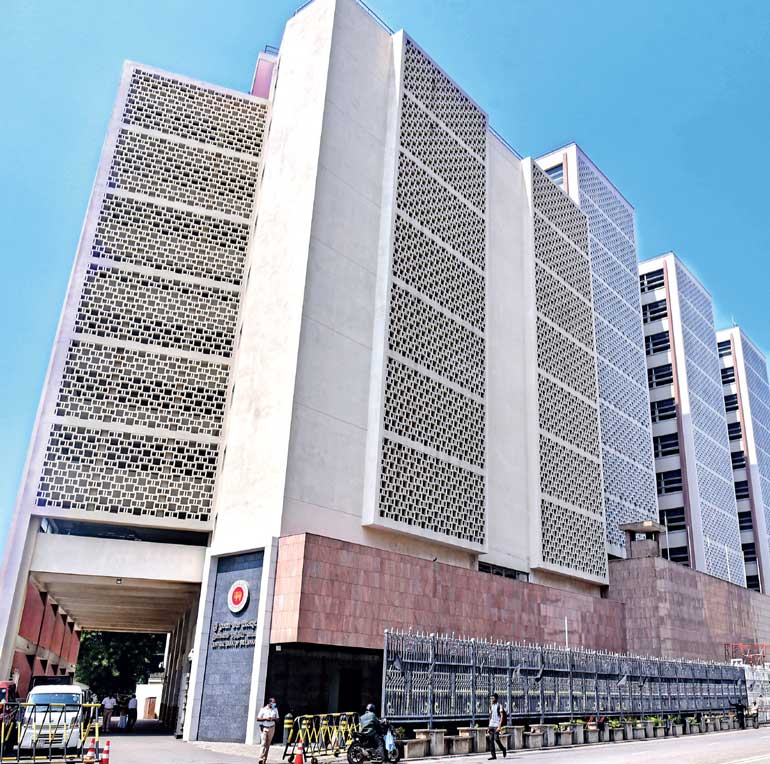
As October 2026 approaches, the Central Bank of Sri Lanka (CBSL) faces a pivotal monetary policy decision. Under the Central Bank Act, CBSL must sign a new three-year Monetary Policy Framework Agreement with the Government, setting the country’s official inflation target. With a new administration in office, the bank must now decide whether to retain the current 5% target, move toward the global benchmark of 2%, or adopt a more gradual transition path.
History of inflation targeting
The move from money supply targeting to inflation targeting began in the early 2000s, when CBSL launched its modernisation project to equip the bank not only with new technology but also with new policy thinking. Since its establishment in 1950, CBSL had sought to stabilise the general price level by controlling money supply, which it regarded as the main driver of price instability. Money supply was a nominal policy instrument, and CBSL correctly recognised that this was the principal nominal instrument available in its arsenal.
Determination of general price level
The general price level is determined by the interaction of two aggregate forces: total demand, or aggregate demand, and total supply, or aggregate supply. Changes in either, or in both, can alter the general price level. A central bank, however, can influence only aggregate demand by changing the quantity of money in the hands of the public.
When people hold more money than they need, they spend the excess on goods and services, thereby pushing up aggregate demand. Conversely, when they hold less money than they need, they curtail purchases of goods and services in order to rebuild their money balances. This is known as nominal, or money, aggregate demand.
By changing the quantity of money, therefore, a central bank can push nominal aggregate demand up or down. Aggregate supply, by contrast, consists of goods and services produced in real terms—called real because people can either use them directly or as raw materials for further production. Its level is determined by the inputs used, the technology applied, the production system, and the combination of capital and labour. CBSL’s task is to adjust aggregate demand so that it is consistent with aggregate supply by changing the quantity of money. In this policy framework, CBSL aims to change the quantity of money—an intermediate rather than a final target—in order to generate price stability in the country.
New CBSL’s mandate: Inflation targeting
Although CBSL had the freedom to conduct monetary policy according to what it believed to be correct, its money supply targets were frequently derailed by the Government’s practice of running budget deficits and financing them through borrowing from CBSL or commercial banks—a process commonly described as “money printing”.
This also provided CBSL with an easy scapegoat: it could explain its failure to stabilise the general price level by placing the blame on the Government. Such an arrangement did not provide satisfactory policy accountability.
Therefore, in the early 2000s, it was felt that CBSL should move toward the final objective of monetary policy, namely achieving an inflation rate agreed in advance with the Government. Although the theoretical work required to adopt inflation targeting was completed in the early 2000s and thereafter,
CBSL lacked the legal authority to implement it under the now-repealed Monetary Law Act. With the enactment of the new Central Bank Act, however, CBSL acquired both the legal power and the independence needed to pursue inflation targeting as its monetary policy framework. That is how the new Central Bank management came to adopt inflation targeting as the bank’s policy framework. Even so, CBSL is still at the learning stage, and it will take many years for it to acquire the knowledge and competence needed to operate the framework properly.
Legacy of 5% target
With the enactment of the new Central Bank Act in September 2023, CBSL obtained the legal authority needed to adopt inflation targeting as its monetary policy framework. Accordingly, under the new legislation, CBSL reached an agreement in October 2023 with the Government headed by Ranil Wickremesinghe to attain and maintain an inflation target of 5%, with a tolerance band of two percentage points on either side, over the following three years. It is this policy framework that CBSL is due to renew in October 2026 with the Government headed by Anura Kumara Dissanayake.
Over the past three years, however, inflation has tested the limits of the band agreed with the Government, namely 3% to 7%. Driven by the tight monetary policy implemented under the International Monetary Fund (IMF) program, inflation fell well below the 3% lower threshold, hovering around zero or 1% for extended periods. More recently, external shocks — including escalating conflicts in the Middle East and rising global energy prices — pushed headline inflation above the 7% ceiling. Having spent much of the agreement period outside its target range, CBSL now faces intense scrutiny over the design and credibility of its inflation-targeting framework.
Four criticisms of inflation targeting
Critics have raised four main objections to CBSL’s pioneering inflation-targeting framework.
First, the bank describes the framework as flexible inflation targeting (FIT), although the law permits only inflation targeting (IT). Critics argue that by adopting an unavailable framework such as FIT, CBSL has created room to adjust its targets to suit governments in power, particularly those seeking to expand the money supply before elections. In their view, this innovation has diluted the bank’s independence.
Second, CBSL has chosen to target headline inflation, even though it has no control over all the prices captured by that indicator. Monetary policy can influence only prices that are sensitive to it, such as discretionary prices, which are better reflected in core inflation than in headline inflation. Critics therefore contend that CBSL has committed itself to controlling an indicator over which it has limited influence, making failure an inherent risk in the framework agreed with the Government. 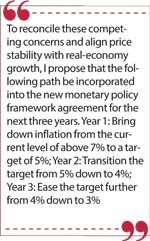
Third, CBSL has targeted headline inflation measured by the Colombo Consumers’ Price Index (CCPI), which covers only prices in the Colombo District. Yet the bank’s mandate is to control inflation for the country as a whole, a goal that would be better served by targeting the National Consumers’ Price Index (NCPI). Using the NCPI would not derail the targeting program, since NCPI data are available within three weeks of the release of CCPI data.
Fourth, both the CCPI and NCPI are based on consumption baskets derived from the Household Income and Expenditure Survey conducted by the Department of Census and Statistics in 2018–19. As a result, food items carry a weight of only 24% in the total consumer basket. However, the COVID-19 pandemic of 2020 and 2021, followed by the economic crisis of 2021 and 2022, has substantially altered household consumption patterns. Critics therefore argue that CBSL should ask the Department of Census and Statistics to update the consumer basket through a new survey. Without such an update, even if the Central Bank meets its target, the outcome may do little to improve public welfare because the target would no longer reflect people’s current consumption patterns.
The debate: 2% best practice vs. historical realities
Independent economists and policy analysts have strongly supported lowering the inflation target to 2%. In their view, a 5% target remains too high because persistent price increases erode household purchasing power, operate as a hidden tax on fixed-income earners, and discourage long-term investment. Aligning Sri Lanka’s target with the 2% standard common in developed and emerging market economies, they argue, would anchor long-term price stability and strengthen institutional credibility.
Historical experience, however, points to a different economic reality. Between 1978 and 2026, Sri Lanka’s long-term average inflation rate remained in double-digit territory, at about 11%. From a pragmatic policy perspective, CBSL officials and defenders of the 5% target argue that structural rigidities and the country’s heavy reliance on imported energy make an ultra-low 2% target impractical at this stage.
Ravi Rathnasabapathy’s critique
This argument has been advanced most cogently by independent economist Ravi Rathnasabapathy, who, in an article published in the Daily FT, made a strong case for reducing Sri Lanka’s inflation target to 2%.
His central claim is that, in the long run, it is not a permissive inflation target but a low and credible one that will encourage investment, protect savings, and sustain economic growth. A 2% target, in his view, would give entrepreneurs, savers and investors greater confidence that the value of money will not be steadily eroded by policy-induced price increases.
Rathnasabapathy’s argument is particularly important because it challenges one of the implicit assumptions often made in central banking, namely that money is broadly neutral in the long run and that its distributional effects are secondary to its macroeconomic effects. 
Drawing on the Cantillon Effect, named after the eighteenth-century economist Richard Cantillon, he argues that new money created by a central bank does not enter the economy evenly or simultaneously. Instead, it first reaches those closest to the financial system — especially banks, large corporations, and high-net-worth borrowers — enabling them to acquire assets, invest, or settle obligations before the general price level has fully adjusted. Those who receive the new money later, including wage earners, pensioners, small businesses, and ordinary consumers, face higher prices without having enjoyed the earlier purchasing-power advantage.
Inflation therefore becomes not merely a macroeconomic phenomenon but also a mechanism of income redistribution. It transfers real resources from those distant from the source of new money to those who receive it first.
Rathnasabapathy’s warning is highly relevant in the present Sri Lankan context. Banks and large corporates continue to announce substantial annual profits, while small and medium-sized enterprises and ordinary households struggle under the weight of inflation that remains above 5%.
If CBSL maintains a high inflation target, it risks legitimising this unequal outcome: financial institutions and large borrowers benefit from the liquidity created under an accommodative policy framework, while the small man in the street pays the price through the erosion of real income, savings, and living standards. This is not a penalty imposed for any economic wrongdoing on his part, but a consequence of a policy design that tolerates excessive inflation. The issue, therefore, is not only whether CBSL can technically achieve a given inflation target, but whether that target is consistent with fairness, social welfare, and sustainable growth. By insisting that money is not neutral and that inflation has winners and losers, Rathnasabapathy adds a powerful distributional dimension to the debate over Sri Lanka’s future monetary policy framework.
Rejoinder by
Dr. P. K. G. Harischandra
Against this background, Dr. P.K.G. Harischandra, a renowned economist at CBSL, has rebutted this position in a two-part article series published in the Daily FT. His argument is not that CBSL should never reduce the inflation target from 5% to 2%, but that this is not the appropriate moment to do so.
A sharp and immediate reduction, he contends, would require a tightening of the existing monetary policy parameters, especially interest rates and credit growth, at a time when the economy is still struggling to preserve its long-term growth potential. In his view, the current inflationary pressure has arisen largely from supply shocks rather than from an excessive expansion of demand. If that is the case, forcing inflation quickly down to 2% through monetary tightening would impose a heavy burden on the real economy without directly addressing the source of the price increase.
Harischandra’s preferred approach is therefore one of postponement rather than rejection. CBSL, he suggests, should commit itself to a lower inflation target only after the economy has adjusted to the present external shocks and acquired the resilience needed to withstand a tighter policy environment.
He has also made it clear that this is his personal view and not the official position of CBSL. Yet that disclaimer has not prevented the market from interpreting his articles as an indication of the bank’s own thinking: namely, that CBSL is unwilling to reduce the inflation target immediately. In my view, this interpretation is deeply damaging to the effort to build market confidence. At a time when credibility is central to the success of inflation targeting, even an unofficial signal that the bank is hesitant to move toward a lower target can weaken expectations, raise doubts about its commitment to price stability, and make the eventual adjustment more difficult.
Consultations and internal pushback
In keeping with modern democratic practices in monetary governance, CBSL initiated open public consultations to gauge public views on where the country’s inflation target should be set. To build internal consensus, the bank’s management also held discussions with its own staff economists and officers.
Harischandra’s article has added weight to this democratic governance initiative by educating those interested in understanding the issues involved. Although the debate has now entered the public domain, the bank’s leadership has yet to issue an official statement on whether it is prepared to revise the target. The longer it remains silent on the issue, the greater the likelihood that the market will engage in speculation about future inflation and interest-rate paths. In my view, such guesswork is not conducive to the continuation of inflation targeting as CBSL’s legally mandated monetary policy framework.
Practical solution: Staggered glide path
I share Harischandra’s view that an immediate shift from current inflation levels above 7% to a rigid 2% target would be impractical. Given the fragile and stagnant recovery in the real sector, aggressive monetary tightening at this stage could seriously undermine the country’s broader growth prospects. At the same time, I also agree with the critics that an inflation target of 5%, with a two-percentage-point tolerance band on either side, remains too high for Sri Lankan consumers and investors to bear.
To reconcile these competing concerns and align price stability with real-economy growth, I propose that the following path be incorporated into the new monetary policy framework agreement for the next three years:
Under this phased approach, CBSL would have the necessary runway to tighten monetary policy gradually without imposing a sudden shock on the real sector. By the time CBSL enters into its next agreement three years later, the Sri Lankan economy would be more structurally stable and better prepared to move fully toward the global 2% standard.
(The writer, a former Deputy Governor of the Central Bank of Sri Lanka, can be reached at [email protected])




