Tuesday Sep 15, 2026
Tuesday Sep 15, 2026
Tuesday, 3 March 2026 05:11 - - {{hitsCtrl.values.hits}}
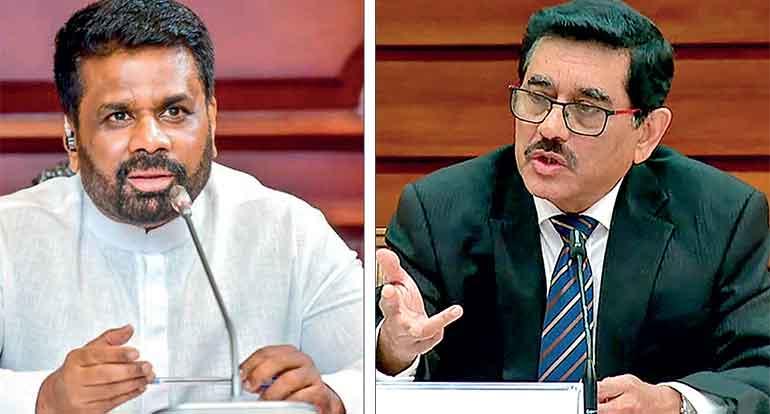
President and Finance Minister Anura Kumara Dissanayake / Central Bank Governor Dr. Nandalal Weerasinghe
 Whatever you do, it will harm people
The Devil’s Alternative is the title of a thriller by bestselling author Frederic Forsyth published in 1979 which coined the phrase ‘devil’s alternative’ that at one stage, you reach a state in which whatever you do, it will harm others [1]. When I watched the recent non-conclusive between Central Bank officials and Parliament’s standing Committee On Public Finance or COPF [2], it appeared to me that the present Central Bank is caught up in a choice similar to a devil’s alternative in the exercise of its new monetary policy framework – inflation targeting – mandated to it by the new Central Bank Act or CBA.
The beauty of economic and price stability as a goal
Prior to the enactment of the CBA, an amendment made to the now repealed Monetary Law Act (MLA) in 2002 mandated the Central Bank to simultaneously attain two co-goals, economic and price stability and financial system stability. As I have explained elsewhere, the addition of the intruding term ‘economic’ to elaborate what is meant by ‘price stability’ was the fine work of the then Governor of the Bank, the late A.S. Jayawardena [3].
When Jayawardena was confronted by experts on the subject, including the then IMF Resident Representative in Sri Lanka, Dr Nadeem ul Haque, for an explanation about this peculiar way of defining price stability, his answer was based on the overall stability of the macroeconomy and not just stabilising a price index.
Jayawardena told us as follows: “…if you have only price stability, then you would fall into the trap of attempting to stabilise a price index which is not what is meant by price stability, in the context of a Central Bank. The attainment of price stability for a Central Bank means the elimination of both excess demand and excess supply in the market so that the market is free of potential inflationary or deflationary pressures. Such an equilibrium will help the country to maintain a balance in the balance of payments and thereby stability in the exchange rate” [4].
The contention of Jayawardena was that if the Central Bank sought to stabilise only a price index, the Governments in power could manipulate the index by revising prices upward or downward administratively. If the index has fallen due to a downward revision of prices, the bank should not be content with its achievement since there is already a gap in the macroeconomy. By the same token, if the index has increased due to an administratively upward revision of prices, the Central Bank should not be blamed for it.
Thus, by pursuing the goal of economic and price stability, the Central Bank should continue its policy action until the entire macroeconomy is in equilibrium. However, Jayawardena concluded that, to maintain transparency in its policy action, in either case, the Central Bank should explain it to the public.
Defects of current inflation targeting
But there was a hitch in this monetary policy framework. Since the Central Bank was not the sole authority in the price index and inflation could be generated by the Government by creating money over and above the safe levels through its counter fiscal policy, the blame game could be continued: the Central Bank taking cover behind the Government’s profligacy and free it from the accountability for inflation or deflation in the economy.
To resolve the issue and make the Central Bank fully accountable for its action, several new features have been added to the new CBA. One was that the Central Bank has been made independent from the Government’s direct controls. Another is that it had been mandated to target an inflation rate agreed with the Finance Minister. A third is that to make its actions transparent and accountable, it has been mandated to report its policy success or failure to Parliament which now gets an opportunity to review the Central Bank action.
In terms of the inflation rate agreed with the Finance Minister, the Central Bank was required to report to Parliament if it failed to maintain the inflation target for two consecutive quarters. The rate agreed with the Minister in September 2023 was 5% per annum with a leeway of plus or minus 2 percentage points. Thus, the Central Bank was required to operate within an inflation range of 3% to 7% though the optimal achievement amounted to 5%.
Inflation was measured in terms of the headline inflation of the Colombo Consumers’ Price Index or CCPI compiled by the Department of Census and Statistics (DCS) monthly. Though CCPI covers only consumer prices – both food and non-food – in the Colombo District, apparently that index would have been chosen as the monitoring index since it also happened to be the official price index for salary adjustments etc.
A narrowly defined index
There are three basic drawbacks in this arrangement. One is that, as mentioned above, it covers only the prices in the Colombo District and, therefore, it is not representative of the inflation rate in the entire country. For that purpose, the better choice would have been the Sri Lanka National Consumer Price Index or NCPI covering the entire country, also compiled by DCS with a time lag of the weeks from the release of CCPI data.
For Central Bank’s inflation management purposes, it is not mandatory that it should follow the official price index in the country. It should have been a representative index and the NCPI is more suitably qualified for that.
The second is a fundamental issue relating to inflation and welfare of the people. Inflation is controlled by Governments, and on behalf of Governments, by Central Banks, to prevent any welfare loss due to rising prices. Prices, for this purpose, are all types of prices affecting the choices of people when it comes to deciding on the aggregate demand of the country. In addition to consumer prices, they include the prices of investment goods like building materials and export prices which, when risen to a higher level, cause the local prices also to increase. For instance, if the prices of building materials or those of rooftop solar power installations rise, they directly reduce the welfare of people. In that context, choosing to control only the consumer prices leaves much of the welfare losses arising from outside those prices unattended.
A case in point is the GDP Deflator which covers consumer, investment, and export prices compiled by DCS when it converts the money value of the total output, called Gross Domestic Product or GDP, into real output, called the real GDP in the country.
Third, the Central Bank should control what it can control leaving aside what it cannot control. In this context, what it should control are the prices which can be influenced by its monetary policy action, namely, interest rates and credit levels. The administered prices in both the food category and the non-food category are outside this influencing factor. To separate these prices, DCS compiles another index called the Core inflation index which excludes the prices of food items, fuel, and transportation which can be controlled by the Government through its fiscal actions. Instead of controlling headline inflation which the Central Bank cannot do single-handedly, it should have agreed with the Finance Minister to use the core-inflation index under the inflation targeting framework.
Then, there is the dangerous and impossible outcome arising from the choice of a high inflation target as 5% per annum with a leeway of 2 percentage points either way.
Danger of choosing a high inflation target
It is dangerous because this high rate defies the neutrality of an inflation rate that should be there in the context of the Sri Lankan economy. People are willing to pay a higher price if the quality of the products have improved, on one side, and they could accommodate them with an increased income, on the other. From the side of the businesses, any factor-cost increase due to inflation can be accommodated, if there is an increase in the output produced by that factor too. Both these are related to the level of productivity increase in the economy.
For instance, if productivity has increased by 2%, an inflation rate of 2% or close to it is considered neutral in the economy. Since the productivity increase in many countries happened to be on average about 2%, the inflation target chosen by those countries has also been 2% with a leeway of one percentage point in either direction.
It seems that Sri Lanka’s choice of 5% as the inflation target is out of alignment with the average productivity growth in the country. According to data compiled by the London based Census and Economic Information Centre (CEIC), Sri Lanka’s labour productivity, measured from the macro side has increased on average by about 1.45% during January 2023 to September 2025 [5]. For the period from June 2013 to September 2025, Sri Lanka’s productivity has declined by an average of 4.54%.
Other researchers have estimated that Sri Lanka’s primal total factor productivity growth during 1980-2019 had amounted to 2.1% and dual to 3.3% [6]. On average, Sri Lanka’s productivity growth could be estimated to be about 2% and an inflation target of 2% would have been the ideal rate for targeting. But when the Finance Minister and the Central Bank agreed on a 5% inflation target with tolerance up to 7% at the upper bound, what is underlying is inflating the economy annually by 3-5% which is non-neutral and intolerable.
Lack of Government support to the Central Bank
This target is impossible when the Government does not support it with a compatible fiscal policy stance. The Government supported the Central Bank’s action when it was on a disinflation path to reduce the inflation rate from the historically high 70% in September 2022. This action required stringent monetary policy to drastically curtail aggregate demand and the Government supported it with an equally stringent fiscal policy.
Hence, both policies going in the same direction were responsible for a rapid decline in the inflation rate pushing it below the lower bound of 3% by early 2024 and to a negative range by mid-2025.
The Central Bank would now reflate the economy by relaxing monetary policy and causing the aggregate demand to rise, eliminating the gap between aggregate supply. To attain this goal, it has reduced the policy rates by about 6 percentage points, allowed banks to increase their credit to the private sector and caused reserve money to expand by buying foreign exchange from the free market. But aggregate demand has not increased to required level due to the Government’s counter policy actions. In other words, when it comes to reflating the economy, the Government has not supported the Central Bank.
Government is still to be blamed
The issue of contention at the COPF meeting under reference was that the Central Bank had furnished four reports to Parliament when the country’s inflation rate had been below the lower bound of 3% consecutively for six quarters beginning from the Second Quarter of 2024, and the timeline it had given the Parliament to restore the rate to the required level had been postponed to a future date each time.
The explanation had been that there had been external factors like the administratively-reduction of key fuel and cooking gas prices pushing the inflation below the targeted path. But the real reason had been that the Government had been getting a massive revenue, a historical record according to some Government sources, reducing the disposable income of the people through income taxes and curtailing the real value of the basket of goods they buy out of that lowered disposable income through indirect taxes.
At the national level, this has been at about 15% of GDP. But the Government which had been pursuing a surplus in the primary account had overdone it by reaching a level of 2.5% of GDP, principally by cutting down the capital expenditure programs. For instance, in the Budget of 2025, the envisaged capital expenditure amounted to Rs 1.3 trillion, but what was spent was only Rs 650 billion. This has resulted in a massive buildup of cash in the Treasury amounting to about Rs 1.3 trillion, another historical record as claimed by some Government sources. Thus, money is taken out of people curtailing their aggregate demand but not given back to the economy through a corresponding Government expenditure within the country. So, Central Bank’s attempt at pushing the aggregate demand on to the desired level had been foiled.
Need for reducing the high inflation target
Sri Lanka has a low inflation rate at around 2% per annum, according to both CCPI and NCPI. It is a favourable development since such a low inflation will encourage the people to take a long-term view of the economy and save and invest. Such a low inflation rate will help the country to stabilise the exchange rate too. Further, low inflation means low interest rates which are favourable for long term economic development. Hence, in my view, instead of seeking to beat the Central Bank on account of its failure to keep up to the target which is undesirable, the Central Bank and the Finance Minister should now sign a new monetary policy framework mandating the Central Bank to achieve a target of 2% with a leeway of one percentage point either way. Such a target is neutral on the welfare of people since it is compatible with the country’s average productivity growth levels.
Caught up in a choice involving a devil’s alternative
As it is, the Central Bank is caught up in a devil’s alternative. If it reaches the target level, it harms the people by reducing their welfare. If it does not, it is blamed for policy inefficiency.
(The writer, a former Deputy Governor of the Central Bank of Sri Lanka, can be reached at [email protected] )
(Endnotes)
1 Forsyth, Frederic, 1979, Devil’s Alternative, Hutchinson & Com, London.
2 Watch the two live episodes here: https://youtu.be/GsURiFBRYT0?si=cxacrjry17sQXdcS; and https://youtu.be/CQAzzR3kY-o?si=H-e7X7umakpr_Xq0
3 Wijewardena, W.A, 2017, Central Banking: Challenges and Prospects, BMS Publications, Colombo, p 193-204.
4 Ibid, p 196.
5 https://www.ceicdata.com/en/indicator/sri-lanka/labour-productivity-growth
6 Kumari, Ranpati Dewage Thilini Sumudu and Tang, Sam Hak Kang, 2025, “Identifying Sources of Economic Growth in Sri Lanka under trade liberalization: the primal and dual total factor productivity growth, Journal of the Asia Pacific Economy, Vol 30; Issue2, pp 617-42.




