Sunday Sep 20, 2026
Sunday Sep 20, 2026
Tuesday, 2 December 2025 00:47 - - {{hitsCtrl.values.hits}}
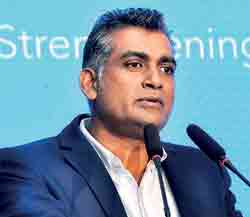 |
| SLTDA Chairman Buddhika Hewawasam |
Sri Lanka Tourism Development Authority (SLTDA) Chairman Buddhika Hewawasam recently said the sector is at a turning point, as new evidence-based insights challenge long-held assumptions about tourist behaviour and spending.
Speaking at the launch of the 12-month national airport exit survey conducted in partnership with Australia’s Market Development Facility (MDF), Hewawasam said the findings provide a more accurate, transparent and modern foundation for policymaking, whilst also exposing gaps that must be urgently addressed.
Hewawasam said the survey, carried out using international Tourism Satellite Accounting methodology, presents a “remarkable and sometimes controversial” reset in understanding visitor spending.
“For years, Sri Lanka operated on the assumption that tourists spent an average of $ 171 per day, based on a study conducted over 15 years ago under vastly different economic conditions. The new survey, however, reveals the actual figure is $ 148, underscoring how outdated estimates and misinterpreted data had previously shaped policy without proper context,” he stressed.
The Chairman said the SLTDA could have simply stuck to the previously high per day analysts to gain political mileage, but instead showed the “reality of the industry” to ensure that the right decisions are taken based on accurate data to boost the industry.
He said tourist behaviour has evolved globally since COVID-19 and Sri Lanka is no exception. “Visitors now seek immersive experiences rather than luxury stays, embracing homestays, local transport, community interactions and experience-based travel. Tourism is no longer about observing and staying in expensive properties. Lower-priced options are being embraced, and that has to reshape our tourism offerings,” he explained.
The Chairman noted that travellers increasingly plan their itineraries independently, relying heavily on digital platforms and AI, reducing the role of traditional tour operators. “The industry must rethink how it packages and markets services, as decision-making is now driven by real-time data and online transparency,” he added.
Hewawasam stressed that data alone is not enough; it must be interpreted intelligently and contextually. “Misused statistics, can distort reality and lead to misguided decisions,” he warned, calling for a national tourism data warehouse enabling public institutions, operators and policymakers to access real-time analytics. He said such a system would better inform strategies around markets, pricing, seasonality management and product development.
Highlighting the persistent challenge of seasonality, Hewawasam noted that Sri Lanka welcomes over 180,000 tourists monthly between December and March, but arrivals drop by more than 100,000 during the rest of the year. “This imbalance, strains capacity in peak months, while leaving resources underutilised in off-peak periods. Data-driven insights are needed to identify new source markets and design targeted strategies to stabilise arrivals year-round,” he pointed out.
He also underscored the importance of understanding where tourist spending “leaks” out of the economy. “We have partnered with the UNDP to conduct a survey on tourism leakages. With only an estimated 60% of expenditure retained locally, mapping leakage patterns is essential for strengthening value chains and increasing net foreign exchange earnings,” he added.
Hewawasam thanked the Australian High Commission and MDF for their partnership, and noted SLTDA’s ongoing technical collaboration with the UNWTO.
He asserted that continuous data conversations, industry engagement and institutional discipline are critical to ensuring Sri Lanka uses insights responsibly and not to create stories around data, but to make real decisions based on it.
He also credited the SLTDA Research and Planning team for carrying out what he described as a “tireless, rigorous process” in gathering and analysing visitor feedback, and reaffirmed the authority’s commitment to building a modern, evidence-based tourism system.
- Pix by Lasantha Kumara




