Sunday Sep 20, 2026
Sunday Sep 20, 2026
Friday, 20 March 2026 00:08 - - {{hitsCtrl.values.hits}}
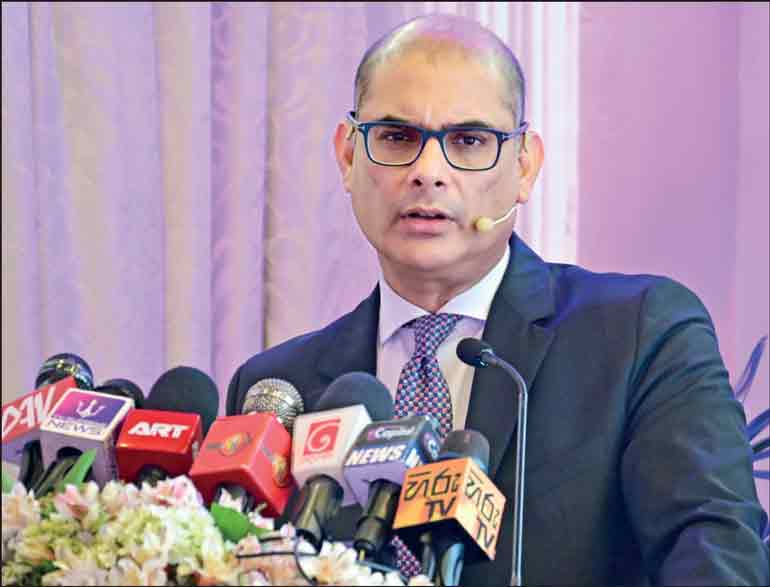
NIPL Managing Director and CEO Ritesh Shukla
– Pic by Sameera Wijesinghe
By Dilrukshi Fernando
NPCI International Payments Ltd., (NIPL), in partnership with LankaPay, the national payment network of Sri Lanka, is leveraging Indian tourist flows to the island to scale Unified Payments Interface (UPI) merchant acceptance, according to NIPL Managing Director and CEO, Ritesh Shukla. His remarks were made at NIPL’s first media roundtable in Sri Lanka, on ‘Connecting Indian Tourists with Sri Lankan Businesses Through Seamless Digital Payments’, held at the Taj Samudra, Colombo.
Indian tourists to Sri Lanka: key driver in UPI merchant acceptance
According to Sri Lanka Tourism Development Authority statistics, India remains the leading source for tourism in Sri Lanka, with over 416,000 Indian tourist arrivals marked in 2024, which grew to 531,000 (of a total tourist count of 2.36 million), in 2025, accounting for the highest share - 22% of total international arrivals. In 2025, Sri Lanka averaged 44,000 monthly Indian visitors, of which 60.2% were travelling for leisure, with 5.6% for MICE (Meetings, Incentives, Conferences and Exhibitions) travel.
By 2040, Indian travellers are expected to make 80 to 90 million trips, positioning Sri Lanka as a key destination of choice, according to data presented by NPCI International. In 2023, approximately 30 million Indians travelled overseas and spent a total of $33 billion for overseas travel. Against this backdrop of rapid growth, the availability of seamless and reliable payment solutions is set to become a critical enabler for Indian tourists visiting the country.
“NPCI International is foreign-focused, and that’s where we work in partnership with LankaPay to build an India-Sri Lanka corridor to drive more value for small businesses here,” Shukla said further.
NIPL, the international arm of the National Payments Corporation of India (NPCI), operating on the values of access, speed, transparency and affordability, is engaged in expanding UPI merchant acceptance in Sri Lanka. The initiative aims to grow Sri Lanka’s digital economy while enhancing cross-border payment experiences for Indian tourists in the categories of Food and Beverage, Shopping, Transportation, and Recreation.
“We can only create value by leveraging the purchasing power of Indian consumers and creating more opportunities for businesses in these countries to sell to the Indian tourists,” said Shukla, sharing the integrated marketing campaign planned by NPCI International to promote Sri Lanka as a UPI-enabled travel destination, mapping key touchpoints in the end-to-end customer journey.
The opportunity for SMEs in Sri Lanka
According to Shukla, through its partnership with LankaPay, NCPI International is looking at strengthening UPI acceptance by small businesses in Sri Lanka to create value-based opportunities.
LankaPay is the equivalent of UPI in Sri Lanka, through which local merchants of small businesses can serve tourists using QR-based payments not only from India, but also from several other South Asian countries, minimising the need for travellers to carry or exchange physical cash. LankaPay merchants simply need to offer the existing integration to enable UPI payments.
Through UPI, Indian travelers to Sri Lanka can enjoy the convenience of real-time payments, transparent exchange rates, and a familiar, secure payment experience. For merchants, UPI provides access to a large digitally connected customer base, while reducing the dependence on physical currency.
“After World War II, what the United States did, which others failed to do, was to empower its small businesses. Small businesses create jobs and can increase economic activity. In India, we are using the digital ecosystem to empower such opportunities,” said Shukla, explaining how it has enabled the informal economy to be part of the financial framework.
Currently, LankaPay has over 400,000 merchants in Sri Lanka through its LANKAQR network. Meanwhile, several tourist frequented establishments have enabled UPI payments, including Cinnamon Hotels, Taj Hotels, Barista, Keells Supermarkets, and ODEL, amongst others.
Over the past few years, UPI has been implemented in key corridors of Nepal, Bhutan and Sri Lanka, which have cultural similarities and are neighbouring countries in the region.
UPI: the scale and capabilities
UPI (alongside other payment access points) forms an integral part of the Cashless Layer in the four-layered India Stack - a collection of digital technologies set up by the national government of India, as part of a public-private partnership, aimed at supporting the digitisation of the Indian financial system through democratisation.
“Today, up to 49% to 50% of instant payments that happen in the world are processed in India. That is the scale of this platform, which was launched in 2016. We are now doing about 750 million transactions in a day,” said Shukla, outlining UPI’s capabilities.
UPI has emerged as one of the world’s most advanced digital payment infrastructures, processing over 20 billion financial transactions monthly. It has a 80% share in digital payments across India, with over 700 million UPI QR-touchpoints with an open, interoperable architecture and strong security framework. During the last financial year, FY 24-25, commerce worth $3 trillion was processed through the UPI platform.
UPI allows the user to connect to multiple funding sources of their choice, and works on an API-built approach, which works better with the financial ecosystem. Two-factor authentication is enabled in UPI, and the platform allows for both push and pull transactions. Furthering its objective to remain digitally inclusive, UPI supports both smartphones and feature phones.
Displacing cash to formalise the economy
According to Shukla, a country’s economy incurs a cost of 1.5% to 2% of its GDP every time cash is printed, circulated, and sustained across the system.
“It’s all about displacing cash. Imagine if you could save that money and put it to better use, such as healthcare, education, and green energy. There is a lot of good in displacing cash. It also helps you formalise the economy,” he said, outlining the broader national strategy of NPCI, which has a series of platforms and solutions to serve that objective.
Formalising the economy, said Shukla, has multiple benefits for developing countries, such as India and Sri Lanka, for better tax collection, increased economic activity and job creation.




