Sunday Sep 20, 2026
Sunday Sep 20, 2026
Thursday, 26 March 2026 00:02 - - {{hitsCtrl.values.hits}}
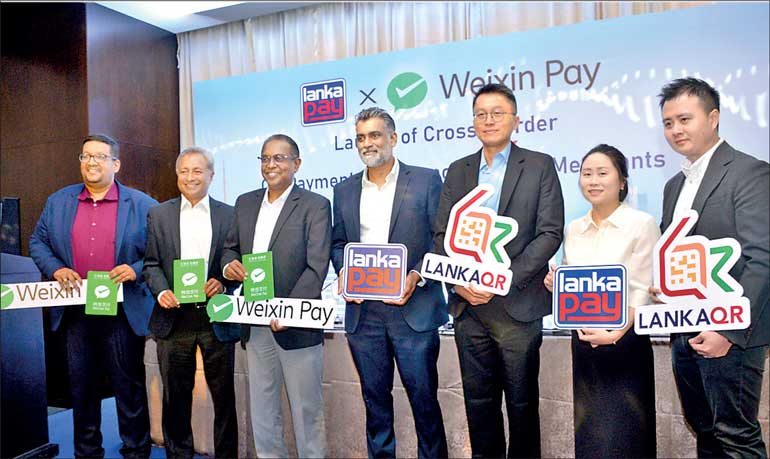
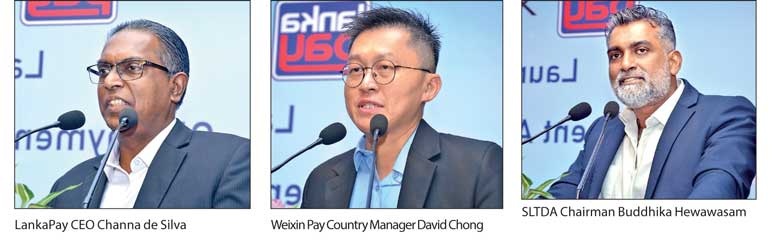
From left: LankaPay Global Operations Senior Manager Harsha de Silva, LankaPay Deputy CEO Dinuka Perera, LankaPay CEO Channa de Silva, SLTDA Chairman Buddhika Hewawasam, Weixin Pay Country Manager David Chong, Weixin Pay Senior Manager Laura Wang and Weixin Pay Senior Manager Calvin Thye
By Dilrukshi Fernando
LankaPay, Sri Lanka’s national payment network, has partnered with Weixin Pay (also known as WeChat Pay), enabling cross-border QR payment acceptance at over 400,000 LANKAQR merchants for inbound tourists and business travellers from China to use their local digital wallets.
The partnership is expected to enhance Sri Lanka’s cross-border digital payment capabilities while driving financial inclusion for the island’s rural merchants, who are part of the tourism ecosystem, to accept global payments.
“Our main objective is to provide a seamless digital payment for Chinese tourists when they are visiting Sri Lanka,” said Weixin Pay Country Manager David Chong. Weixin Pay is used as a payment tool in mainland China via the WeChat super app, with more than 1.4 billion users within its ecosystem. The platform has over 900 million active users each month.
“We believe that Sri Lanka is well-positioned to capture the next wave of Chinese tourism. With Weixin Pay and LankaQR, we can connect, convert, and grow”, said Chong, outlining the broader strategy for Sri Lanka.
LankaPay’s partnership with Weixin Pay is a strategic value addition for Sri Lanka, as it sharpens its focus on the Asia-Pacific region, particularly China, to diversify its visitor base.
“Tourism arrivals to Sri Lanka were at their historical high in 2025. Last year, we had about 132,000 Chinese tourists to Sri Lanka. This year, we are expecting about 300,000,” said the Sri Lanka Tourism Development Authority (SLTDA) and Sri Lanka Tourism Promotion Bureau (SLTPB) Chairman Buddhika Hewawasam.
According to Hewawasam, the integration with Weixin Pay seeks to address two key challenges faced by the tourism industry. “One is the distribution of tourism revenue to the rural communities and other vendors. The smaller vendors in the tourism areas are not getting the benefits from tourism yet”.
At present, the lack of QR acceptance among small vendors means that the benefits of tourism are largely confined to hotels and larger vendors. “When we introduce a platform such as QR payment acceptance, that will be an enabler for the rural communities in tourism, and even for the smallest vendors to be linked with global tourists,” Hewawasam added.
“The other challenge is the leakage effect in the tourism market. Leakage of tourism is over 30% in Sri Lanka. If tourists are more engaged and purchasing things from the local communities, the leakage can be reduced as well,” Hewawasam said, explaining how the global payment platform acceptance will help to retain the income generated through tourism within the country.
“We see Weixin as a full omnichannel platform journey from discovery, engagement, all the way to the payment”, said Chong, outlining how Weixin Pay aims to address structural gaps in Sri Lanka’s tourism ecosystem.
Chong said the recent integration enabling Weixin to scan LankaQR marks the first step in a broader strategy to position Sri Lanka as a preferred destination for Chinese travellers. Central to this is Weixin’s Mini Program, which is designed to support the entire visitor journey, including the three stages of pre-trip, in-trip and post-trip. This includes pre-trip planning through access to destination information and promotional offers, in-trip services such as transport and other on-ground conveniences, and post-trip engagement that allows users to continue purchasing Sri Lankan products even after returning to China.
By linking with local stakeholders, Weixin Pay aims to convert digital engagement into seamless transactions, while enabling Sri Lankan merchants to market their offerings directly to consumers in mainland China.
“Our service is not just about payments; it is about delivering a full-cycle experience while helping our merchant partners drive more transactions in Sri Lanka,” Chong said further.
According to Weixin Pay data, during the summer holidays of 2025, cross-border transactions rose by 34%, while its Mini Programs recorded over 5 billion end users from cross-border and overseas users.
The partnership announced recently in Colombo was the culmination of a five-year journey, involving various regulatory and technical challenges, according to the LankaPay CEO Channa de Silva. Through LankaPay and Weixin Pay integration, inbound travellers from China to Sri Lanka can make seamless payments via LankaQR, with a single conversion, removing the hassle of cash and currency exchanges.
“It’s a great opportunity for Sri Lanka. We are having several discussions with SLTDA and SLTPB on how to take this message to both sides. We have 400,000 plus QR merchants, thanks to the Central Bank (of Sri Lanka), and the banking community who have enabled QR payments, and the (Chinese) consumers, who are used to paying with QR, so obviously LankaQR is a natural choice for them”, de Silva said. Plans are also underway to jointly promote awareness programs and offer incentives to merchants.
A key advantage of the new system lies in its cost structure for local businesses. Unlike traditional card networks, which typically impose higher commission rates, the Central Bank of Sri Lanka has capped the merchant discount rate for QR-based transactions at 1.8%.
– Pix by Lasantha Kumara




