Friday Oct 16, 2026
Friday Oct 16, 2026
Tuesday, 17 March 2026 07:35 - - {{hitsCtrl.values.hits}}
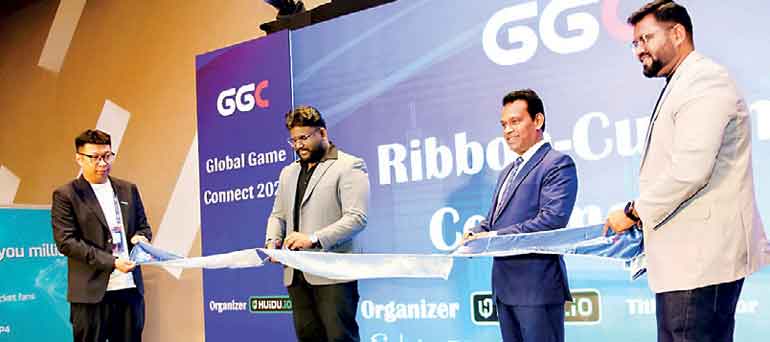
Tourism Deputy Minister Prof. Ruwan Ranasinghe (second from right) together with HUiDU .iO Gaming Operators Business Development and Partnership Manager Raja Alan, HUiDU .iO Gaming Operators Business Development Manager Kyle and API Manager Jerry at the launch of Global Game Connect 2026 at Cinammon Life yesterday - Pic by Pradeep Dilrukshana
Sri Lanka is moving to position Colombo as a regional gaming and digital innovation hub, leveraging cutting-edge technology, particularly from Chinese firms to transform the island’s fast-growing integrated resort sector into a high-value economic driver.
Speaking at the opening of the two-day Global Game Connect (GGC) 2026 summit at City of Dreams Sri Lanka within the Cinnamon Life complex, Deputy Tourism Minister Prof. Ruwan Ranasinghe said the Government is focused on building a regulatory and technological ecosystem that supports high-tech innovation in gaming, including the fast-expanding online or “i-gaming” segment.
“We are positioning Colombo and Sri Lanka as a hub for the next wave of technological innovation and the gaming industry in this region,” he told delegates comprising global software developers, gaming operators, API integration specialists and payment platform providers, many of whom are linked to the Chinese tech sector and seeking to scale operations across Asia.
The summit, endorsed by the Sri Lanka Tourism Promotion Bureau (SLTPB), reflects a broader policy push to align the country’s recovering tourism industry with high-growth digital sectors. Officials see gaming, particularly technology-driven integrated resorts and online platforms, as a natural extension of Sri Lanka’s ambitions to attract higher-spending visitors and foreign investment.
Sri Lanka’s gaming and integrated resort industry has evolved rapidly in recent years, shifting from a fragmented network of small-scale clubs into a multibillion-rupee sector closely tied to luxury tourism and real estate development. A key turning point was the 2025 opening of the $ 1.2 billion City of Dreams project in Colombo, which repositioned the capital as a premium gaming and entertainment destination targeting affluent South Asian travellers, especially from India.
Prof. Ranasinghe highlighted Sri Lanka’s geographical advantage, describing it as a gateway to the vast South Asian market.
“We have significant potential for industries like this, particularly for the growing markets next to us, like India. We can accommodate Sri Lanka as a platform for growing enterprises,” he said.
Participants at GGC 2026 include major game operators, platform providers, fintech payment firms and senior industry executives exploring opportunities in emerging Asian markets. The presence of Chinese technology firms underscores Colombo’s intent to integrate advanced gaming software, secure payment systems and scalable digital infrastructure into its broader tourism proposition.
Beyond the technological dimension, the Government sees such summits as catalysts for tourism earnings. High-level business conferences attract premium corporate travellers, generate hotel occupancy and reinforce Colombo’s branding as both a leisure and investment destination.
“Events like this benefit our tourism industry. We believe there is great potential to move forward by bringing technologies and investments down to Colombo,” Prof. Ranasinghe said.
Industry estimates project annual revenues from the gaming sector at around $ 250 million, alongside a rising fiscal contribution. Tax rates on gaming operations were recently increased to 18%, reflecting the Government’s intent to bolster national reserves, while maintaining regulatory oversight of the sector’s expansion.
The Government is also linking gaming to its broader tourism targets, including a goal of attracting 3 million visitors in 2026. Officials argue that integrated resorts help lengthen average visitor stays and reduce the seasonal volatility traditionally driven by monsoon cycles. High-end entertainment offerings are seen as a way to smooth demand fluctuations and draw repeat travellers.




