Thursday Oct 08, 2026
Thursday Oct 08, 2026
Wednesday, 7 October 2026 05:46 - - {{hitsCtrl.values.hits}}
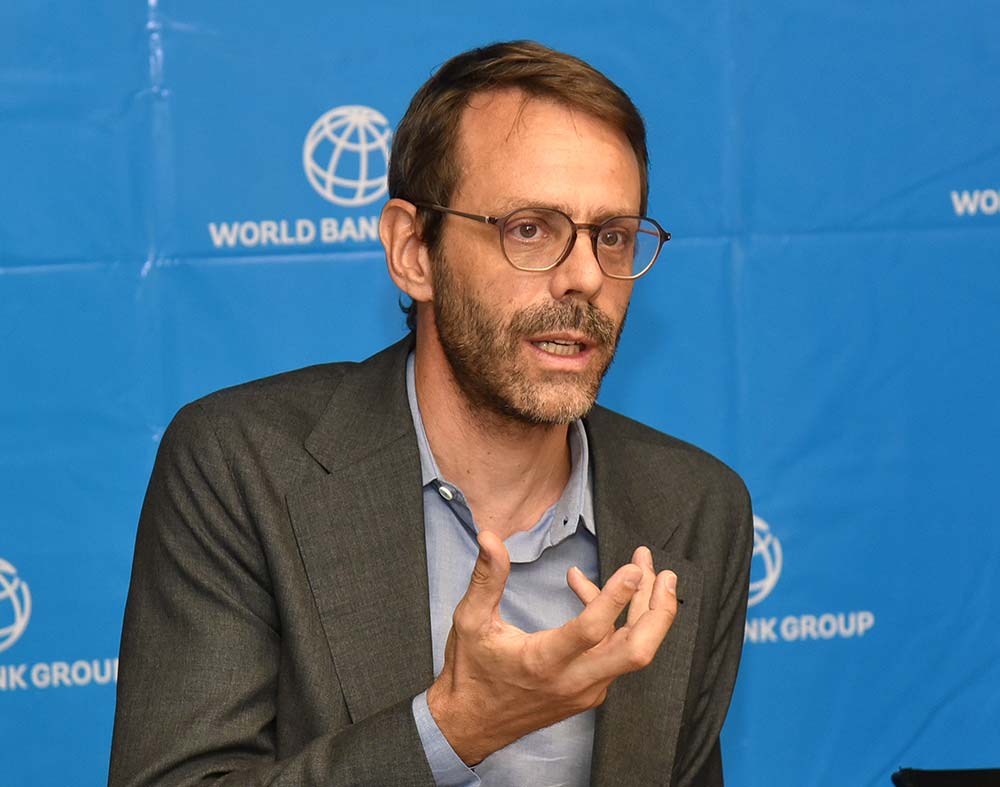
World Bank Acting Country Manager for Sri Lanka Stephan Massing
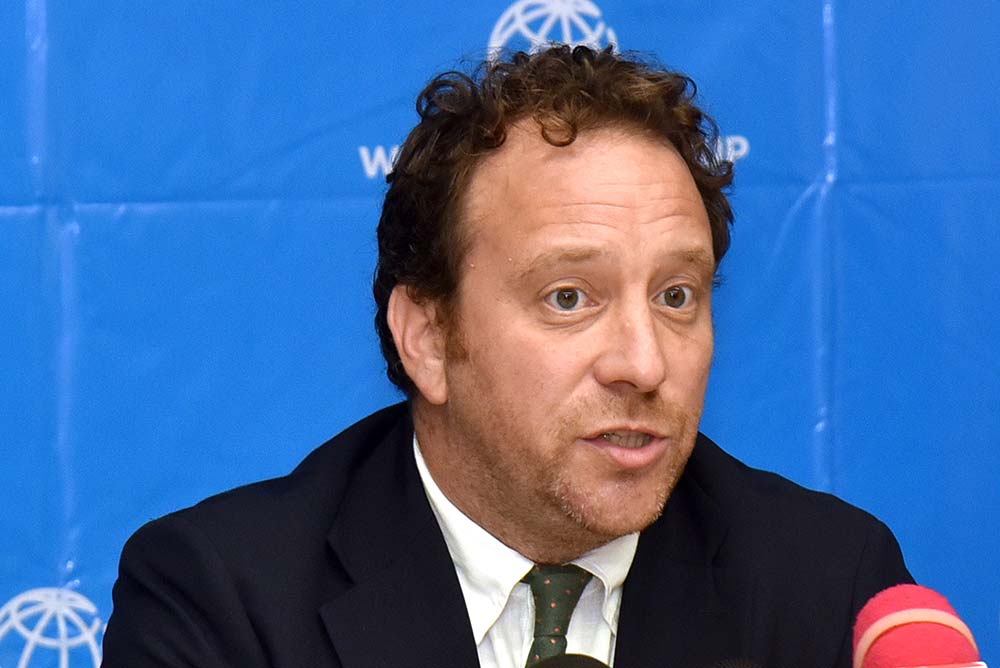
World Bank Senior Economist Jakob Engel
The World Bank yesterday upgraded its outlook for Sri Lanka, raising its 2026 growth forecast to 4.4% from 3.6% in April, but warned that the recovery remains uneven, with poverty above pre-crisis levels and real wages still about 12% below 2019.
The latest in the Bank’s twice-yearly Sri Lanka Development Update, titled ‘From Recovery to Transformation’, projects growth easing to 4.2% in 2027 and 4% in 2028 as the post-crisis rebound fades and growth converges to its long-run trend amid weak productivity. The upgrade reflects the economy’s resilience to the Middle East conflict, though the forecast still marks a slowdown from 5% growth in both 2024 and 2025.
“Our baseline outlook represents an upgrade from the last edition,” World Bank Senior Economist Jakob Engel said, presenting the report at a media briefing in Colombo.
- Pix by Ruwan Walpola
World Bank...
The economy grew 4.7% year-on-year in the first half of 2026, its 12th consecutive quarter of expansion, returning GDP to its 2018 level. In July, the World Bank Group reclassified Sri Lanka as an upper middle-income country.
“Four years ago, Sri Lanka was confronting a deep and unprecedented economic crisis. Today, the news is that the economy has recovered to pre-crisis levels,” World Bank Acting Country Manager for Sri Lanka Stephan Massing said. “It has been growing for 12 consecutive quarters, and it has consistently been exceeding expectations, including our own projections.”
However, he cautioned that the gains have yet to reach many households. “What we have seen is recovery at the macroeconomic level that has not yet fully translated into recovery for ordinary families, for people across the country,” Massing said. “The challenge for Sri Lanka is no longer just economic recovery; it is economic transformation.”
How far growth can rise above the baseline depends on reform. Asked by the Daily FT whether the outlook reflected the economy’s current structural state or assumed reforms, Engel said the baseline assumed neither a major reform push nor any retreat from announced fiscal and trade policy plans.
“Our baseline outlook essentially assumes that current conditions continue into the future, so that we have about 4% growth,” he said. “If you have a big push on structural reforms, you could be looking at much higher growth rates of 5% or 6%.”
A significant weakening of fiscal discipline and more distortions in the economy would lower the outlook, he added. The Government’s medium-term growth target is 7%.
The baseline itself rests heavily on consumption. Private consumption is forecast to grow 4.7% in both 2026 and 2027 and 4.8% in 2028, while growth in fixed investment slows from 13.3% in 2025 to 6% this year and 3.8% by 2028. Imports are projected to outpace exports in each year of the forecast, with import growth rising to 6.3% by 2028 against export growth of 4.3%. Investment surged 25.5% in the first half, fuelled by private credit growth of 27.4% in June, much of it in personal loans, pawning and consumer durables.
That credit boom has also fed price pressures, which the Bank expects to ease only gradually. Inflation is forecast to average 5.7% this year, 5.3% in 2027 and return to the Central Bank’s 5% target in 2028, as the effects of higher energy prices and a weaker rupee work through the economy. Headline inflation reached 8% in August, breaching the 7% upper bound of the target band for a second month, prompting the Central Bank to raise its policy rate by 100 basis points to 8.75% in May, its first increase since 2023.
Energy costs are also weighing on the external accounts. The Bank projects a current account deficit of 0.5% of GDP this year, after a surplus of 1.6% in 2025, with deficits of 0.3% in 2027 and 0.4% in 2028, as imported energy inflates the import bill and key exports underperform. The current account swung to a deficit of $ 387 million in January to July, from a surplus of $ 1.7 billion a year earlier. Remittances are expected to remain the main counterweight. Gross reserves are projected to rise from 3.2 months of imports this year to 4.1 months by 2028, while net foreign direct investment is forecast to stay below 1% of GDP without major reforms to the investment climate.
The fiscal outlook is stronger. The primary surplus, which excludes interest payments, is projected at 3.9% of GDP this year, easing to 3.6% in 2027 and 3.5% in 2028, well above the 2.6% targeted in the Government’s Fiscal Strategy Statement. The overall deficit is forecast to narrow from 2.6% of GDP to 2.1% over the period, while revenue and grants hold at around 16.4% to 16.6% of GDP.
On that basis, central Government debt is projected to fall from 87% of GDP this year to 81.9% in 2027 and 77.2% in 2028, and public and publicly guaranteed debt to 86.2% by 2028. Interest payments, which absorbed 46% of revenue in 2025, are expected to fall to about 34% by 2028.
Part of the fiscal outperformance, however, reflects money not spent. Only 16.7% of the 2026 capital budget and 8% of the Rs. 500 billion allocated for Cyclone Ditwah reconstruction had been disbursed by mid-year, which the Bank attributed to weaknesses in project selection, procurement and implementation rather than financing constraints. Public spending is expected to remain muted under the 13%-of-GDP primary expenditure ceiling set by the Public Financial Management Act.
These macroeconomic gains are expected to reach households only slowly. Poverty at the $ 4.20-a-day line is projected to fall from 16.9% in 2025 to 15.8% this year, 14.8% in 2027 and 14% in 2028, still above the 11.5% of 2019. At the $ 8.30-a-day line, more relevant for an upper middle-income country, the rate is forecast to decline from 59.1% this year to 55.7% in 2028. Higher prices will slow poverty reduction this year, the Bank said, with labour force participation and real wages still below pre-crisis levels.
The Bank said risks to the outlook are tilted to the downside. These include prolonged energy market volatility, weaker global growth, reform setbacks and a strong El Niño, which forecasters give a greater than 90% probability and which could hit harvests, infrastructure and food prices into 2028. On the upside, faster structural reforms, a de-escalation in the Middle East, milder weather and a quicker recovery in tourism could lift growth and accelerate poverty reduction.
To move beyond the baseline, the Bank called for a new growth model in which private investment, exports and productivity, rather than public spending, drive growth. This would require stronger infrastructure and fiscal and external buffers, a predictable business environment, an end to anti-export bias, and private finance in sectors such as agribusiness, tourism, logistics and digital.
Agribusiness, the report’s special focus, illustrates both the potential and the obstacles. While primary agriculture accounts for 8.4% of GDP, the broader agrifood system, including processing, logistics, trade and food services, accounts for an estimated 17.3% of GDP and 42% of employment. Agriculture and food products made up 31.4% of goods exports in 2025, worth $ 4 billion, led by tea at $ 1.5 billion and coconut-related products at over $ 1 billion. Food processing generates about five times the value added per worker of primary agriculture.
Yet policy has penalised exporters. Between 2013 and 2022, tea growers were effectively taxed by about 33% and coconut growers by 42%, while potato and onion growers enjoyed protection of over 50%. Tea output is about 25% below its 2013 peak, with replanting at just 17% of the recommended rate in 2022.
The Bank recommended reforming export cess levies on tea and coconut, making tariff changes predictable, redirecting subsidies towards research and climate-smart agriculture, operationalising the National Single Window and cold-chain infrastructure, and extending plantation leases beyond 2045. It estimated that fully eliminating para-tariffs, which the Government plans to phase out by 2029, could raise exports by up to 11% and real GDP by about 4.7% in the long run.
“Sri Lanka’s story for the last four years has been one of recovery. The story for the next four years should be one of opportunity,” Massing said.
The report accompanies the World Bank’s South Asia Economic Update, ‘Adopting AI for Growth’, which projects regional growth rising to 6.9% this year.

