Tuesday Sep 15, 2026
Tuesday Sep 15, 2026
Wednesday, 28 January 2026 00:00 - - {{hitsCtrl.values.hits}}
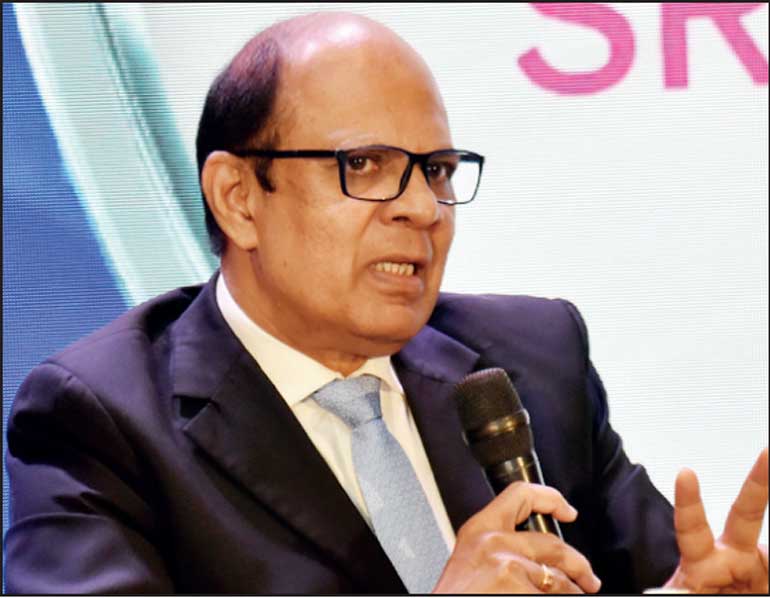
BOI Chairman Arjuna Herath
– Pic by Upul Abayasekara
Board of Investment Chairman Arjuna Herath said Sri Lanka must push through structural reforms to attract between $ 2 billion and $ 2.3 billion in foreign direct investment, stressing that the country cannot compete with the scale of fiscal concessions offered by other investment destinations.
Speaking at the Nations Trust Bank Investment Forum last week, Herath said Sri Lanka does not have the fiscal space to match concession-heavy regimes deployed by larger and better-capitalised economies, and must instead build competitiveness through lower costs, policy certainty and institutional efficiency. Herath said attracting investment would depend on creating a predictable and credible framework rather than relying on incentives the country cannot afford.
The BOI this week said it surpassed the $ 1 billion foreign direct investment (FDI) mark in 2025, describing it as an early indication of recovering investor interest and changes underway within the institution. However, this level of inflows remains well below the capital required to support sustained economic expansion.
However, the FDI inflow is inadequate to meet the growth needs of the country. According to a study by the Lanka Impact Investing Network, Sri Lanka’s annual investment demand is estimated at $ 7–10 billion to meet sustainable development goals, $ 3–5 billion for infrastructure development, and a further $ 2–3 billion annually for climate finance. The study also estimates an additional $ 695 million funding gap faced by women-led enterprises.
Referring to earlier reform episodes, Herath said liberalisation in the telecommunications sector during the 1990s had acted as a catalyst for wider FDI inflows. He said tools such as the Strategic Development Project Act had helped channel investment in recent years, with 14 projects approved under the framework, but acknowledged that the mechanism had been arbitrary and lacked consistent rules.
Herath identified high energy and construction costs as major constraints, noting that electricity tariffs remain among the highest in the region. He said the Government has stated its intention to reduce consumer tariffs from around 13–14 cents per unit to 7–8 cents, supported by renewable energy projects now being secured below 4 cents per unit.
He said the BOI currently has around $ 1 billion worth of investment proposals in hand in mineral sands and that policy clarity could unlock these projects. Improvements in connectivity, including highways, ports, airports and logistics infrastructure, were cited as important enablers for manufacturing-led investment and export growth.
Herath said macroeconomic stability has been restored and stressed the importance of avoiding policy reversals that could undermine investor confidence. He added that the proposed Investment Protection Act and a review of the Economic Transformation Act are intended to strengthen legal certainty for investors.
He said the Government is also considering a dedicated commission, with legislative authority, to expedite approvals and resolve investor issues, building on existing coordination mechanisms chaired by the Finance Ministry.
The BOI, he said, is moving towards proactively offering structured investment opportunities, including calls for interest in data centres, green hydrogen and green ammonia projects, as well as a pilot program to attract capital into technology startups.


