Thursday Oct 22, 2026
Thursday Oct 22, 2026
Saturday, 9 May 2026 02:25 - - {{hitsCtrl.values.hits}}
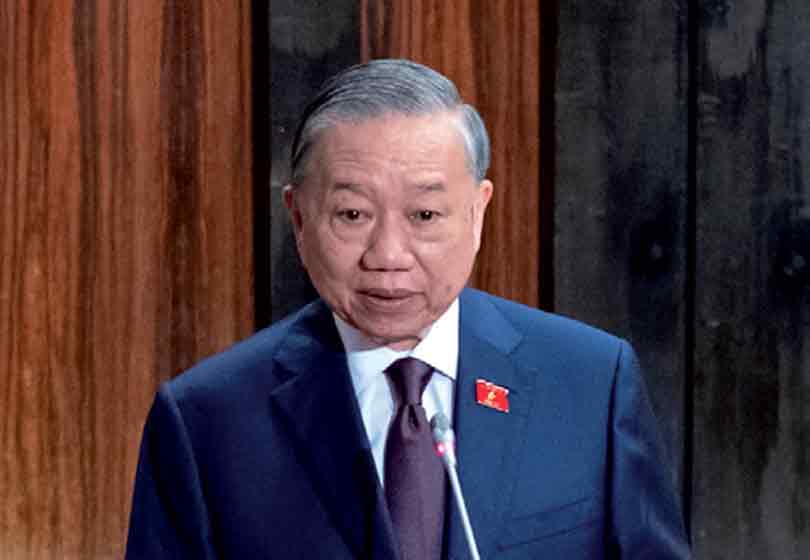
Vietnamese President Tô Lâm addressing Parliament
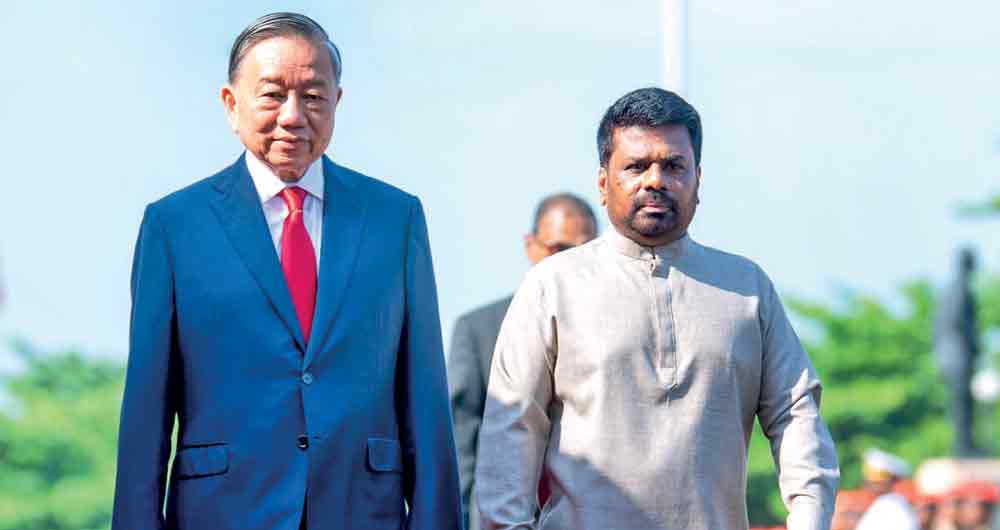
Visiting Vietnamese President Tô Lâm (left) with President Anura Kumara Dissanayake
 Visiting Vietnamese President Tô Lâm addressed Sri Lanka Parliament yesterday
Says reform began with “a new way of thinking” and confronting structural weaknesses
Calls for stronger institutions, rule of law, productivity and deeper global integration
Warns growth without people-centricity, internal capability, governance and innovation is unsustainable
Proposes Vietnam as bridge to ASEAN, Sri Lanka bridge to South Asia
Visiting Vietnamese President Tô Lâm addressing Sri Lanka’s Parliament yesterday shared lessons from the country’s transformation into an economic miracle.
“Our infrastructure ravaged, our economy in stagnation, the people’s lives in great deprivation, and resources for national development extremely limited. That was the backdrop against which Vietnam embarked on its ‘Doi Moi’ reforms,” Lâm said.
Initiated in December 1986, the Doi Moi reforms (meaning, renovation) transformed Vietnam from a centrally planned, struggling economy into a market-oriented, high-growth, socialist economy. Key reforms included legalizing private business, encouraging foreign investment, and introducing land ownership rights, resulting in substantial poverty reduction and economic growth.
“Doi Moi, first of all, meant a new way of thinking,” Lâm said.
“We were aware that to develop our countries, we need to look straight into the truth, evaluate reality as it stood, boldly change institutions that are no longer suitable, rouse the people’s creativity, harness the role of the businesses, open our door to reintegrate with the world, and build a socialist state under the rule of law, by, of, and for the people,” he said.
Lâm outlined how Vietnam gradually shifted from a subsidised centrally planned economy towards a socialist-oriented market economy that encouraged competition, innovation and international integration while maintaining the State’s strategic role in guiding development.
He said reforms in agriculture empowered farmers, strengthened food security and transformed Vietnam from a food-deficit nation into one of the world’s leading agricultural exporters.
He said Vietnam simultaneously opened its economy to foreign investment, expanded infrastructure, established industrial and economic zones, and integrated into regional and global value chains while maintaining an outward-looking foreign policy centred on trade, investment and multilateral engagement.
Vietnam’s GDP reached $ 514 billion in 2025, with per capita income exceeding $ 5,000, while the country had emerged as one of the world’s top 15 trading economies and investment destinations, linked to more than 60 economies through over 20 free trade agreements.
However, Lâm cautioned against complacency, saying Vietnam continued to face challenges including weak productivity growth, climate change, ageing demographics, strategic competition, digital transformation pressures and energy transition risks.
“From the journey, Vietnam has derived a number of lessons that we believe may be of use for fellow developing countries,” Lâm said.
Among the key lessons highlighted was the need to balance openness to trade and foreign investment with the development of domestic productive capacity, workforce quality, governance standards and technological capability.
Lâm stressed that attracting foreign investment alone was insufficient for sustainable development, arguing that countries needed stronger domestic firms, supportive industries, innovation ecosystems and deeper participation in global value chains. Vietnam, he said, was now attempting to transition away from labour- and resource-intensive growth towards productivity, technology, science, digitalisation and green growth.
He also emphasised the importance of legal and institutional reform, describing Parliament and governance systems as critical pillars in sustaining investor confidence and enabling inclusive growth.
“If the government is to open a new path ahead through policies, the government must ensure that this path is illuminated by the law, accountability, and the will of the people,” Lâm said, noting that Vietnam’s National Assembly played a key role in institutionalising reforms and overseeing governance.
“We are, at the same time, both doing and reviewing, both piloting and up-skilling, without haste, without going to extremes, but instead persevere with Doi Moi. Vietnam’s lesson is that all must stem from national realities, that we must respect objective laws and principles, while at the same time learning from international experiences, with selective eyes mindful of Vietnam’s particular conditions,” Lâm said.
The Vietnamese President also argued that development should not be measured solely through GDP growth, but by improvements in living standards, jobs, education, healthcare and public trust.
“The people are not simply beneficiaries, but are also actors delivering innovation, they are participants and masters of the development process. An economy may enjoy a short period of growth, but a nation can only enjoy sustainable development when the people feel they are truly the beneficiaries, the participants and masters of that development process,” Lâm said.
Lâm also announced that Vietnam and Sri Lanka had agreed to elevate bilateral ties to a Comprehensive Partnership framework, opening the door for expanded cooperation in trade, investment, logistics, digital transformation, artificial intelligence, agriculture, tourism and maritime industries.
The two countries have also agreed on a target of achieving $ 1 billion in bilateral trade in the near future, with Vietnam positioning itself as a bridge to ASEAN markets while viewing Sri Lanka as a gateway to South Asia and the Indian Ocean region.
Lâm said the upgraded Comprehensive Partnership framework would also deepen cooperation in defence, security, education, science and technology, tourism, digital transformation and parliamentary engagement, while creating new mechanisms for trade and investment facilitation between the two countries.
He said Vietnam and Sri Lanka would seek closer cooperation between ministries, legislatures and local government institutions, alongside stronger B2B engagement, trade missions, investment promotion and participation in trade fairs and conferences.
Lâm identified agriculture, food processing, manufacturing, renewable energy, electronics, auto parts, pharmaceuticals, healthcare, telecommunications, logistics, infrastructure, tourism and IT services as priority sectors for future collaboration and investment flows.
The Vietnamese President also proposed deeper cooperation in maritime economy development, ports, transport, logistics, marine environmental protection and blue economy initiatives, noting Sri Lanka’s strategic position in the Indian Ocean and Vietnam’s growing maritime ambitions in Southeast Asia.
He further called for collaboration in artificial intelligence, e-commerce, digital public services, digital healthcare, renewable energy and green finance, describing technology, innovation and data as “new bridges” capable of linking the two economies beyond geographical distance.
Lâm also stressed the importance of improving air connectivity, educational exchanges, cultural cooperation and tourism flows between the two countries, while encouraging stronger links between universities, researchers, youth entrepreneurs and cultural institutions.

