Tuesday Sep 15, 2026
Tuesday Sep 15, 2026
Thursday, 22 January 2026 06:44 - - {{hitsCtrl.values.hits}}
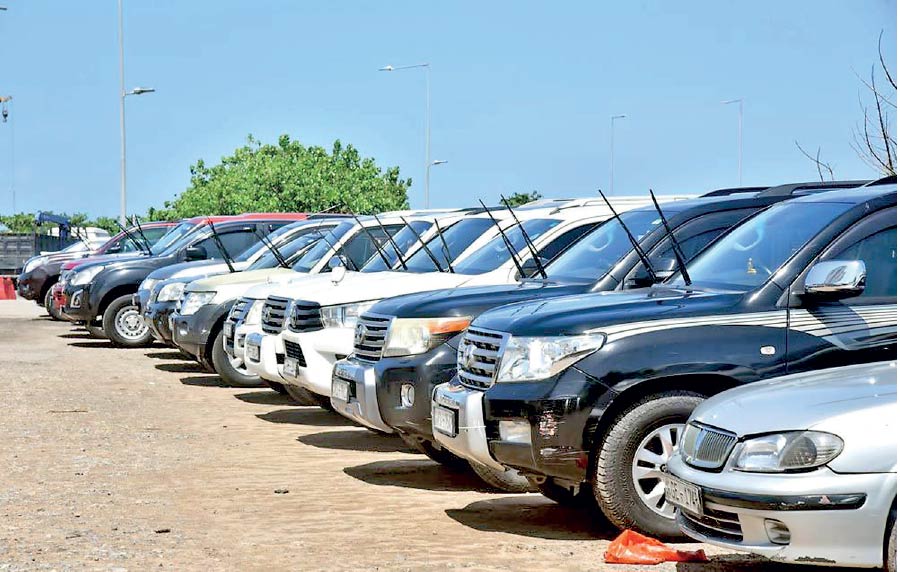
Vehicle registrations surged in December 2025 to their highest level in a decade, with total registrations rising to 48,525 units, up from 43,810 units in November 2025, according to data analysed by JB Securities Ltd.
The increase was driven by strong volumes across the motor cars, pre-owned vehicles, hybrids, electric vehicles (EVs), and premium passenger segments. Comparative vehicle registration volumes for 2015, 2019, and 2025 indicate a marked shift in both scale and composition.
Total passenger vehicle registrations, including cars, Sports Utility Vehicles (SUVs), and passenger vans, reached 68,323 units in 2025, lower than the 82,489 units recorded in 2015, when demand surged in the second half of the year following tax revisions. Compared with 2019, regarded as a more representative pre-COVID baseline year, passenger vehicle volumes in 2025 were approximately 50% higher, JB Securities noted.
Central Bank of Sri Lanka (CBSL) data show vehicle imports rose to $ 281 million in November 2025, up from $ 261 million in October 2025, and second only to the September 2025 peak of $ 286 million. Cumulative vehicle imports reached $ 1.7 billion in the first 11 months of 2025.
The composition of demand has shifted materially over the decade. SUVs and crossovers accounted for 52% of registrations in 2025, compared with 16% in 2019 and 12% in 2015. In contrast, cars represented 42% of registrations in 2025, down from 67% in 2019 and 74% in 2015.
By country of origin, Japanese vehicles accounted for 62% of registrations in 2025, lower than the 81% share recorded in 2019 but higher than the 51% share seen during the 2015 boom. Indian-origin vehicles, which accounted for 51% of registrations in 2015, declined sharply to 8% in 2025. Chinese vehicles increased their presence to 8% in 2025, having been virtually absent in the earlier comparison periods.
Sri Lanka earned Rs. 904 billion from vehicle imports in 2025, exceeding the Rs. 441 billion originally expected, Economic Development Deputy Minister Nishantha Jayaweera told Parliament.
Commenting on the data and the Deputy Minister’s statement, JB Securities Managing Director Murtaza Jafferjee said that taxes collected on vehicle imports alone amounted to around Rs. 905 billion for the year, equivalent to approximately 2.7% of GDP.
“Vehicle taxes, among the highest globally outside city-states such as Singapore, have delivered an exceptional fiscal windfall. Beyond strengthening fiscal balances, they have also been the single largest contributor to GDP growth. In the third quarter, taxes accounted for over 40% of nominal GDP growth and around 15% of real GDP growth,” he said.
Jafferjee said that up to November 2025, total imports of transport equipment and personal vehicles reached $ 1.851 billion, with the full-year figure expected to be around $ 2.1 billion.
“Vehicle imports accounted for just 12.86% of current account outflows, while CBSL reserve accumulation exceeded $ 200 million during November 2025. Given the relatively stable exchange rate, strong remittance inflows in December 2025, and the tourism high season, the external position is likely to improve further,” he said.
Rejecting claims that vehicle imports represented a misuse of scarce foreign exchange, Jafferjee said past foreign exchange shortages were driven by systematic resource mispricing and prolonged fiscal imbalances that resulted in fiscal dominance over monetary policy.
“Under the current macroeconomic framework, these imbalances have largely been corrected. Crucially, the fiscal adjustment has been materially supported by the willingness of high-income households to spend large sums on vehicle purchases. In this instance, conspicuous consumption has overridden economic rationality and, paradoxically, has been a significant boon for the Treasury,” he said.
Assuming gross profit margins of around 10%, Jafferjee estimated that total industry turnover in 2025 would be approximately Rs. 1.688 trillion, or about 5% of GDP, noting that this represents turnover rather than value addition to GDP.
According to JB Securities, motor car registrations increased to 5,007 units in December 2025 from 3,691 units in November 2025. Brand-new motor car registrations rose to 1,150 units from 781 units a month earlier. BYD led the new motor car segment with 408 units, comprising 263 Dolphin and 145 Atto 1 models, followed by BAW with 283 units, driven primarily by the E7 model. Toyota ranked third with 191 units, largely from the Wigo, while Perodua placed fourth with 99 units and Wuling recorded 50 units. Small vehicles, defined as those below 1,000 cc or electric motors under 100 kW, accounted for 93.9% of total registrations, with financing penetration estimated at around 50%.
Pre-owned motor car registrations increased to 3,857 units in December from 2,910 units in November. Suzuki led the segment with 1,446 registrations, mainly Wagon R units, followed by Toyota with 1,021 units, driven by the Yaris and Roomy. Daihatsu recorded 677 units, while Nissan registered 385 units. Small cars accounted for 96% of pre-owned registrations, and 95% of vehicles were imported from Japan. Financing penetration stood at 52.8%.
Premium passenger vehicle registrations rose to 187 units in December 2025 from 145 units in November 2025. New premium vehicles accounted for 54 units, dominated by Mercedes-Benz. The mix included C-Class, E-Class, S-Class, and GLB models. The pre-owned premium segment recorded 133 units, up from 98 units in November 2025, again led by Mercedes-Benz, followed by Audi, BMW, and Lexus. Individual registrations included one Porsche Macan, one Jaguar F-Pace SUV, one Bentley Bentayga SUV, and one Rolls-Royce Ghost.
Hybrid vehicle registrations increased to 3,142 units in December 2025 from 2,261 units in November 2025. Motor cars accounted for 80 units, while SUVs dominated with 3,002 units. Brand-new hybrids totalled 576 units, with the balance being pre-owned. Honda led the hybrid segment with 1,312 units, followed by Toyota with 1,099 units.
EV registrations reached 3,220 units in December 2025, marginally higher than 3,158 units in November 2025. Motor car EV registrations increased sharply to 803 units from 423 units, driven primarily by BYD models. SUV EV registrations rose to 232 units from 146 units, while two-wheelers accounted for 2,124 units. Three-wheelers recorded 33 units, led by the Mahindra Treo.


