Thursday Oct 15, 2026
Thursday Oct 15, 2026
Wednesday, 10 December 2025 03:11 - - {{hitsCtrl.values.hits}}
 |
| UNDP Resident Representative Azusa Kubota |
United Nations Development Program (UNDP) has called on international partners to provide affordable financing and recovery instruments for Sri Lanka, warning that the country cannot absorb additional debt to rebuild after Cyclone Ditwah, which flooded 1.1 million hectares and exposed 2.3 million people nationwide.
The organisation said recovery efforts now hinge on targeted external support to prevent the disaster from deepening into long-term economic and social fragility.
“After one of its worst economic crises and a slow but steady recovery underway, Sri Lanka cannot shoulder more debt to cover the costs of a rebuild from this massive natural disaster,” UNDP Resident Representative Azusa Kubota said.
“International partners must step up with affordable financing and innovative instruments that enable a rapid recovery and rebuilding with greater resilience, without the country falling off the debt cliff,” said UNDP Resident Representative Azusa Kubota.
UNDP’s early recovery analysis identifies high-need regions where cyclone impacts overlap with pre-existing vulnerabilities, particularly in Puttalam, Kilinochchi, Mullaitivu, the central highlands, and parts of the North and East.
These areas face combined pressures from damaged homes, disrupted livelihoods, weakened local governance systems, and reduced access to basic services. Over half of the exposed population was already living with high debt and unstable incomes before the cyclone, a factor UNDP says will slow economic recovery without intervention.
The organisation has outlined a set of sequenced early recovery priorities requiring urgent financing.
These include debris and waste clearance, rehabilitation of community infrastructure and service delivery lifelines, support for MSMEs and household income generation, and replacement of lost civil and financial documentation so affected families can reconnect to banking, social protection schemes, and recovery assistance.
Temporary reinforcement of local governance systems will also be required to manage targeting, outreach, and registries as communities return home.
“Where high flooding and high vulnerability overlap, recovery is likely to be slower and more costly. Early action in these locations is critical,” Kubota said. UNDP added that the concentration of exposure in Colombo and Gampaha has placed heavy pressure on essential public services and underscored the need for permanent solutions for communities living in disaster-prone areas.
Cyclone Ditwah also generated more than 240,000 tons of non-construction waste and over 60,000 cubic metres of construction debris.
UNDP warned that clearance costs will rise as verification progresses and that disruptions to transport links, agriculture, and access to essential services will continue to impede recovery.
Agriculture-related losses are significant, with over 530,000 hectares of paddy land flooded and several districts already experiencing food-security pressures.
UNDP Crisis Bureau Crisis Readiness, Response and Recovery Chief Devanand Ramiah said the cyclone was a reminder of how quickly compounding risks can materialise, adding that the priority now is to restore essential services, repair transport networks, and strengthen resilience systems.
UNDP said it is working with the Government, development partners, and affected communities on immediate relief and early recovery efforts, but stressed that external financing will be pivotal to stabilising livelihoods and ensuring a recovery that does not add to Sri Lanka’s debt burden.
Ditwah floods 20% of Sri Lanka, triggers 1,200 landslides, heightens food insecurity: UNDP
Cyclone Ditwah inundated 1.1 million hectares, or about 20% of Sri Lanka’s land area, and exposed 2.3 million people to flooding, according to new UNDP geospatial analysis that expands on earlier assessments of the country’s worst flooding disaster in decades.
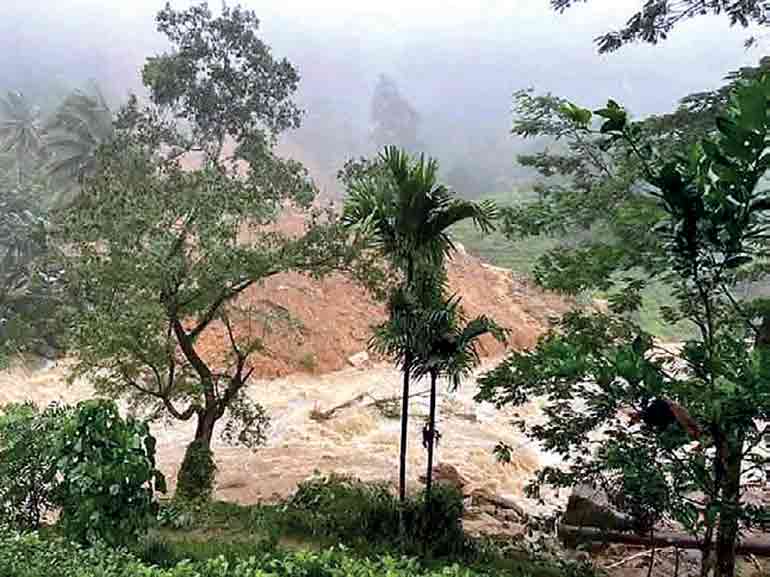
The cyclone also triggered nearly 1,200 landslides across the hilly interior, compounding access constraints and slowing rescue operations.
UNDP’s integrated analysis shows that the greatest early recovery needs are in areas where flooding and landslides converge with pre-existing socioeconomic vulnerability.
Divisional Secretariats such as Mundel and Arachchikattuwa in Puttalam, Kandavalai in Kilinochchi, and several locations in the central highlands face overlapping pressures from damaged homes, disrupted livelihoods, and reduced access to basic services compounded by weakened local governance systems.
These communities are unlikely to recover without targeted interventions that stabilise incomes, restore mobility, and reconnect essential services.
Flood severity varied across the island. The largest inundation was recorded in Dimbulagala in Polonnaruwa, with more than 23,000 hectares submerged. Significant flooding also occurred in Kandavalai in Kilinochchi, Maritimepattu in Mullaitivu, and in Welikanda and Medirigiriya in Polonnaruwa.
In the central highlands, districts such as Nuwara Eliya, Badulla, and Kegalle experienced intense rainfall that produced localised slope failures rather than large floodplains. Ududumbara in Kandy District recorded the highest number of landslides at 135, while Laggala, Kothmale East, Lunugala, and Passara all registered more than 60 events each.
The exposed population includes roughly 1.2 million women, 522,000 children and youth, and 263,000 older persons.
Kolonnawa in Colombo District recorded the highest exposure with over 150,000 people living in flooded areas.
Kolonnawa, Wattala, Kelaniya, and Dehiowita are among the few divisional secretariats where more than half the population was exposed, underscoring the scale of recovery challenges in densely populated low-lying settlements.
Nearly 720,000 buildings were exposed to floodwaters, including 243 hospitals and hundreds of schools.
Ja Ela in Gampaha District recorded more than 44,000 exposed structures, while Kolonnawa, Kaduwela, Katana, and Wattala each recorded over 35,000.
More than 16,000 kilometres of roads and 480 bridges were exposed to flooding, with Katana, Gampaha, and Ja Ela each exceeding 300 kilometres of affected roads. Over 278 kilometres of railway lines and 35 railway bridges were also exposed, reducing connectivity and access to services.
Preliminary debris assessments indicate that the cyclone generated more than 240,000 tons of non-construction waste and over 60,000 cubic metres of construction debris.
Colombo faces the largest debris load due to dense settlement patterns, but substantial volumes are also reported in Badulla and Puttalam. Clearance needs will evolve as field verification progresses.
Agricultural exposure is significant. More than 530,000 hectares of paddy land were flooded, with Dimbulagala again the most affected at nearly 19,000 hectares. Other heavily impacted areas include Welikanda, Medirigiriya, Horowpathana, and Dehiattakandiya.
In several of these locations, 20-30% of households lack sufficient dry food stocks to last a week, indicating heightened food-security risks.


