Friday Sep 18, 2026
Friday Sep 18, 2026
Friday, 18 September 2026 00:00 - - {{hitsCtrl.values.hits}}
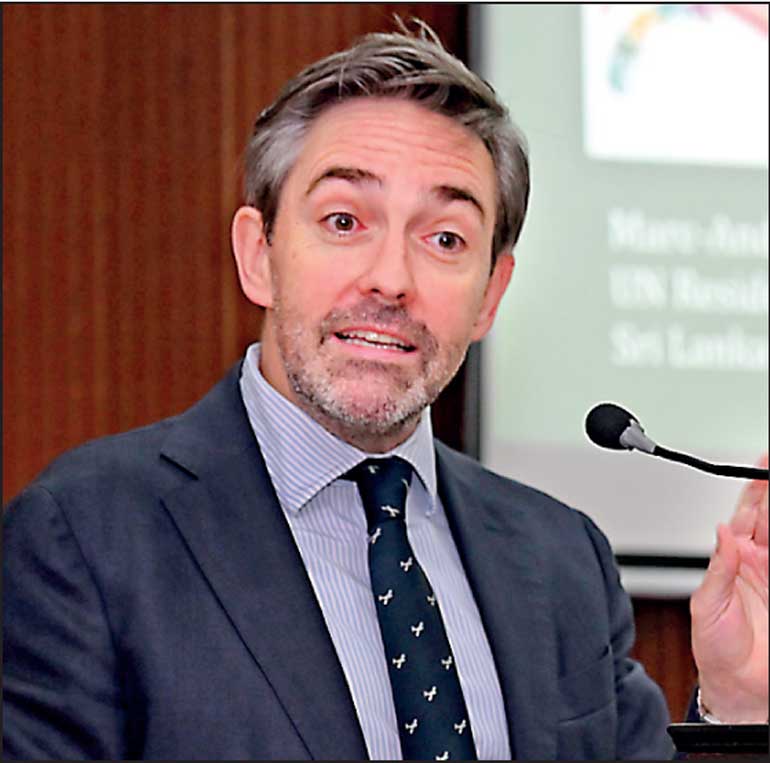
Resident Coordinator in Sri Lanka Marc-André Franche
- Pic by Daminda Harsha Perera
UN Resident Coordinator in Sri Lanka Marc-André Franche yesterday said Sri Lanka risks undermining the same security and development goals its anti-money laundering and counter-terrorism financing (AML/CFT) rules are meant to serve if those rules are applied as blanket restrictions on civil society rather than through targeted risk assessment.
His remarks came as Sri Lanka undergoes it third Mutual Evaluation process on AML/CFT with the Asia-Pacific Group on Money Laundering (APG), the regional body affiliated with the Financial Action Task Force (FATF).
Speaking at the launch of the Sri Lanka Civil Society FATF Shadow Report, organised by the Sri Lanka CSO FATF Network, Franche said the FATF’s Recommendation 8 exists because terrorist organisations have exploited non-profits’ public trust and relatively light oversight to move and disguise money.
He said the standard’s original 2001 approach led many countries into broad, one-size-fits-all restrictions on the entire non-profit sector, straining legitimate charitable work without meaningfully reducing risk.
A 2023 revision to the standard narrowed its focus to organisations actually facing high risk, and required governments to assess that risk individually rather than regulate all non-profits uniformly, he said.
“If it’s applied well, in a targeted, focused, proportionate, and evidence-based way, as it is intended, it strengthens security, civic space, and it will enable development and growth of this country,” Franche said. “If it is applied as a blanket measure, it will do the opposite.”
The report launched at the event found that Sri Lanka’s regulatory measures, introduced under the justification of meeting FATF requirements ahead of the Mutual Evaluation, have instead constrained non-profit organisations broadly.
A 2025 survey of 102 non-profits found 69% had experienced difficulties receiving foreign funds, with at least 42% of those told by banks to register with the Non-Governmental Organisations (NGO) Secretariat to receive such funds, a requirement not stipulated by law. Nearly half of respondents reported difficulty opening new bank accounts, and only 17% reported no issues at all.
Franche said Sri Lanka has “a documented tendency to broadly interpret or over-apply security measures,” pointing to how the Prevention of Terrorism Act has been used against civil society, journalists, and minority groups.
He said 2026 amendments to the Financial Transaction Reporting Act, the Prevention of Money Laundering Act, and the Convention on Suppression of Terrorist Financing Act have expanded investigative, surveillance, and asset-management powers, while a proposed law on NGO registration and supervision raises further concerns the UN has already conveyed to the Government about replicating powers associated with the Prevention of Terrorism Act.
He said UN human rights treaty bodies have separately raised concerns about funding restrictions and bureaucratic obstacles facing non-governmental organisations, including registration and clearance requirements that contradict human rights law.
Franche called for an enabling regulatory environment built on institutionalised, inclusive consultation, with draft legislation published with adequate time for review in local languages, arguing this was absent from the current legislative process.
He said laws governing civil society should provide safeguards against arbitrary detention, disproportionate surveillance, and unjustified asset seizure without due process, while ensuring continued access to banking and protection for humanitarian and disaster-response activity.
Protecting civic space was not a concession to civil society but an investment in the country’s resilience, Franche said, noting the sector’s role in the humanitarian response to Cyclone Ditwah in November 2025, which affected an estimated 2.2 million people.
He said no major challenge facing Sri Lanka, including poverty reduction, could be resolved by Government alone without a functioning civil society and private sector alongside it.
The UN, he said, stood ready to support an approach to the Mutual Evaluation that is evidence-based and proportionate.

