Friday Sep 25, 2026
Friday Sep 25, 2026
Friday, 12 December 2025 00:00 - - {{hitsCtrl.values.hits}}
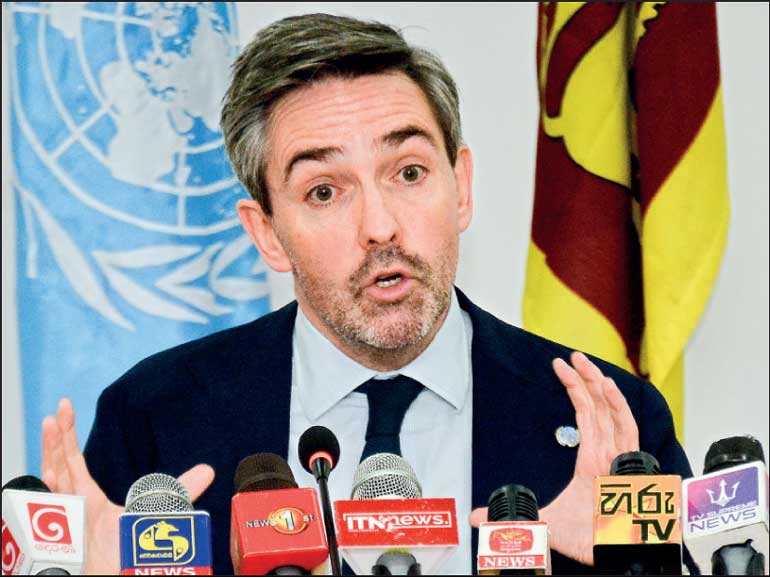
UN Resident Coordinator in Sri Lanka Marc-André Franche – Pic by Upul Abayasekara
By Charumini de Silva
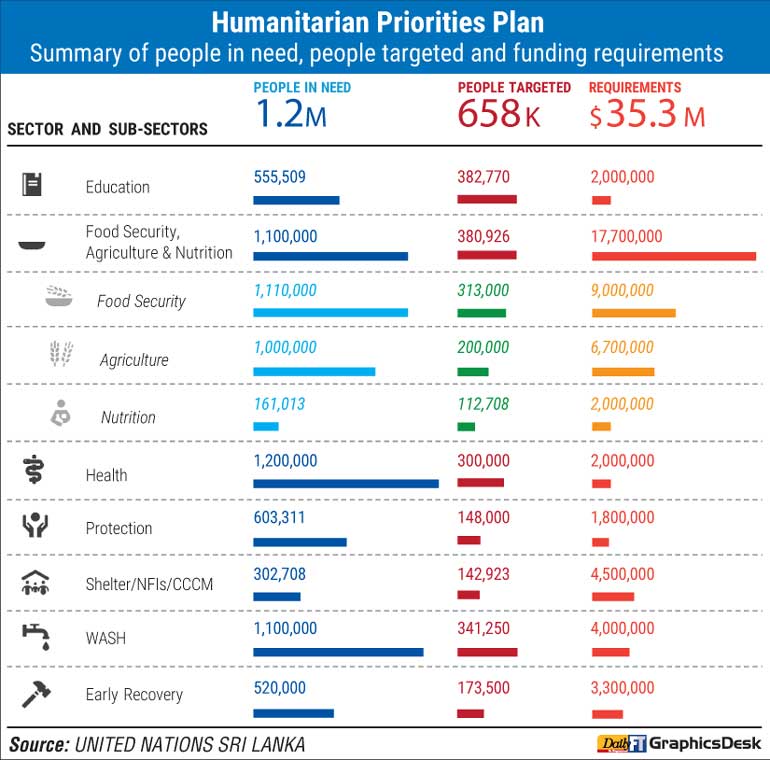
The United Nations and humanitarian partners yesterday launched a Humanitarian Priorities Plan (HPP) seeking $ 35.3 million (around Rs. 10.9 billion) to scale-up life-saving assistance for communities devastated by Cyclone Ditwah.
The plan aims to support 658,000 of the most vulnerable people between December 2025 and April 2026, as Sri Lanka grapples with what the UN describes as its worst natural disaster in at least two decades.
Speaking at the launch, UN Resident Coordinator in Sri Lanka Marc-André Franche warned that the scale of destruction is “well beyond what we had initially forecasted, with 2.2 million people affected across all districts, with over 600 confirmed dead and around 200 still missing.”
The HPP, developed jointly with the Disaster Management Centre (DMC) following last week’s needs assessment, targets seven priority sectors including education; food security, agriculture and nutrition; health, protection; shelter, non-food items and camp coordination; water, sanitation and hygiene; and early recovery.
Franche stressed that the plan responds directly to a formal request by the Government seeking international multi-sectoral support. “Some of the Government’s support, such as allowances for cleaning damaged homes or rental support, will take time to roll out. This is where the UN and partners are stepping in to cover gaps for the next three to four months,” he added.
He said so far, the UN has secured around $ 9.5 million from its own resources and contributions from Australia, Canada, the European Union (EU), Switzerland, the UK and the US.
“The organisation is now seeking the remaining $ 26 million required for the plan,” he stated, adding that the balance will be sought from member States, development partners, the private sector and individuals,” Franche said.
He clarified that the $ 35 million humanitarian plan is entirely grant-based and will not add to Sri Lanka’s debt burden.
“We are appealing to the international community, to our member States, to support Sri Lanka in this time of need. Many of you who have been on the ground know the magnitude of this disaster. Enormous work remains to be done,” he added.
Franche said 21 countries, along with development banks, bilateral agencies and charitable organisations have already extended support through funding, emergency teams, logistics and in in-kind contributions.
According to him, a key boost came from the UN Central Emergency Response Fund (CERF), which has approved $ 4.5 million for Sri Lanka. The UN has also deployed an emergency team and activated the UN Space Charter, giving the DMC access to satellite imagery for impact mapping.
He stressed that the cyclone’s impact was worsened by the country’s existing vulnerabilities.
“The disaster has hit the island at a moment of compound impact, after the COVID pandemic, after the economic crisis when about 25% of Sri Lankans still live in poverty. It is coming on top of a lot of stress and anxiety, and we need to be very conscious of this,” he pointed out.
Despite the hardship, Franche praised the “extraordinary” solidarity shown by Sri Lankans. “People, citizens, associations have come together to support one another. I am not sure if this would happen in my own country,” he remarked.
He emphasised that while rebuilding and recovery planning must begin, what is most important now is to respond to emergency and humanitarian needs of so many Sri Lankans across the country. “That is the priority,” he added.
He warned that delaying emergency support risks greater vulnerability to diseases and long-term setbacks for children, particularly if schooling remains disrupted in the thousand damaged schools.
Addressing concerns about housing, Franche said the priority is ensuring displaced families have safe shelter, while authorities identify medium term solutions. “The priority is to make sure that the thousands of people that do not have a home have a roof over their shoulder,” he said, adding that resolving broader land and housing issues “will take time”.
Asked whether the UN may need to extend assistance beyond four months, the Resident Coordinator said humanitarian interventions are by definition short-term, designed to preserve life, while longer term rebuilding must be led by national systems and development partners.
“Adjustments to the plan are possible,” he said, noting that the UN expects the emergency phase to conclude within four months.
On concerns about aid delivery, Franche noted that Sri Lanka’s tightly knit community structures, local, civil society and Government officials allow strong monitoring. “The UN uses community feedback channels and works very closely with the Sri Lankan authorities,” he stressed.
He opined that needs differ by region, with riverbank communities requiring relocation due to unsafe conditions, while hill-country communities face landslide damage and blocked access roads. The situation is quite complex and depends very much on the local situation,” he explained.
Franche also confirmed that the humanitarian assessment guiding the HPP is separate from the Government-led recovery and reconstruction assessment that will determine long term financial requirements with support from the World Bank, Asian Development Bank (ADB), UN agencies and others.
“We don’t know yet what the number is,” he said, adding that initial damage figures show extensive destruction, including 30% of the rail network inoperative, thousands of kilometres of damaged roads and major losses to agriculture and small businesses.
He added that the UN will also assist groups who fall outside Government schemes, such as small farmers who do not have registered farms.
Franche also acknowledged that Sri Lanka faces stiff competition for international funding, as countries across the region, including Vietnam, Indonesia and Thailand grapple with simultaneous climate related disasters.


