Thursday Oct 15, 2026
Thursday Oct 15, 2026
Monday, 23 February 2026 02:13 - - {{hitsCtrl.values.hits}}
 Treasury Secretary Dr. Harshana Suriyapperuma says over 20 new laws under review; several to be enacted this year
SOE Act, insolvency law and anti-corruption measures nearing completion
Eyes FTAs and credit rating improvement to access international capital and improve FDI
By Devan Daniel
|
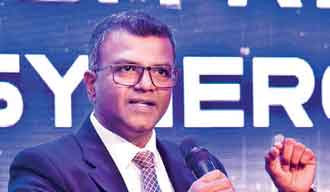
Treasury Secretary Dr. Harshana Suriyapperuma |
More than 20 pieces of legislation are at various stages of review and are expected to be implemented within the year, Treasury Secretary Dr. Harshana Suriyapperuma said last week, outlining the reform agenda set out in the 2026 Budget.
With the Government earning acclaim for stabilising the economy and creating buffers that are now helping the country absorb Ditwah-related shocks, the focus on the reforms agenda is intensifying, particularly those related to critical, complex, and contentious big tickets such as State-owned enterprises (SOEs), energy, Customs, and the Inland Revenue Department, which feature significantly in the International Monetary Fund’s (IMF) 2023 report ‘Sri Lanka: Technical Assistance Report-Governance Diagnostic Assessment.’
Speaking at the Association of Professional Bankers’ (APB) Annual Convention, Dr. Suriyapperuma responding to a question on reform timelines and complexity said the 2026 Budget sets out the roadmap.
“If we take a look at the 2026 Budget, that will show the policy reforms the Government has approved for implementation purposes. The direction is very clear in terms of repealing certain existing Acts and introducing new laws to facilitate businesses to do business better and to bring investments into the country,” he said.
“The one unique advantage Sri Lanka enjoys over any other country is its geographic location, and the Government is focused on unlocking the maritime hub potential that has eluded this country for decades,” Dr. Suriyapperuma said.
“We need to ensure sustainability is maintained and give rating agencies the confidence to restore us to a position where we can access financing at lower cost. At the same time, we must provide confidence to investors, particularly foreign investors and foreign direct investment (FDI) partners, that Sri Lanka is a credible destination for their capital.”
He said the Government has lodged its first application to pursue new Free Trade Agreements (FTAs) with identified countries and regions.
The proposed State-Owned Enterprises Act, intended to strengthen governance, improve efficiency, and speed up decision-making, is expected to be finalised within weeks.
Legislation dealing with financially distressed businesses has already been approved, providing a framework for restructuring and revival. Measures to prevent leakages and recover assets amassed through corruption have either been enacted or cleared by Parliament, with certain fiscal provisions to take effect from 1 April.
Dr. Suriyapperuma said the Treasury had settled Rs. 45 billion in outstanding obligations reflected in bank balance sheets.
“Because of the way the Treasury managed itself, we were able to pay Rs. 45 billion outstanding that was sitting in bank balance sheets for years,” he said, noting that non-performing loans were declining and that the medium-term growth target was 7%.
He said pro-bank measures in the Budget would take effect from April. A Rs. 95 million allocation for 2026 is being channelled through the banking sector to support small and medium enterprises (SMEs), with Rs. 8 million disbursed as at 31 January.
Nearly Rs. 7 million in collateral-free loans has also been extended to SMEs, including young and women entrepreneurs across districts and provinces.
Dr. Suriyapperuma said the reform drive was unfolding against a backdrop of global uncertainty, environmental risks, and geopolitical tensions, alongside Sri Lanka’s own structural constraints. He said confidence remained the central variable in maintaining economic, political, and social stability.
“This is the reality that we are living. It is the confidence that we give to our stakeholders, whether G2G partners, multilateral institutions, creditors, local businesses, or citizens, that will determine our stability,” he said.
He acknowledged that Sri Lanka’s external position, including its reserve buffers, left limited room for error, but said financial discipline and zero tolerance for corruption were strengthening credibility.
“The changes and the results that we have seen are not accidental. They are structural. The revenue increase is not an accident. It is a result of structural reforms, including zero tolerance for corruption,” he said.
He said risk premiums on Sri Lankan International Sovereign Bonds (ISBs), as well as on domestic Treasury Bills and Bonds, were declining, reflecting improved market sentiment.
“You can see in the international trading of Sri Lankan Bonds, the premiums are going down. In the local market for Bills and Bonds, premiums are going down. That is the premium of risk that this nation takes,” he said.
Dr. Suriyapperuma said the 2026 Budget had been presented without additional borrowing despite significant fiscal pressures, describing it as evidence of restored financial discipline.
“Despite the difficult environment, we were able to present the Budget to Parliament without borrowing a single extra rupee. That is the financial discipline this country was waiting for for decades,” he said.
He said continuous engagement with businesses, investors, and development partners would remain a priority, adding that the objective was to create conditions for the banking sector and private enterprise to expand, while positioning Sri Lanka as a credible investment destination.