Thursday Oct 22, 2026
Thursday Oct 22, 2026
Saturday, 28 March 2026 00:53 - - {{hitsCtrl.values.hits}}
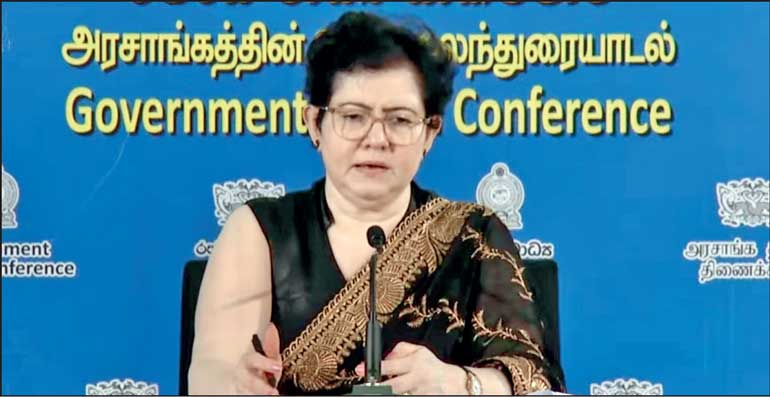
Industry Ministry Secretary Thilaka Jayasundara
By Charumini de Silva
Industry Ministry Secretary Thilaka Jayasundara yesterday said the cess tax on imports will not be fully removed from 1 April, with the Government opting for a slower phase-out for vulnerable sectors.
Addressing the media, she said the broader plan for phased reduction will begin with a 50% cut in cess rates from 1 April 2026, followed by a further 25% reduction in April 2027 and the remaining 25% will be deducted in 2029.
“However, the Government has postponed timeline for a selected group of 107 HS codes in eight sectors, which will see a more gradual reduction, beginning only in 1 April 2027 with a 25% cut, followed by another 25% in 2028 and the remaining 50% in 2029,” she explained.
She reiterated that the levy will not be scrapped outright, opting instead for a multi-year, phase-out aimed at balancing competitiveness with domestic industry protection.
Jayasundara said the Government has identified around 7,800 HS codes for reform, aligning the move with global trade norms and World Trade Organisation (WTO) principles. “The overhaul follows 3-4 months of consultations with stakeholders including the Finance Ministry and the World Bank,” she stressed.
Cess is a special levy imposed on select imports and exports under the Export Development Act No. 40 of 1979, often used to discourage non-essential imports, protect local industries, and fund export development. It is calculated as a percentage (ranging from 1% to 35%) or a specific unit rate on goods, often resulting in the highest amount.
On 3 March 2026, the Cabinet of Ministers approved the phased elimination of cess on 2,634 classification codes over four years. Accordingly, 697 intermediate goods will see cess removed between 2026 and 2028, a total of 107 sensitive intermediate goods used by local industries will be phased out by 2027–2028, while 265 textile-related goods will have cess removed this year and 46 goods with a marginal cess rate below 5% will also see immediate removal in 2026.
Jayasundara noted that the reform is not merely about tariff reduction, but about repositioning Sri Lanka’s trade framework to enhance export competitiveness. High para-tariffs such as cess have long been criticised for inflating production costs, particularly for export-oriented industries reliant on imported raw materials and intermediate goods.
She maintains that the gradual rollback will help reduce production costs, improve quality standards, and strengthen Sri Lanka’s standing in global export rankings.
The Ministry Secretary also assured that safeguarding measures will remain in place to prevent market distortions, including the use of the Anti-dumping and Countervailing Act to curb the influx of low-quality imports.
Removing trade restrictions via various taxes forms part of the Government’s ongoing reforms program.
When the International Monetary Fund (IMF) approved the $ 206 million Rapid Financing Instrument (RFI), post-Ditwah in December 2025, the Government issued a Letter of Intent committing to preserve fiscal discipline and maintain an open trade and payments regime.
“We will not impose new or intensify existing restrictions on the making of payments and transfers for current international transactions, trade restrictions, or multiple currency practices, or enter into bilateral payments agreements which are inconsistent with Article VIII of the Fund’s Articles of Agreement,” the LOI stated.
Central Bank of Sri Lanka (CBSL) Governor Dr. Nandalal Weerasinghe earlier this week said the IMF would discusses changes to the ongoing IMF EFF program parameters in line with the economic disruptions caused by the Middle East war. “This time, changes may be more significant than the last several reviews, because this time, it is a significant shock,” he told journalists at the announcement of the 2nd Monetary Policy Review for 2026 on Wednesday.
The CBSL Governor also said critical reforms, in fiscal policy trade and labour would have to continue to place the economy on a sustainable footing. “These reforms must happen whether or not there is a crisis,” he said. Dr. Weerasinghe ruled out the need to impose import and capital restrictions for now.


