Thursday Oct 08, 2026
Thursday Oct 08, 2026
Thursday, 8 October 2026 05:32 - - {{hitsCtrl.values.hits}}
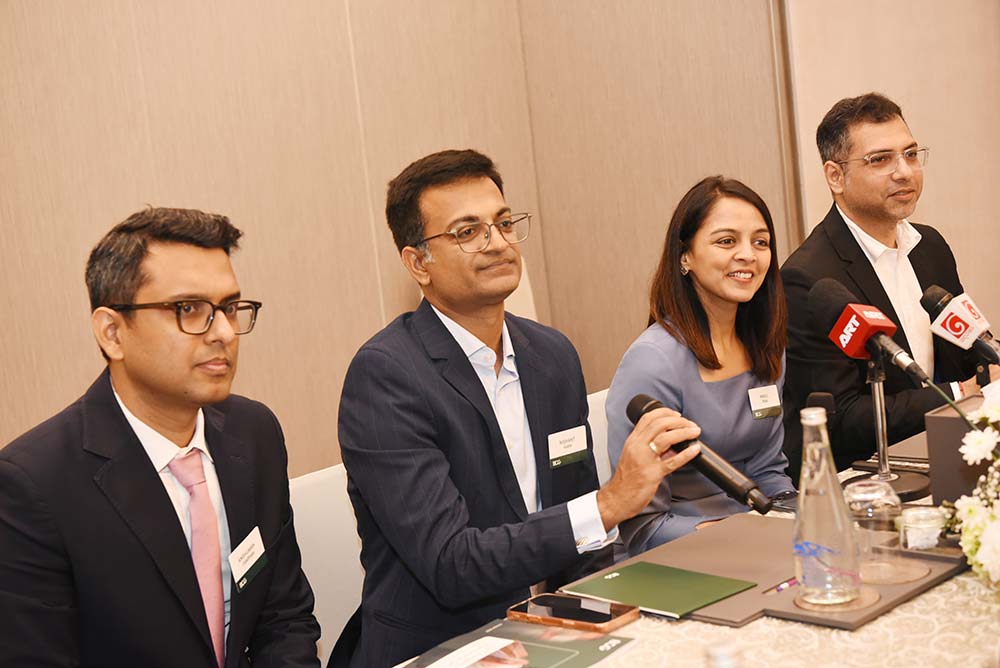
From left: BCG Managing Director and Partner Anshuman Upadhyaya, Managing Director and Senior Partner Nishant Gupta, India Leader – Marketing, Sales and Pricing Practice, Managing Director and Partner Parul Bajaj, and Centre for Customer Insight Associate Director Devraj Bharati – Pic by Shehan Gunasekara
Sri Lankan brands face a tougher fight for customers both from local rivals and from abroad, with a new study showing that brand loyalty is eroding across key categories as digital channels widen consumer choice, even as household spending reaches a record.
‘The Changing Path to Purchase in Sri Lanka: How Consumers Discover, Select and Transact Today,’ released by Boston Consulting Group (BCG) with The Ceylon Chamber of Commerce as collaborative partner, shows household consumption has rebounded to an all-time high and become a larger driver of the economy than before
the crisis.
“The fact that consumption is increasing as a percentage of overall GDP is an indicator that consumption is positive,” BCG Managing Director and Senior Partner Nishant Gupta said. “Going forward, consumers are also saying they want to spend more, so I think it is moving in a positive direction.”
Real household consumption rose to Rs. 8.9 trillion in 2025 at 2015 prices, from Rs. 8.4 trillion in 2024 and Rs. 8 trillion in 2023, well above the pre-crisis peak of Rs. 8.2 trillion in 2019. It grew at an average 5.5% a year in real terms in 2023-2025, against 2.7% in 2015-2019 and an average annual contraction of 0.8% in 2019-2023, when it fell as low as Rs. 7.8 trillion in 2020.
Consumption’s share of real GDP rose to 67% in 2023-2025 from 63% during the crisis years and 61% in 2015-2019.
That spending, however, is no longer tied to any single brand. The survey of 2,272 respondents shows consumers moving away from unbranded goods but refusing to commit to one brand. Among staples buyers, the share committed to one specific brand fell to 6% from 14% in 2020, while those weighing two to three brands rose to 50% from 36%. Single-brand preference fell to 29% from 39% in personal care and to 17% from 22% in packaged food.
“Loyalty becomes very difficult for a brand to prove or demonstrate, and the competitive environment therefore becomes much more challenging,” BCG Centre for Customer Insight Associate Director Devraj Bharati said.
Asked by the Daily FT what the findings meant for local brands’ competitiveness, BCG India Leader – Marketing, Sales and Pricing Practice, Managing Director and Partner Parul Bajaj stressed that preference for Sri Lankan brands remained strong and was growing. In personal care, it has climbed to 49%.
The data, however, point to rising pressure from abroad. Preference for international brands in personal care, the category where it is highest, has more than tripled to 10% from 3%. Bajaj said affluent households were more brand-driven and showed a slightly higher preference for international brands. That matters because the same households carry the strongest intent to spend more, and are also the most digitally active, with 46% of Generative AI users among households earning above Rs. 150,000 a month using the tools for brand research.
Digital has become the main gateway for new entrants. Word of mouth remains the leading influence, cited among the top three by 66% of consumers, but digital channels now rank second at 51%, up from 32% in 2020, well ahead of television at 37% and newspapers and radio at 7% each. With 55% of consumers now aware of Generative AI and a third of its users turning to it for brand research, rising to 39% among Gen Z, brands also have to compete on platforms where traditional advertising carries little weight.
“If consumers are not going to see your brand on Generative AI platforms, then the brand will not even be in their consideration set,” Bajaj said.
Consumers are also more demanding on what they buy. Better prices and discounts rank as the second most important factor for large-appliance buyers, cited by 51%, and health is emerging as a criterion among higher-income households, 38% of whom rank purity certification among their top five factors for staples against 16% overall. Bharati said brands could no longer serve every segment with the same budget, and that higher-income consumers would need a more tailored offering.
The squeeze on wallets sharpens the contest. While 77% of consumers expect household spending to rise over the next six months, only 38% expect their income to rise and 27% expect it to fall. Bajaj said the expected increase reflected both higher prices and higher volumes, and households were rebalancing as a result: essentials are protected, impulse categories such as packaged snacks and beverages are being held steady, low-ticket discretionary items such as mobile phones and home improvement face cuts, and big-ticket purchases such as vehicles and furniture are being deferred. Bharati said brands in essentials needed to double down on loyalty, while those in discretionary categories would have to unlock latent demand from a more cautious consumer.
The authors stopped short of calling for a strategic overhaul. Their data, however, suggest that the recovery will not lift all brands as past upturns did: with loyalty weakening, foreign competition gaining among the most valuable customers, and discovery shifting online, Sri Lankan brands will have to compete for each purchase rather than rely on habit and legacy distribution.


