Tuesday Sep 29, 2026
Tuesday Sep 29, 2026
Wednesday, 17 June 2026 06:42 - - {{hitsCtrl.values.hits}}
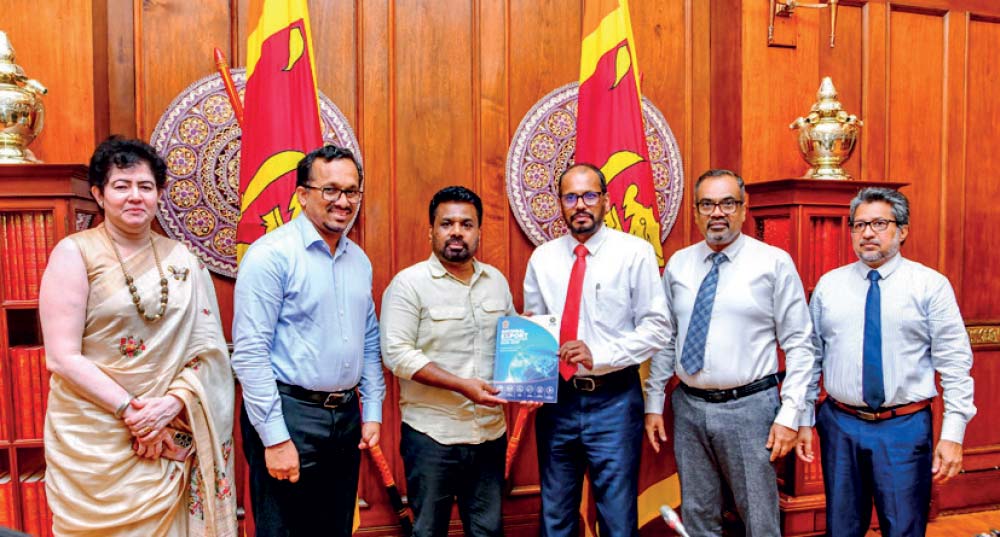
EDB Chairman Mangala Wijesinghe (third from right) presents a copy of the National Export Development Plan to President Anura Kumara Dissanayake at the Presidential Secretariat yesterday. Others from left: Industry and Entrepreneurship Development Ministry Secretary Thilaka Jayasundara, Industry and Entrepreneurship Development Minister Sunil Handunneththi, Labour Minister and Finance and Planning Deputy Minister Dr. Anil Jayantha Fernando and Senior Additional Secretary to the President and Energy Ministry Secretary to Russell Aponso
- Pic by Upul Abayasekara -
By Charumini de Silva
Sri Lanka yesterday launched an ambitious five-year National Export Development Plan (NEDP) aimed at almost doubling export earnings to $ 36 billion by 2030, with policymakers and development partners stressing that export diversification, competitiveness and reform implementation will determine the country’s next phase of economic recovery.
Developed by the Sri Lanka Export Development Board (EDB) under the guidance of the Industry and Entrepreneurship Development Ministry with technical support from the Asian Development Bank (ADB), the NEDP 2026-2030 seeks to transform Sri Lanka into a competitive logistics and knowledge-intensive export hub serving regional and global markets.
The launch comes as the country attempts to shift from crisis recovery to sustained growth, with exports increasingly viewed as a key source of foreign exchange, investment, productivity gains and quality employment.
Delivering the keynote address, Labour Minister and Finance and Planning Deputy Minister Dr. Anil Jayantha Fernando said Sri Lanka must move beyond measuring export success solely by export earnings and instead focus on achieving its full potential through deeper integration into global trade and value chains.
Highlighting a major weakness in the country’s export performance, he noted that Sri Lanka’s export basket has changed little over the past three decades despite significant shifts in technology and global demand. “The export composition of the 1990s and 2020 is more or less the same,” he said, adding that both product and market diversification must become key priorities if Sri Lanka is to unlock new growth opportunities.
Dr. Fernando linked the NEDP to the Government’s wider economic reform program, noting that the economy had emerged from a period of severe instability and was now showing signs of recovery. “The country recorded 5% economic growth in 2025 despite challenges. Growth also accelerated to 5.1% in the first quarter of 2026. Although it was slightly less than our expectation, it was the highest first quarter GDP growth since the economic crisis in 2022,” he said.
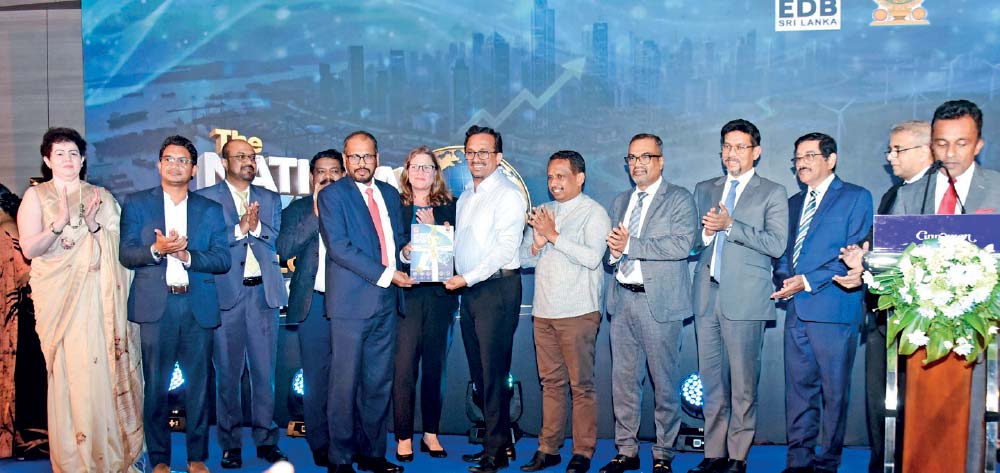
EDB Chairman Mangala Wijesinghe (left) presenting a copy of the NEDP to Industry and Entrepreneurship Development Minister Sunil Handunnetti
He stressed that export expansion would depend not only on trade policies, but also on structural reforms, particularly digitalisation, human capital development and labour market modernisation. “Sri Lanka’s greatest competitive advantage lies in its workforce rather than natural resources,” Dr. Fernando said, noting that knowledge, innovation and skills would increasingly determine success in global markets.
He also pointed to ongoing labour reforms, including the drafting of a new labour law aimed at improving productivity, while ensuring compliance with international standards.
The Chief Guest, Industry and Entrepreneurship Development Minister Sunil Handunneththi described the NEDP, as a practical and target-oriented roadmap designed to overcome decades of policy inconsistency that had constrained export growth.
He said Sri Lanka must aggressively pursue opportunities in the Asia-Pacific region and leverage its strategic location to attract trade and investment, while the traditional markets such as the US, European Union (EU) and the UK remain strong.
Handunneththi also called for the expedited implementation of long-delayed trade facilitation initiatives, including the National Single Window, investment facilitation mechanisms and broader digitalisation reforms.
Despite global uncertainties, the Minister expressed confidence that Sri Lanka is on course to achieve its export target of $ 20 billion this year.
EDB Chairman Mangala Wijesinghe said the plan goes beyond increasing exports and seeks to drive broader economic transformation by strengthening innovation, investment and productivity.
“We are not simply introducing a policy document. We are launching a shared national commitment to building a stronger, more competitive and export-driven Sri Lankan economy,” he said.
Wijesinghe said the EDB would prioritise trade logistics, hub operations, digitalisation of regulatory processes, quality standards and ESG compliance, while helping small and medium enterprises (SMEs) become export-ready and globally competitive.
ADB Country Director Shannon Cowlin termed export development as a macroeconomic necessity rather than simply a trade objective, warning that Sri Lanka’s recovery remains vulnerable to external shocks despite recent progress in restoring stability.
She noted that export earnings had continued to increase, but import expenditure, particularly on fuel, had risen faster, widening the trade deficit and making reserve accumulation more challenging.
In that context, Cowlin said stronger and more diversified exports could generate non-debt creating foreign exchange, strengthen reserve buffers and reduce reliance on external borrowing.
“The launch of the NEDP is an important milestone, but the real test will be implementation,” she stressed.
Cowlin noted that modern export competitiveness increasingly depends on reliability, standards compliance, digital readiness, sustainability and participation in higher-value segments of global value chains rather than low costs alone.
She said the plan’s focus on both traditional export strengths such as rubber, spices, processed foods and marine products, and emerging sectors including electronics, digital services, minerals and automotive components, was aligned with Sri Lanka’s need to broaden its export base.
The NEDP is structured around cross-sector enablers and priority sectors, providing a framework to strengthen competitiveness, improve market access and support sustainable export growth.
Following the launch of the NEDP a panel discussion was held featuring; Industry and Entrepreneurship Development Deputy Minister Chathuranga Abeysinghe, ADB Senior Public Sector Economist Nyda Mukhtar, CEAT Kelani Holdings Ltd., Managing Director/CEO Ravi Dadlani, Dilmah Ceylon Tea Chairman Dilhan C. Fernando and EDB Chairman Mangala Wijesinghe. They converged on one message; Sri Lanka’s ability to meet its ambitious export targets will depend less on strategy formulation and more on the effective execution of reforms aimed at reducing trade costs and red tapes, improving productivity, streamlining investment processes, expanding market access and integrating local firms into regional and global value chains. The session was moderated by ADB Consultant Anuj Chaudhary.

