Sunday Oct 25, 2026
Sunday Oct 25, 2026
Tuesday, 8 September 2026 03:35 - - {{hitsCtrl.values.hits}}
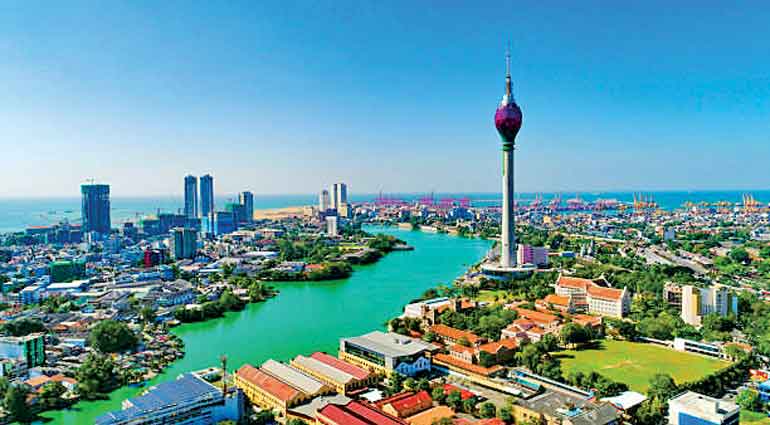
Sri Lanka’s macroeconomic foundations are stronger than they have been in years, though the recovery remains incomplete and structural reforms must be deepened rather than merely maintained, Capital Alliance Holdings PLC (CAL) said.
“Macroeconomic foundations are stronger than it has been in years,” CAL said in its 2025/26 Annual Report released last week, pointing to rebuilt reserves, anchored inflation, ongoing debt restructuring, and restored growth. “Sri Lanka’s journey from crisis to credibility is not complete, but the 2025/26 period marks an important milestone on that path.”
The report noted that headline inflation, which peaked at nearly 69.8% in September 2022, fell into negative territory by the final quarter of 2024, before settling at 2.2% year-on-year (YoY) by March 2026 against the Central Bank of Sri Lanka’s (CBSL) 5% target.
Gross official reserves rose from 0.3 months of import cover at end-2022 to $ 7.3 billion by February 2026. The CBSL’s benchmark policy rate stood at 7.75% for most of the reporting period, before rising 100 basis points to 8.75% in a subsequent move outside the reporting period, as private credit growth picked up.
The report noted the International Monetary Fund’s (IMF) $ 3 billion Extended Fund Facility (EFF), approved in March 2023, remains the anchor of the reform program, with three consecutive Reviews completed and Sri Lanka’s 2024 primary surplus of 2.2% of GDP exceeding its original 0.8% target.
A rebound in construction activity, spanning both private residential and public infrastructure, has been a notable feature of the recovery, with post-Cyclone Ditwah reconstruction expected to provide a further boost in 2026, though CAL said the sustainability of that contribution depends on the Government’s ability to execute its elevated capital expenditure budget.
“The period of 2025/26 stands as a compelling chapter in Sri Lanka’s economic history; one defined not by crisis, but by the disciplined pursuit of stability and the careful cultivation of growth. The nation has demonstrated that even after a sovereign default, with the right combination of institutional commitment, international partnership, and policy coherence, recovery is not only possible but achievable faster than many had anticipated,” CAL said.
Despite the progress, CAL said the “challenges ahead are real”.
Poverty remains elevated, and capital expenditure has consistently fallen short of budget, averaging 3% of GDP against a budgeted 5% to 6% between 2022 and 2025.
“Domestic risks include the danger of reform fatigue. Three consecutive years of fiscal consolidation, subsidy reform, and structural adjustment have placed meaningful burdens on households, particularly the most vulnerable. Poverty remains at 24.5% of the population, twice the 2019 level, and the urgency of translating macroeconomic recovery into household-level welfare improvement is paramount,” CAL said.
CAL reported a Group Profit Before Tax (PBT) of Rs. 4.2 billion for the year, on total operating income of Rs. 8 billion, with all four business lines—primary dealing, stockbroking, asset management and investment banking—profitable for a second consecutive year. CAL Investments became Sri Lanka’s largest asset manager, with assets under management surpassing $ 1 billion. CAL Partners acted as Exclusive Transaction Adviser on DFCC Bank PLC’s acquisition of Standard Chartered’s Wealth and Retail Banking business in Sri Lanka during the year.
CAL said its strategy rests on three growth pillars: overseas expansion, building a balance sheet-based business, and platform solutions. On overseas expansion, the company pointed to its Bangladesh operation, now employing 50 people, and the establishment of CAL Global in Singapore alongside its existing United Arab Emirates (UAE) presence, as it looks towards an addressable market of over 750 million people and $ 1 trillion in combined GDP beyond its two current markets.


