Wednesday Jul 22, 2026
Wednesday Jul 22, 2026
Wednesday, 22 July 2026 06:41 - - {{hitsCtrl.values.hits}}
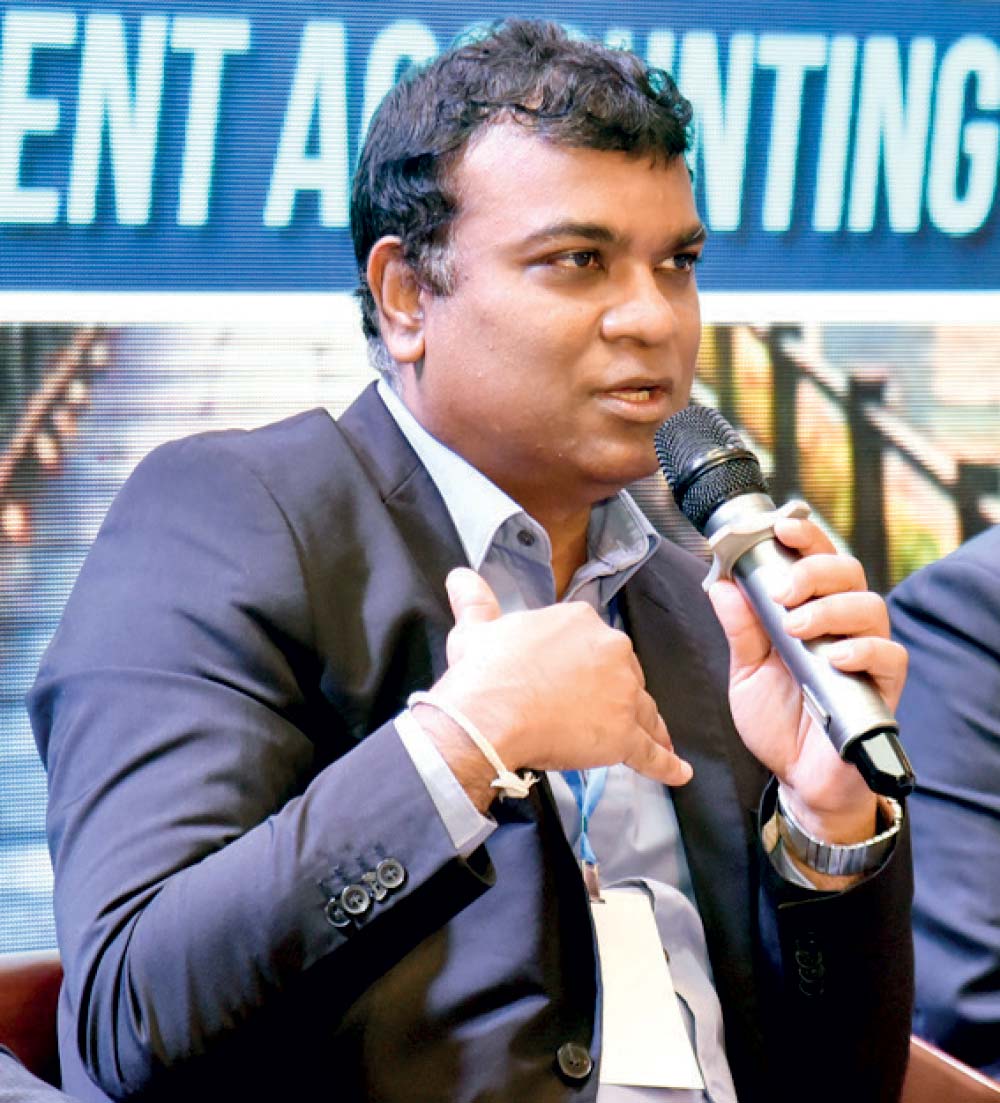
Brandix Lanka Group Managing Director Hasitha Premaratne – Pic by Upul Abayasekara
Sri Lanka risks losing one of its historic competitive advantages unless it rebuilds resilience, strengthens governance and earns greater global trust as strategic assets in an increasingly fragmented world economy, Brandix Lanka Ltd. Group Managing Director Hasitha Premaratne said yesterday, warning that regional manufacturing rivals have overtaken the country in their ability to absorb geopolitical and economic shocks.
Delivering the keynote address at the CMA National Management Accounting Conference 2026 during the technical session on “Navigating the New World Order: Geopolitical Turbulence and Sri Lanka’s Strategic Economic Positioning,” Premaratne said businesses and policymakers alike must recognise that geopolitical volatility is no longer an intermittent disruption but a permanent feature of the operating environment, requiring a shift in strategy from pursuing efficiency alone to building resilience.
Reflecting on Sri Lanka’s competitive position, Premaratne said resilience had historically been one of the country’s defining strengths, forged through decades of political and economic disruption. However, he cautioned that competing manufacturing economies had strengthened their own ability to withstand external shocks, eroding what was once a distinctive Sri Lankan advantage.
“Bangladesh, Vietnam and Indonesia are seeing more resilient brands than Sri Lanka now. Whereas maybe 5-10-15 years ago, Sri Lanka was seen as the place of resilience when it came to competitive advantage. We need to bounce back. We need to find that back and embed that into our brains so that resilience becomes a strategic tool in this global environment.”
Premaratne argued that resilience should be viewed not as a defensive response to crises but as a source of competitive advantage that would increasingly influence where global customers place their business.
“If you demonstrate the resilience, your customers will come behind you because volatility means you need suppliers who are resilient. The resilience itself can become your next wave of competitive advantage.”
He said governance and transparency should similarly be regarded as strategic economic assets rather than compliance requirements, particularly as investors place greater emphasis on institutional credibility and policy certainty.
“How do we move that as a strategic effort, and we look at that as a case for investments to be looked at?” he said.
Premaratne said Sri Lanka should also capitalise on its strategic location by positioning itself as a reliable logistics and export hub, while shifting from competing primarily on low-cost manufacturing towards higher-value products and innovation.
“How do we turn these geopolitical challenges and location advantages into logistics, reliability and customer service, so that we can change our challenge into more of a competitive advantage?”
He said value creation rather than production volume would determine future competitiveness.
“Value creation is what is important, rather than just giving volume.”
Premaratne said geopolitical developments had fundamentally changed corporate decision-making, with conflicts, trade fragmentation, sanctions, shipping disruptions and tariff disputes becoming structural factors that directly influence business costs.
“I think geopolitics has not just become a risk, but it has become a variable in the cost structure. If it’s going to be a cost driver, what’s the impact and how are we going to minimise that impact?”
He said finance professionals should therefore move beyond analysing historical financial performance and instead become architects of strategic foresight by incorporating geopolitical assumptions, scenario planning and trigger points into business planning.
“What we’re trying to say here is that the new normal is not about one crisis, but it’s more about how it is becoming a continuous volatility and crisis becomes part of the daily.”
Drawing on Brandix’s own experience during the recent Middle East conflict, Premaratne said the company’s initial concern over fuel supplies soon gave way to disruptions in shipping schedules, delaying deliveries of fabrics and other essential raw materials after vessels were rerouted.
To reduce the risk of production interruptions, Brandix increased its inventory lead times from 30 days to 40 days despite the additional working capital requirement, judging that the cost of idle production capacity would be significantly higher.
“Our cost of open capacity or cost of idle lines is much, much more than what we are talking about in the context of freight. Resilience essentially should not be seen as an inefficiency, but it has to be seen as a cost of staying in the game.”
Premaratne said businesses needed to optimise total economic costs rather than individual expense lines, even if that meant carrying additional inventory, strengthening logistics flexibility or investing more heavily in supply chain resilience.
“You might have to move from just-in-time to thinking about just in case.”
He also stressed the importance of stronger balance sheets and liquidity, arguing that financial resilience would increasingly determine how effectively companies navigate external shocks.
“The more the strength of the balance sheet, more the strength of cash, that’s where you will find things better.”
Premaratne identified India, Africa and other emerging markets as long-term opportunities for Sri Lankan exporters while encouraging businesses to diversify customers, suppliers and export markets to reduce concentration risks.
He also described artificial intelligence as the next major source of productivity gains, provided organisations adopt it with appropriate governance and organisational change.
Concluding his address, Premaratne said the objective should not be to predict every geopolitical event but to build organisations capable of absorbing repeated shocks while continuing to grow.
“The future gives you only one option. Don’t ever think tomorrow will be easier and better. The pressure will only get worse,” he advised. “It’s about building your organisation to absorb some of those shocks and still move forward.”

