Saturday Nov 21, 2026
Friday, 20 November 2026 00:00 - - {{hitsCtrl.values.hits}}
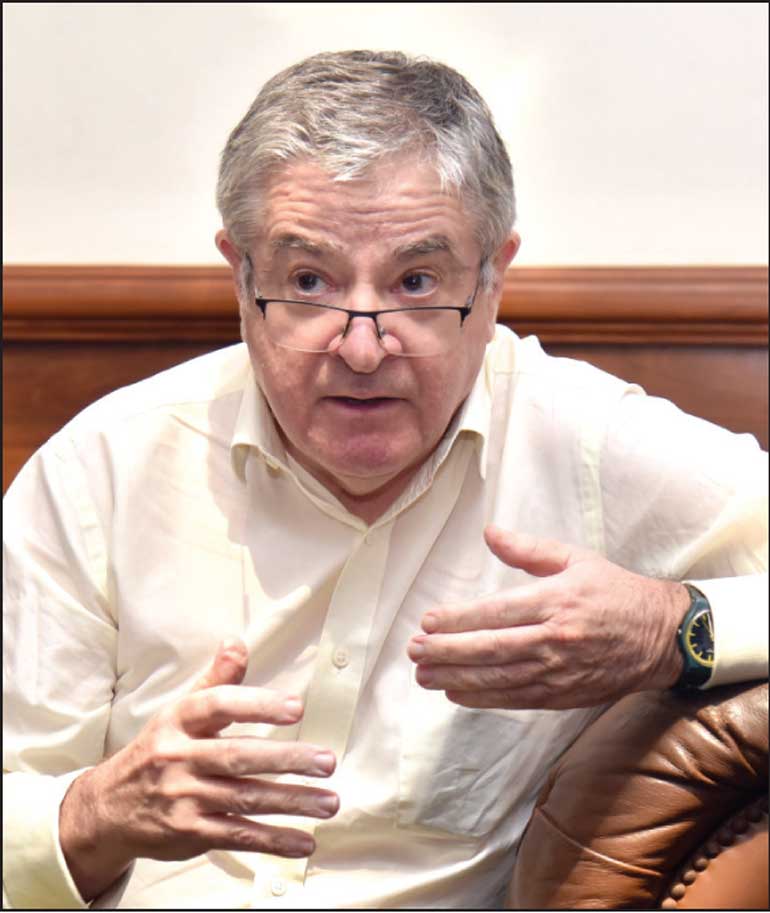
Hosking Partners LLP Founder and Portfolio Manager Jeremy Hosking
- Pic by Ruwan Walpola
By Devan Daniel
Sri Lanka’s recovery has earned the patience of one of its most committed foreign investors, who continues to add to his holdings, but not yet his full conviction.
Hosking Partners LLP Founder and Portfolio Manager Jeremy Hosking said the London-based fund, encouraged by the 2027 Budget, would stay invested in Sri Lanka. He said it would make a substantially larger commitment only if the country proved its turnaround was secular rather than cyclical, a test he said entrenched resistance to change would make hard to pass.
“I think if we got more confidence that the Sri Lankan story was a secular story, we would increase our investments. That would imply quite a lot of change. I think the Government is pretty sound, but so is the resistance to change,” Hosking told the Daily FT during a visit to Sri Lanka.
Sri Lanka accounts for about 2% of the fund’s global portfolio, spread across about 12 companies. That is a large position for a global generalist in a frontier market outside the index. The fund added to its holdings when the economy collapsed in 2022, consistent with the capital cycle approach Hosking helped pioneer in 1986. The approach holds that returns recover where capital has fled and competition has thinned, and fall where capital floods in. Those holdings have since risen sharply.
“I think recent evidence, not least in your Budget, is quite encouraging, so we’ll be holding on for the time being,” he said, adding that the Government’s drive to widen the tax base and improve transparency was “very, very encouraging”.
Hosking’s prescription for lasting change starts with money. He said he would like Sri Lanka to adopt a currency board, and would prefer it to go further and dollarise.
“I don’t think the Sri Lankan rupee really merits its perpetuation as a currency,” he said, arguing that it had caused a misallocation of investment.
Foreign exchange controls, he said, block capital in both directions. Portfolio and corporate investors would like stakes in Sri Lankan businesses, while local investors want to invest abroad. He said capital must be free to leave if it is to come in, and that the controls invite the very abuse they are meant to prevent.
He said the appeal of interventionist economics lay in the power it confers, while its unintended consequences were generally negative. “Controlling the money supply to get the inflation rate down is not a job for 10,000 civil servants. It’s a job for a committee of about three people meeting once a month at most,” he said.
The second obstacle, Hosking said, is fragmentation, which is most acute in banking. Sri Lanka has too many banks, and the Central Bank micromanages them. He cited Nations Trust Bank (NTB), which he said was required to raise capital after acquiring an HSBC business in Sri Lanka last year.
“They’ve basically been punished for having the temerity to try and start consolidating the sector, which has far too many banks in it to begin with,” he said.
He also questioned the 10% cap on bank ownership, saying the fund favours anchor shareholders who care about long-term outcomes. “Insisting on a banking sector that is wholly in the hands of paid staff may not be the best outcome,” he said.
Consolidation, he said, is almost always the route to higher returns, and he pointed to the telecom merger in which the fund is a major shareholder. “Less competition tends to mean higher returns, and the Dialog share price has gone up five times. So we need more of that,” he said.
He likened Sri Lanka’s conglomerates, each with near-identical hotel and retail arms, to Hong Kong’s family groups, which each set up mobile phone subsidiaries and took decades of low returns to unwind.
Hosking said Sri Lanka’s struggle to attract capital was not entirely its own fault, but that its companies did not help themselves. “My industry, the fund management industry, is particularly dysfunctional, especially at this time. So it’s hard for a country like Sri Lanka and its companies to attract attention to themselves, but they don’t help themselves,” he said.
Global managers typically hold about 40 stocks, which in practice leaves Sri Lanka with no place in their portfolios, he said. Local companies compound this with weak investor relations, and the Government with a “siege mentality”. Hosking Partners gets around the problem by holding about 400 stocks, an approach he called “deeply unfashionable”.
CT Smith Securities Consultant and CT Holdings Director Marianne Page, who accompanied Hosking, said bank valuations had fallen from about 2.0 times book value a decade or more ago to about single digit levels. She said the Central Bank had urged consolidation for some 30 years without a single merger among the country’s 13 local commercial banks, and that leading conglomerates could combine their fragmented hotel businesses into a single investable company.
Globally, Hosking said the US was more likely mid-cycle than late-cycle. The fund remains wary of AI, where capital is pouring in on a scale he called “truly stupendous”, though it has profited from semiconductors and disc drives, the “picks and shovels” of the boom.
“This is going to be a huge stress test of the capital cycle lens,” he said.