Saturday Oct 10, 2026
Saturday Oct 10, 2026
Saturday, 10 October 2026 00:00 - - {{hitsCtrl.values.hits}}
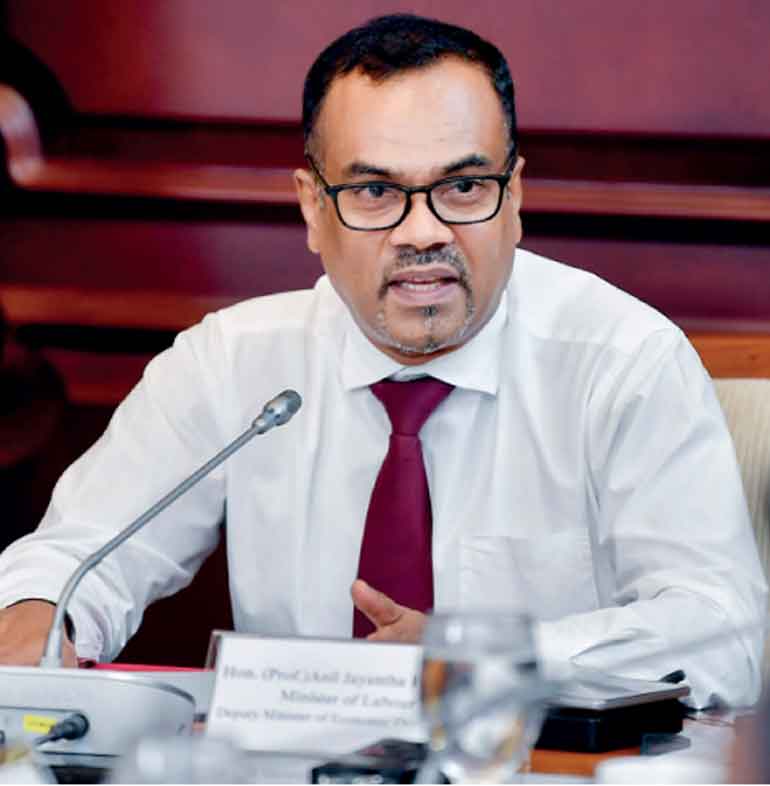
Finance and Planning Deputy Minister Dr. Anil Jayantha Fernando
Discussions are under way on Sri Lanka’s options after its current IMF program, which is on track to conclude successfully in March 2027, Finance and Planning Deputy Minister Dr. Anil Jayantha Fernando told Parliament.
“In parallel, discussions are currently under way regarding the options beyond the current program, reflecting a shift from crisis-driven support towards a more sustainable, long-term, growth-targeted engagement model,” Dr. Fernando said, addressing the house this week.
He said the program under the IMF’s Extended Fund Facility (EFF) had delivered transformative outcomes. Within three years, it moved the country from crisis to recovery and then to stabilisation. It also built the institutional resilience to manage further shocks, including the Middle East conflict and Cyclone Ditwah.
The economy contracted by 7.3% in 2022. Real GDP then grew by 5% in 2025, the second straight year of growth, and by 4.7% in the first half of 2026. Per capita GDP rose to $ 5,300 in 2025. The World Bank upgraded Sri Lanka from lower-middle-income to upper-middle-income status with effect from 1 July, 2026.
The World Bank’s latest Sri Lanka Development Update followed 12 consecutive quarters of expansion through the first half of 2026. In it, the Bank raised its 2026 growth projection to 4.4% from 3.6%.
The external accounts have also strengthened. The current account recorded a surplus of 1.6% of GDP in 2025, the third consecutive annual surplus, which Dr. Fernando described as a structural improvement in the country’s external position. Workers’ remittances rose to $ 8.1 billion in 2025, reflecting improved confidence and greater use of formal channels. They reached $ 6.1 billion in the first eight months of 2026. Export earnings grew by 6.3% to $ 13.6 billion in 2025. Tourist arrivals reached 2.36 million in 2025, bringing in $ 3.2 billion.
On the fiscal side, the Central Government’s primary balance, which excludes interest payments, moved from a deficit of 3.7% of GDP in 2022 to a surplus of 5.4% of GDP in 2025, the highest on record. The surplus stood at Rs. 1.24 trillion as at end-June 2026. Tax revenue nearly doubled from 7.3% of GDP in 2022 to 15.4% in 2025. By end-September 2026, tax revenue had reached 85% of the annual target, a significant increase on the same period in 2025.
Central Government debt fell from 114.2% of GDP in 2022 to 94.9% in 2025. This is already below the program target of 95%, which was set for 2032. Headline inflation dropped from nearly 70% in September 2022 to 2.1% in December 2025.
Dr. Fernando said debt restructuring is near completion. Agreements have been reached with the Official Creditor Committee, the Export-Import Bank of China, the China Development Bank and holders of International Sovereign Bonds (ISBs). Sovereign bond spreads, the premium investors demand over US Treasuries, narrowed from about 1,900 basis points at the onset of the crisis to around 520 basis points by early 2025. The Public Debt Management Office was set up in December 2024, and a Medium-Term Debt Management Strategy for 2025-2029 has been published.
Several reforms are already in place, he said. The Public Financial Management Act has been enacted, introducing binding fiscal rules and accountability mechanisms. The Integrated Treasury Management Information System has been fully rolled out. The first Fiscal Strategy Statement and Fiscal Risk Statement were published in June 2025. Fuel and electricity prices now follow automatic, formula-based adjustments that recover costs.
To protect financial stability, the Banking Act was amended in April 2024 to tighten supervisory standards and strengthen governance and independence at State-owned banks. In 2025, the moratorium on parate execution was lifted. Parate execution is the right of banks to auction collateral without going to court, so lifting the moratorium lets banks resolve non-performing loans and expand credit. Private sector credit grew by about 25% year-on-year by end-2025. Commercial bank lending rates have fallen from around 29% in 2022 to about 10.6% by end-July 2026. Dr. Fernando said this has substantially improved operating conditions for small and medium enterprises and the self-employed, who were among the hardest hit by the crisis.
On governance, the Anti-Corruption Act was enacted in July 2023 in line with the United Nations Convention against Corruption. The Proceeds of Crime Act No. 5 of 2025, an asset recovery law, has also been passed. The IMF’s Governance Diagnostic Report was published in September 2023.
To unlock growth, all import restrictions on motor vehicles were removed in January 2025, which Dr. Fernando said cleared a major impediment to trade and investment. Rationalisation of para-tariffs, the import levies charged on top of customs duties, is continuing under commitments to the World Bank. The Women’s Empowerment Act was enacted in July 2024. Targeted credit programs support MSMEs, and restructuring of State-owned enterprises is continuing.
Social spending targets were met in 2025 for the first time in the program’s history. The Government spent 3.4% of GDP on household subsidies and transfers that year, of which 0.7% of GDP went to the Aswesuma welfare program. Aswesuma determines eligibility objectively using the National Social Registry. Energy subsidies are now targeted only at low-consumption households. Labour force participation rose to 49.4% in 2025.
Dr. Fernando said the growth, employment and export performance envisaged at the start of the program had been achieved. Gaps remain, however. Poverty is estimated at 16.9% in 2026, well above pre-crisis levels. While investment recovery has shown encouraging early signs, he said, foreign direct investment has yet to fully materialise. That remains a priority, reflecting structural challenges in the investment environment that are being actively addressed.


