Thursday Oct 22, 2026
Thursday Oct 22, 2026
Wednesday, 13 May 2026 10:38 - - {{hitsCtrl.values.hits}}
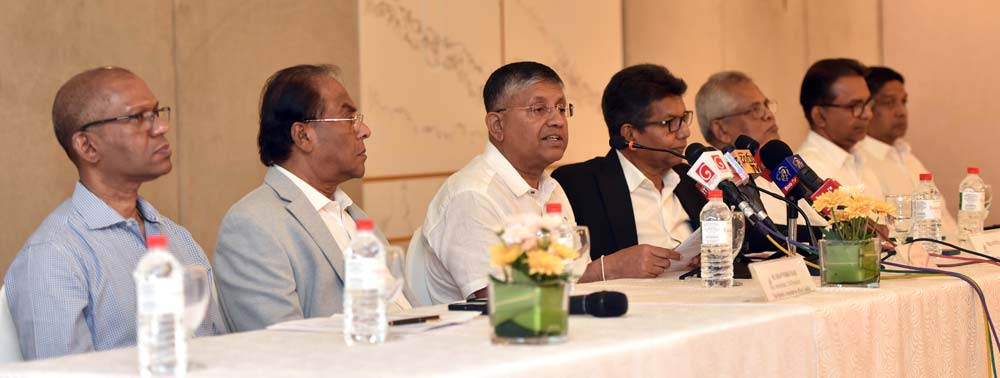
The Hotels Associations of Sri Lanka (THASL) President Asoka Hettigoda (third from left) addresses the media yesterday in Colombo. Other THASL members from left: Committee Member Sanjeewa Anthony, Immediate Past President M. Shanthikumar, CEO Priantha Fernando, Vice President Bandula Ekanayake, Vice President Eksath Wijeratne and Committee Member Chamin Wickremasinghe
- Pic by Ruwan Walpola
By Charumini de Silva
The hotel industry yesterday warned that the country risks losing billions in potential revenue, unless authorities urgently address mounting policy delays, foreign exchange leakages, weak regulation and the absence of sustained global destination marketing.
At a media briefing, The Hotels Association of Sri Lanka (THASL) said a growing disconnect between tourist arrivals and actual earnings was emerging as one of the sector’s biggest concerns, even as visitor numbers continue to recover.
THASL President Asoka Hettigoda said the widening gap between visitor arrivals and tourism receipts was becoming increasingly alarming, warning that Sri Lanka could miss its long-term revenue targets unless urgent structural reforms are introduced.
“This widening gap between visitor arrivals and actual earnings is a concerning trend,” he said.
Hettigoda noted that tourists are increasingly exploring emerging destinations such as Hiriketiya, Mirissa, the Deep South, Arugam Bay and Jaffna, reflecting the island’s untapped tourism potential.
While the Government has set a target of $ 8 billion in tourism earnings by 2030, Hettigoda said the industry believes Sri Lanka can achieve $ 10 billion, provided the country reaches 6 million tourists by 2030, sustains 20% annual growth, and increases per-night spending by 30% through high-value travel experiences.
He said Sri Lanka must commit at least $ 50 million annually for global destination marketing beginning next year, promoting not just beaches, wildlife and culture, but also higher-yield segments including wellness tourism, surfing, yoga retreats, architecture tourism, trekking, local cuisine and community tourism.
“These categories attract high-spending travellers and differentiate Sri Lanka as a unique global destination,” he said.
The industry also warned that the ongoing conflict in the Middle East has begun to hurt occupancy levels, with THASL and the Sri Lanka Association of Inbound Tour Operators pushing for an interim digital marketing campaign targeting India, China, Australia, Russia and East Asian markets.
Hettigoda said discussions with the Sri Lanka Tourism Promotion Bureau (SLTPB) and the Tourism Ministry have resulted in an in-principle agreement to launch a full global campaign within six to eight months, while an interim $ 1.3 million digital campaign could begin within the next two months once procurement approvals are granted.
Based on current geopolitical conditions, THASL estimates Sri Lanka may attract only 2.39 million tourists in 2026, falling short of the Government’s 3 million target by around 600,000 visitors. However, with the proposed campaign, arrivals could recover to 2.54 million, generating around $ 3.3 billion in revenue.
THASL Member Eksith Wijeratne added that Sri Lanka has waited nearly 15 years for a proper global tourism campaign, despite accommodation capacity almost doubling during that period.
“Sri Lanka can no longer rely only on heritage and natural attractions while regional competitors such as Cambodia, Vietnam and Malaysia invest aggressively in tourism promotion,” he added.
THASL also raised concerns over rising operational costs, saying recent 18% electricity hike, fuel and gas prices have pushed many hotels, particularly SMEs close to breakeven.
The association called for tax relief on battery energy storage systems (BESS), improved tariffs for energy storage investments, and policy support for hotels to generate renewable energy through wheeling arrangements.
A major concern highlighted by the industry was the rapid growth of the informal tourism sector, which THASL said is undermining formal operators and discouraging foreign investment.
Citing industry estimates, Hettigoda said nearly 60% of tourism establishments remain unregistered with the Sri Lanka Tourism Development Authority (SLTDA), contributing to foreign exchange leakages through offshore online travel agency (OTA) payouts, foreign POS machines, unlicensed accommodation providers, and foreign nationals operating tourism businesses outside regulatory oversight.
“These issues are creating an uneven playing field for local investors and discouraging established international players from investing in Sri Lanka,” he said.
THASL CEO Priantha Fernando said the sector continues to suffer from weak policy execution despite tourism being identified as a priority industry by the Government.
He said the industry does not support the drafting of a new tourism law or the creation of additional governance structures such as a National Tourism Commission, arguing that the existing legal framework already provides adequate powers.
“The problem is not the law. The problem is that the current Tourism Act has not been properly implemented for over 15 years,” Fernando said, adding that institutions continue to operate under Government bureaucracy instead of the commercial autonomy already granted under existing legislation.
He also criticised political appointments to key positions such as the Director-General and Managing Director within the State institutions and called for professional leadership, competitive salaries and stronger private sector participation.
THASL Member Sanjeewa Anthony highlighted sharp increases in liquor licence fees as another major burden, noting hotels are now facing significantly higher excise costs, deposits and administrative charges.
“There are three types of licences FL 7, FL 8 and FL 11, while the taxes for those have been increased by 80%, 100% and 100% respectively via a Gazette issued from February 2026. The increase has been significant from Rs. 500,000 to Rs. 1 million for larger hotels, depending on the different categories,” he said.
He argued that hotels catering to international tourists should not be regulated in the same way as taverns, noting that operators already face substantial costs through 18% VAT, 2.5% social security contributions levy (SSCL), 1% tourism development levy (TDL) and 10% service charges for the employees.
“These rising costs are forcing hotels to increase prices, affecting Sri Lanka’s competitiveness,” he said.
Anthony also called for the digitalisation of the licence renewal process, pointing out that hotel operators still face lengthy paperwork and approvals across multiple agencies.
Wijeratne also announced that THASL plans to launch its inaugural tourism and hospitality awards later this year to recognise excellence, resilience and contribution across the industry, with the first awards ceremony expected in October or November.


