Thursday Oct 22, 2026
Thursday Oct 22, 2026
Monday, 4 May 2026 04:59 - - {{hitsCtrl.values.hits}}
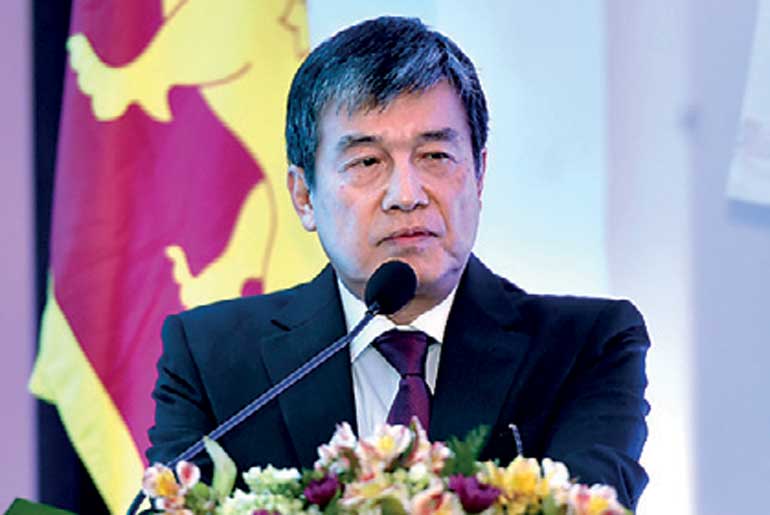
Japanese Ambassador Akio Isomata speaking at the ‘Exports to Japan: Seizing the Opportunity Now’ forum organised by the Sri Lanka Japan Business Council last week – Pic by Ruwan Walpola
By Divya Thotawatte
In seizing opportunities in a ‘Look East’ strategy amidst tensions elsewhere, Japanese Ambassador Akio Isomata last week urged Sri Lanka to “walk the talk” and not “talk the talk.”
“The crux of the matter for Sri Lankan exporters is seizing opportunities with action. We cannot afford to continue to ‘talk the talk.’ We really need to ‘walk the talk,’” Ambassador Isomata told a forum titled ‘Exports to Japan: Seizing the Opportunity Now’ organised by the Sri Lanka Japan Business Council (SLJBC).
Referring to the Japan proposed ‘Export-Oriented Industrial Corridor’ between Japan, Sri Lanka, and India, which was approved by the President Anura Kumara Dissanayake Government given the initiative could ensure 9.3% growth in Sri Lanka’s GDP by 2030, Ambassador Isomata highlighted the need to accelerate progress.
He noted that working groups were being set up on both the Japanese and Sri Lankan sides to advance the initiative, but stressed that the progress must move faster. “We need to accelerate this work.”
“I don’t want to prescribe any legal deadline for a proposal involving Sri Lanka but some of the proposals are time-sensitive. If we don’t act in a timely manner, maybe the Japanese Government too and Japanese business circles will lose interest in working together,” said the Japanese Ambassador. He added that the Japanese Government, Japanese Embassy, and Government-related agencies, the Japan International Cooperation Agency (JICA) and Japan External Trade Organisation (JETRO), are all ready to work with Sri Lanka.
His keynote was followed by a panel discussion featuring Department of Commerce Head of Trade Charitha Yattogoda, Export Development Board (EDB) Chairman Mangala Wijesinghe, Lanka Harness Co., Executive Chairman Dr. Rohan Pallewatte, and BizEx Consulting Managing Director Sunil Wijesinha and moderated by Daily FT CEO and Editor Nisthar Cassim.
Warning that global political tensions, especially in the Middle East, would have lasting consequences, Ambassador Isomata also urged Sri Lanka to consider the “strategic rationality of looking towards the East.”
He advised that Sri Lanka could invest more in the promotion of trade and investment within Southeast Asian countries, highlighting the region’s growth potential alongside opportunities with India. “For Japanese investors, Sri Lanka as a market is too small. There’s a big market in India which is dependent on imports, including from Japan, so why don’t we use India?” queried the Japanese Ambassador, alluding to the proposed Export-Oriented Industrial Corridor, which he said was a practical proposal.
“This export-directed corridor will be established by the Governments, but who will actually utilise this framework? It is the business circles of Japan, Sri Lanka, and India,” he said, underscoring the role of private sector participation in driving the initiative.
Sri Lanka’s exports to Japan have been averaging less than $ 200 million per annum despite considerable potential in multiple sectors.
Ambassador Isomata also urged for a clearly defined industrial strategy. “After arriving in Sri Lanka, I was trying to find this kind of strategy, but unfortunately, I haven’t seen any.” He called for “vigorous reform measures” that would support long-term growth, adding that a structured industrial promotion policy would help improve productivity and competitiveness.
He also reiterated the need for Sri Lanka to have a robust trade policy in addition to export development and a diversification drive. Better utilisation of existing Free Trade Agreements (FTAs), as well as new ones, and the transformation of the existing Indian arrangement with a Comprehensive Economic Partnership was recommended. He referred to Japan having signed 22 FTAs and Economic Partnership Agreements.
Ambassador Isomata further emphasised the need to improve Sri Lanka’s business environment to attract foreign direct investment, including from Japan, noting that a bilateral business environment improvement committee had been meeting regularly to address operational issues.
“We need constant improvement. In a nutshell, we have to try whatever we can to bring about concrete results. Japan and Sri Lanka have enjoyed a great relationship historically. But let us not be too complacent about where we are.”

